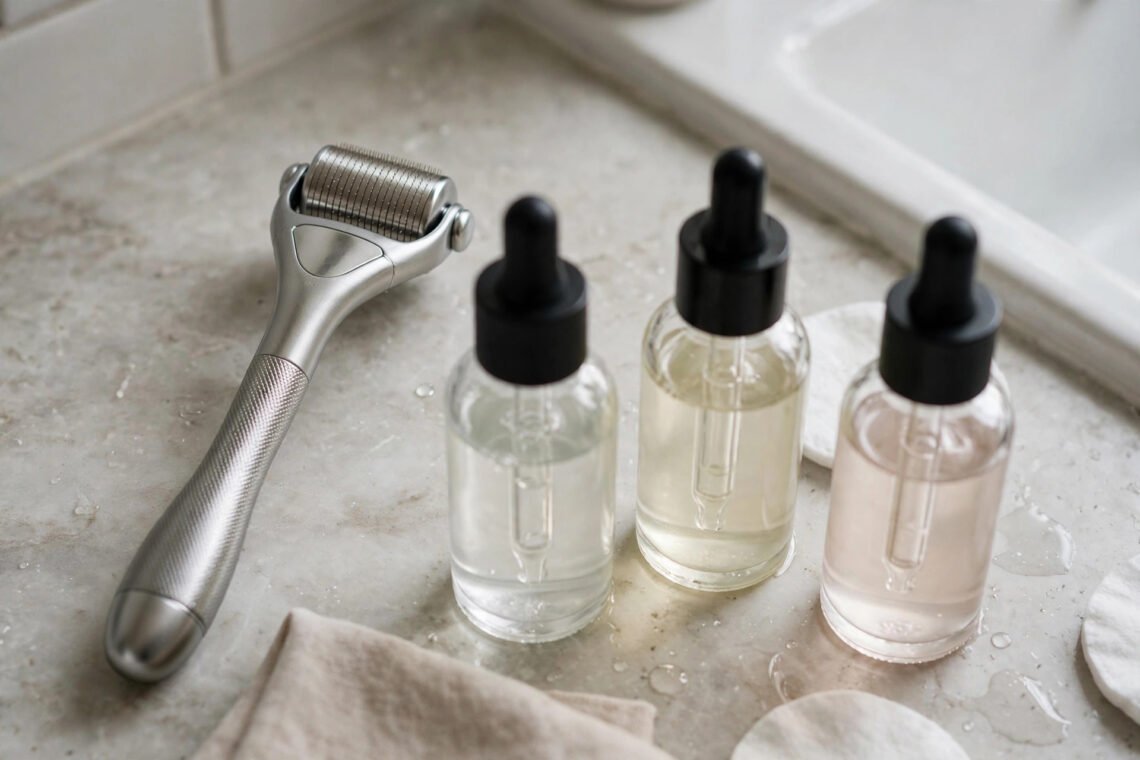
The dermaroller costs £15 online, the influencers show miraculous before-and-afters, and your acne scars are not fading on their own. But something about rolling hundreds of tiny needles across your face at home feels — correctly — risky. Understanding microneedling risks at home is genuinely difficult because the information landscape is polluted: sellers minimise dangers, forums amplify horror stories, and professional clinics have an interest in steering you toward their £200 sessions. This guide gives you the straight medical picture: what microneedling does, where home use goes wrong, and how to assess whether the risk is worth it.
Microneedling works by creating controlled micro-injuries that trigger the skin’s wound-healing response — new collagen, new elastin, improved texture. In professional hands, with medical-grade devices, sterile technique and appropriate needle depths, it has reasonable evidence for acne scarring, fine lines and enlarged pores. The key phrase is “in professional hands” — because every safety variable that professionals control is uncontrolled at home.
What Can Go Wrong: The Real Risk List
Infection is the headline risk. Home rollers are nearly impossible to sterilise properly — alcohol soaking does not achieve true sterilisation, and a non-sterile device dragged across hundreds of micro-wounds is an efficient infection delivery system. Bacterial infections, cold-sore reactivation (HSV), and in rare cases serious infections have all been reported. Needle depth is the second problem: home rollers typically use 0.25–0.5mm needles, but cheap unregulated devices may be longer, uneven or blunt — blunt needles tear rather than puncture, causing more damage and worse healing.
Technique errors compound everything: rolling too aggressively, too frequently (more than every 2–4 weeks at 0.5mm), over active acne (spreads bacteria across the face), over moles or pigmented lesions (can obscure or aggravate them — any changing mole needs dermatologist assessment, not needling), or while using retinoids and acids (compromised barrier plus micro-wounds equals severe irritation). The result spectrum runs from prolonged redness and sensitivity through post-inflammatory hyperpigmentation — particularly in medium to deep skin tones, where any inflammation risks lasting dark marks — to scarring that is worse than the original concern. The British Association of Dermatologists advises caution on home devices, and the NHS guidance on skin procedures sets out when to seek medical advice for complications.
Why Home Devices Underperform Anyway
Beyond safety, there is an efficacy problem hardly anyone mentions: the needle depths that produce meaningful collagen remodelling (1.0–2.5mm) are professional-only depths. Home rollers at 0.25mm barely penetrate the epidermis — they enhance product absorption slightly (the one legitimate home use) but do not reach the dermis where collagen remodelling happens. So home microneedling occupies the worst of both worlds: enough penetration to cause real harm, not enough to deliver real results.
The before-and-after photos that sell these devices are misleading in predictable ways: different lighting, different expressions, makeup, the temporary plumping of post-procedure swelling presented as permanent improvement, and timelines too short for genuine collagen remodelling (which takes 3–6 months). Genuine microneedling results are gradual and modest — improved texture over months — not the overnight transformations advertised. Anyone promising dramatic home results in weeks is selling a device, not a treatment.
If You Insist: Harm Reduction
The medically responsible advice is: do not do this at home. But harm reduction for those who will anyway: never share devices; buy from reputable sources (counterfeit rollers with uneven needles are common); use 0.25mm maximum; sterilise as best you can (recognising it is inadequate); never roll over active breakouts, cold sores, eczema, moles or irritated skin; stop retinoids and strong acids for a week before and after; roll no more than every 2–4 weeks; apply only sterile, fragrance-free products afterwards (not your entire serum collection — micro-channels increase absorption of everything, including irritants); and stop immediately if you develop spreading redness, pus, fever or worsening pain — see a GP or pharmacist promptly.
And seriously consider the professional alternative in context: a course of three professional sessions (£400–£600 total) with proper depths, sterile technique and medical oversight delivers the actual results home devices promise but cannot — for less than many people spend on a year of ineffective home devices and repair products. For scarring specifically, dermatologists can also offer alternatives (subcision, TCA peels, laser) matched to the scar type — microneedling is not even the best option for every scar. Discuss options with your GP for an NHS dermatology referral where scarring is severe, or a reputable private dermatologist.
Professional Microneedling: What Good Treatment Looks Like
If home devices are out, what does proper treatment involve? A reputable practitioner — ideally a dermatologist or a nurse/aesthetician working under medical oversight — starts with a consultation assessing your skin, scar types and suitability (not everyone is a candidate: active acne, keloid tendency and certain skin conditions rule it out). Treatment uses sterile single-use needle cartridges at medical depths (1.0–2.5mm depending on the concern), with topical anaesthetic, proper skin preparation and post-procedure protocols. Expect 3–4 sessions spaced 4–6 weeks apart, with gradual improvement over 3–6 months as collagen remodels — the honest timeline no device seller advertises.
Choosing a practitioner: verify medical qualifications (GMC-registered doctor, NMC-registered nurse, or equivalent), ask about needle depths and device type, expect a proper consultation (not a sales pitch), and be wary of anyone promising dramatic single-session results or offering suspiciously cheap treatments. Costs run £150–£300 per session in most UK cities. And get a second opinion for significant scarring — microneedling suits rolling scars and texture issues, but ice-pick scars often respond better to TCA CROSS and deep boxcar scars to subcision or laser. The right treatment matched to the right scar type is what you are paying the professional to determine.
Whatever route you choose, remember that healthy skin supports every look — our guide to finding your personal style in your 30s puts treatments in the context of a coherent routine, and looking put-together with minimal effort covers the daily habits that matter more than any device.
The Bottom Line
Microneedling risks at home are hard to assess because sellers minimise them — but the medical picture is clear: infection risk from unsterilisable devices, technique errors causing pigmentation and scarring, and depths too shallow for real results anyway. The 0.25mm home roller is the worst of both worlds: risky enough to harm, shallow enough not to work. For genuine concerns like acne scarring, save for professional treatment with proper depths and sterile technique — or explore the proven topicals (retinoids, vitamin C, sunscreen) that improve skin without needles. Your face deserves better than a £15 gamble.
Frequently Asked Questions
Is home microneedling safe?
Dermatologists advise caution: home devices cannot be properly sterilised, unregulated needle quality varies, and technique errors risk infection, pigmentation and scarring. The depths that work are professional-only.
What needle depth is safe for home use?
No home needling is medically endorsed, but harm-reduction guidance caps it at 0.25mm — deeper home use substantially increases risk. Even at 0.25mm, infection and irritation risks remain.
Can microneedling make acne scars worse?
Yes — needling over active acne spreads bacteria, aggressive technique causes new scarring, and post-inflammatory hyperpigmentation can darken the area, particularly in medium to deep skin tones.
How often should you microneedle at home?
No more frequently than every 2–4 weeks at shallow depths — the skin needs full healing time between sessions. More frequent rolling causes cumulative barrier damage.
What should I put on my skin after microneedling?
Only sterile, fragrance-free, simple products — hyaluronic acid serum or plain petrolatum. Micro-channels dramatically increase absorption, so avoid actives (retinoids, acids, vitamin C) and fragranced products for several days.