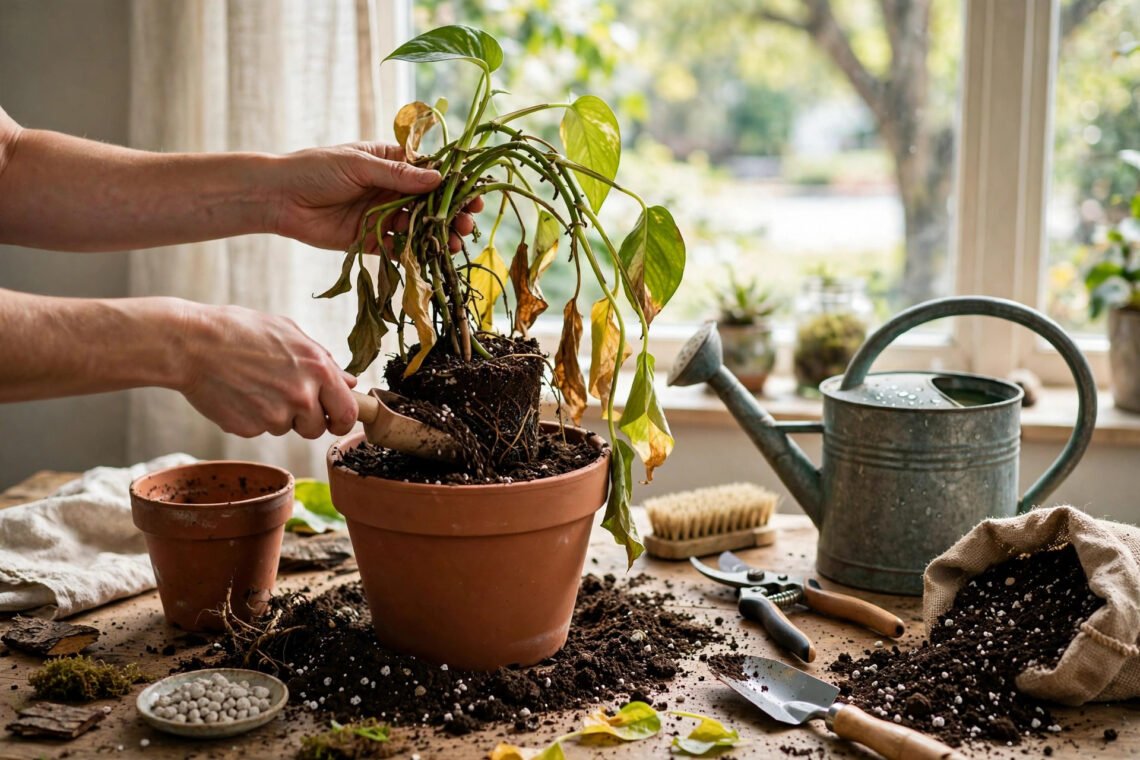
It was thriving when you bought it. Now the leaves are yellow, brown at the edges, dropping one by one, and the whole plant has the unmistakable air of giving up. Before you hold a funeral, know this: most “dying” houseplants are not dead — they are stressed, and stress is reversible. Plant rescue is a learnable skill, and this guide walks you through it step by step.
Follow this triage in order. Do not skip steps, and resist the urge to “do everything at once” — desperate over-treatment kills more plants than neglect.
Step 1: diagnose before you treat (5 minutes)
Look carefully and answer three questions:
- Are the leaves yellow and soft/mushy? → Overwatering (the number one houseplant killer).
- Are the leaves brown, crispy and dry? → Underwatering or too much direct sun/heat.
- Are leaves dropping but stems still green and flexible? → Environmental shock (moved recently? cold draught? new heating season?) — often temporary.
Check the roots if you can: gently slide the plant from its pot. White/tan firm roots = alive and salvageable. Brown, mushy, foul-smelling roots = root rot — serious but sometimes survivable. No roots at all, stem mushy to the base = it may genuinely be over, though cuttings might still save the genetics.
Step 2: stop the harm (immediately)
Whatever the diagnosis, first remove the stressor. Move the plant out of direct scorching sun or away from the radiator. If the soil is waterlogged, stop watering immediately and improve drainage. If it is bone dry, do not flood it — water thoroughly once, let it drain completely, then wait. Remove fully dead leaves (brown and crispy right to the stem) so the plant stops wasting energy, but leave anything with green in it — a half-yellow leaf still photosynthesises.
Step 3: fix the roots (the critical step)
For overwatered plants with root rot: remove the plant from its pot, shake off old compost, and cut away all mushy, brown roots with clean scissors, keeping only firm healthy ones. Let the root ball air-dry for a few hours. Repot into fresh, free-draining compost (houseplant compost mixed with perlite is ideal) in a pot with drainage holes — slightly smaller than before, since fewer roots need less space. Then water once, lightly, and leave it alone.
This feels brutal. It is also the step that saves plants everyone else gives up on. Healthy roots regrow remarkably fast in spring and summer.
Step 4: create recovery conditions
A recovering plant wants bright, indirect light (near a window, not in the sunbeam), stable warmth, and humidity. Bathrooms suit many tropicals during recovery. Resist fertiliser — feeding a stressed plant is like force-feeding a patient; wait until you see new growth, then feed at half strength. Water only when the top 2–3cm of soil is dry. Then wait: recovery takes weeks, not days. New growth is the signal of success, not the old leaves perking up (they often will not).
Light placement matters enormously for long-term health — our guide to the best plants for north-facing spaces covers matching plants to light levels, and the principles apply indoors. Winter is the danger season: central heating dries air dramatically, so consider the humidity angle in our guide to stopping condensation on windows in winter — the same dry air stressing your windows is stressing your plants.
Step 5: the propagation insurance policy
While nursing the parent plant, take cuttings as backup. Many common houseplants (pothos, spider plants, tradescantia, philodendrons) root in water within weeks. Even if the parent does not make it, its offspring will — and you will have learned propagation, the most satisfying skill in houseplant keeping. Snip below a node, place in water, change the water weekly, pot up when roots reach 5cm.
Preventing the next rescue
Most houseplant deaths come from three errors: watering on a schedule instead of by soil dryness (always check first), no drainage (decorative pots without holes are plant coffins — use a nursery pot inside), and wrong light (a sun-lover in a dark corner or a shade plant in a south window). Fix those three and 90% of “dying plant” emergencies never happen. The RHS houseplant hub has care profiles for every common species, and BBC Gardeners’ World publishes expert houseplant rescue advice.
Common rescue scenarios, solved
The overwatered peace lily: yellow leaves, soggy soil. Remove from pot, trim rotted roots, repot in fresh mix, water once, then wait a full week before watering again. Peace lilies dramatise thirst by drooping — wait for the droop, then water. It is a feature, not a bug.
The crispy fern: brown fronds, dry soil. Ferns rarely recover brown fronds — cut them all back to the base, soak the pot for an hour, then keep humidity high (pebble tray, bathroom position). New fronds unfurl from the crown within weeks in growing season.
The leggy succulent: stretched, pale growth reaching for light. This is etiolation — the plant starving for light. Move gradually to brighter light (sudden full sun scorches), and behead leggy rosettes: the top reroots as a cutting, the stump resprouts. Two plants from one rescue.
The shocked fiddle-leaf fig: dropped half its leaves after moving house. Classic shock response — do not repot, do not fertilise, do not move it again. Stable conditions and patience; new leaves emerge once it accepts its new home, usually within a month or two.
Building a resilient indoor garden
Rescue teaches you what thriving needs. Long-term, choose plants matched to your actual conditions rather than your aspirations — a pothos in a dark flat outlives a fiddle-leaf fig every time. Group plants together to raise local humidity. Learn each plant’s water language (finger-test the soil; lift the pot to feel its weight). And keep a simple care card per plant — light, water, feed — on your phone. The gardeners with the healthiest houseplants are not the most talented; they are the most observant.
Conclusion
Saving a dying houseplant is a five-step process: diagnose the stress, remove the cause, repair the roots, provide gentle recovery conditions, and take insurance cuttings. Most plants that look dead are merely stressed, and stress reverses with patience. The plant on your windowsill has survived millions of years of evolution — with a little triage, it can survive your central heating too.
Frequently Asked Questions
Should I cut off yellow leaves?
Remove leaves that are fully yellow or brown — they will not recover and can harbour disease. But leave partially green leaves alone; they still photosynthesise and feed the plant’s recovery. When in doubt, wait.
How do I know if my plant is overwatered or underwatered?
Overwatered: yellow, soft, mushy leaves; wet soil; possibly foul smell from roots. Underwatered: brown, crispy leaf edges; dry, shrunken soil pulling from the pot; wilted but papery leaves. When unsure, check the soil — it settles most arguments.
Can a plant recover from root rot?
Yes, if any healthy roots (or a healthy stem base) remain. Cut away all rot, repot in fresh free-draining compost, water sparingly, and be patient. Recovery takes weeks to months, but plants are remarkably regenerative.
Is it worth repotting a dying plant?
If root rot or compacted, waterlogged soil is the problem — absolutely, it is the cure. If the problem is light or watering habits, repotting alone changes nothing. Diagnose first, repot only when the roots or soil are the issue.
How long should I wait before giving up?
If stems are still green and flexible beneath the bark (scratch test), keep waiting — some plants take months to resprout, especially in winter. Only declare it over when stems are brown and brittle throughout, or mushy to the base with no firm tissue anywhere.