
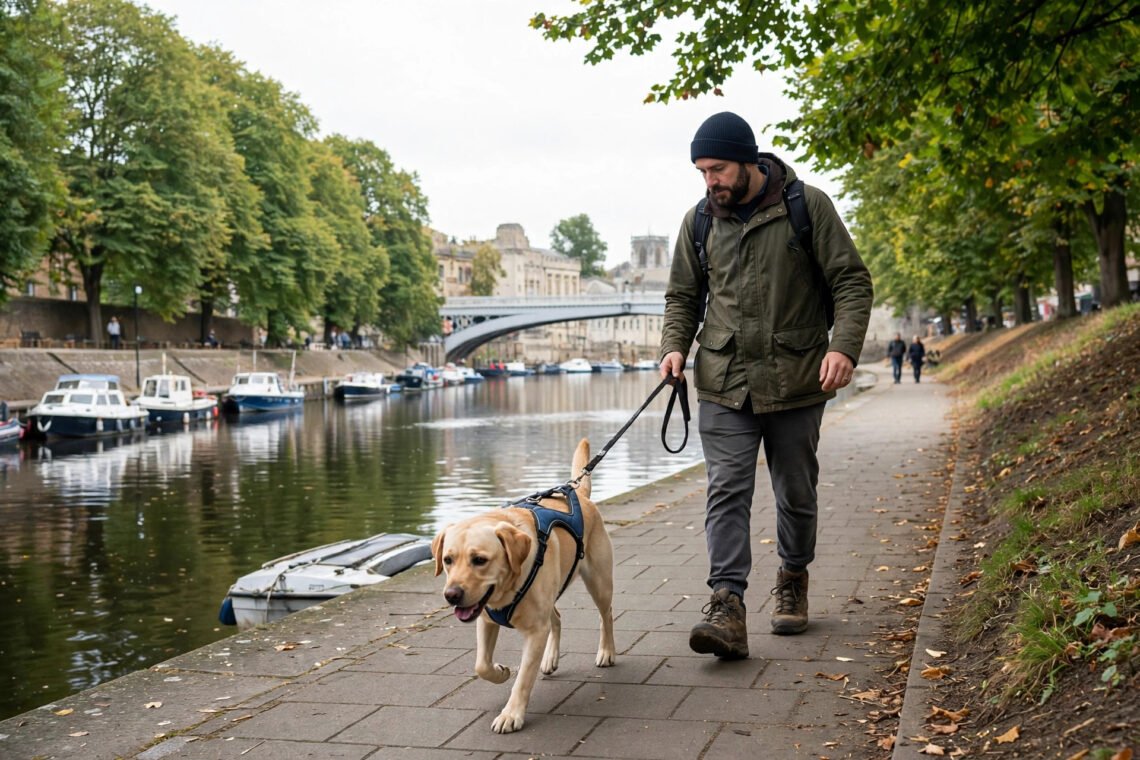
Your shoulder aches, your dog is coughing from the collar pressure, and every walk feels like a waterskiing lesson — with you as the skier. A dog that pulls on the lead turns daily walks from pleasure into ordeal, and in a busy place like York, with its narrow pavements and crowded riverside paths, pulling is not just annoying, it is unsafe. So why is it so hard to stop your dog pulling on a lead in York — or anywhere? Because pulling works: it gets the dog where it wants to go, faster. Every step forward while the lead is tight rewards the pulling. This guide explains how to break that cycle with methods that actually work.
First, abandon the myth that pulling means dominance or disobedience. Dogs pull because they walk faster than humans (a natural trot is around twice our walking pace), because the environment is thrilling, and because we have accidentally trained them to: the lead tightens, we follow, the dog learns that tension equals progress. Retraining means making loose-lead walking pay and pulling not pay — simple in theory, demanding in practice.
Equipment: Set Yourself Up to Succeed
The right kit makes training dramatically easier. A well-fitted Y-shaped harness (not a restrictive no-pull harness that alters gait long-term) with both front and back attachment points gives you control without pain. Clip to the front ring for training — when the dog pulls, they are gently turned back toward you, which removes the opposition reflex that makes collars counterproductive.
Avoid choke chains, prong collars and slip leads used as corrections — they suppress behaviour through pain and fear, damage the human-dog relationship, and are increasingly condemned by veterinary and behaviourist bodies. A fixed-length lead of 1.5–2 metres beats extendable leads for training (extendables teach the dog that variable distance is normal and give you no control). Treat pouch on your hip, high-value treats (real meat or cheese, not dry biscuits, for outdoor distractions) — preparation is half the battle. The Dogs Trust loose-lead walking guide covers equipment and foundations clearly.
The Core Method: Be a Tree, Then Be Rewarding
The foundational technique: the instant the lead tightens, stop dead — become a tree. Wait for any slack (even a glance back at you), mark it (“yes!”), reward, and move forward. The dog learns the equation: tight lead = the walk stops; loose lead = the walk continues plus treats appear. It is tedious at first — you may spend twenty minutes covering fifty metres — but the learning curve steepens fast, usually within two weeks of consistent practice.
Layer in direction changes: when the dog surges ahead, cheerfully turn 180 degrees and walk the other way, rewarding the dog for catching up to your side. This teaches attention to you rather than fixation ahead. And train the “heel position pays” game at home first: reward the dog simply for being in the heel zone, building value for the position before you ask for it amid York’s squirrel population. Short, frequent sessions (5–10 minutes, two or three times daily) beat occasional long slogs — and always train before the dog is bursting with unspent energy, not after. The RSPCA’s training guidance reinforces reward-based methods as the effective, welfare-friendly standard.
Why It Fails: The Common Saboteurs
Inconsistency is the number one killer of loose-lead training. If pulling works on Monday (you are late, you let them drag you to the park) but not Tuesday, the dog learns pulling sometimes works — and “sometimes” is the most powerful reinforcement schedule there is. Everyone who walks the dog must follow the same rules, which means a family meeting before you start.
Insufficient exercise sabotages training too: asking a young Labrador who has been crated all day to walk calmly past the park is asking the impossible. Take the edge off with off-lead running, fetch or a good play session before lead-training walks. Over-facing the dog is the third saboteur — training on a quiet street first, then gradually adding distractions (other dogs, squirrels, food smells), not starting on the busiest path in York at rush hour. And impatience: most owners quit in week two, just before the breakthrough. Commit to six weeks and judge then.
York-Specific Walking Realities
York’s charms are a puller’s paradise: the riverside paths with ducks and joggers, the busy Shambles area, off-lead havens like the Knavesmire and Rowntree Park where excitement peaks before you even arrive. Use this strategically: drive or walk calmly to quieter starting points for training sessions, and treat high-distraction areas as advanced practice, not daily routes, until the foundations are solid.
Consider your own fitness in the equation — strong, fit handling matters with a powerful puller, and building a winter walking routine that keeps you both exercised is part of the long game. Our guide to staying motivated to exercise through winter pairs well with a dog who needs daily walks regardless of weather, and staying active when you work from home shows how to build the midday walks that take the edge off a puller’s energy before training sessions.
Maintaining the Gains Long-Term
Loose-lead walking is a skill that decays without maintenance, like any training. Once your dog walks nicely, keep rewarding intermittently — a treat every few minutes on walks, unpredictable and delightful, keeps the behaviour strong far better than stopping rewards entirely. Revisit foundations briefly after disruptions: holidays, house moves and new walking companions all cause temporary regression, and a week of refresher sessions restores the habit. Watch for your own drift too — most owners gradually start accepting a tight lead again without noticing, and the dog notices immediately. A monthly honest assessment of your walks (phone video helps) catches slippage early. And remember that some days will simply be harder: high winds full of exciting smells, the first spring day after a long winter — on those days, lower your criteria, reward generously and enjoy the walk rather than fighting it.
The Bottom Line
Dogs pull because pulling has always worked — the fix is making loose-lead walking pay and pulling stop paying, through stopping when the lead tightens, rewarding slack, changing direction, and training in short consistent sessions with the right harness. Expect tedious first weeks, a breakthrough around week three to six, and lifelong maintenance. Your shoulder, your dog’s throat and your enjoyment of York’s beautiful walks will all thank you.
Frequently Asked Questions
How long does it take to stop a dog pulling on the lead?
With consistent daily practice, most dogs show clear improvement within 2–3 weeks and reliable loose-lead walking within 6–8 weeks. Entrenched pullers and highly excitable young dogs may take longer.
Are no-pull harnesses bad for dogs?
Front-clip harnesses used as a training aid are fine. Harnesses that tightly restrict shoulder movement as a permanent solution can alter gait and cause musculoskeletal issues — use them to enable training, not replace it.
Should I use a choke chain to stop pulling?
No. Aversive tools suppress behaviour through pain and fear, risk physical injury, and damage trust. Reward-based loose-lead training is more effective long-term and supported by veterinary behaviourists.
Why does my dog only pull on the way to the park?
Because the destination is hugely rewarding and the dog has learned pulling gets them there faster. Train the route to exciting places specifically, and consider taking the edge off with play before the walk.
Can an older dog learn to stop pulling?
Absolutely — dogs learn at any age. Older dogs may actually progress faster than adolescents because they are calmer, though long-ingrained habits take consistent weeks to reshape.


