
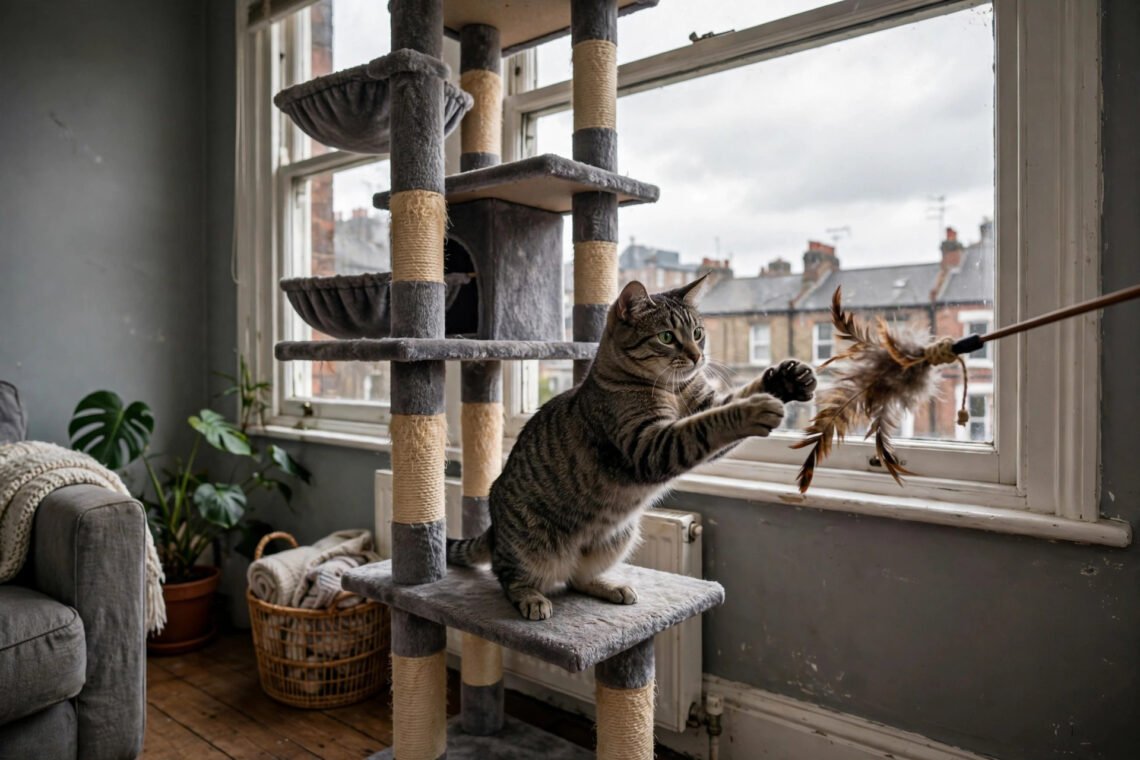
You work from home in Manchester, the rain is doing its usual thing outside, and your indoor cat has just knocked your third mug off the desk this week — while staring directly at you. Keeping indoor cats entertained all day is genuinely hard, and the difficulty is not a personal failing: you are trying to satisfy the needs of a small, intelligent predator in a two-bedroom flat, mostly alone, for sixteen waking hours. But it is solvable. This guide explains why indoor cats get bored, the enrichment framework that works, and practical ideas for real Manchester homes — rented or owned, big or small.
The welfare stakes are real. Under-stimulated indoor cats do not just get mischievous — they develop stress-related problems: over-grooming, obesity (indoor cats are significantly more prone), aggression, house-soiling and depression-like withdrawal. The UK’s indoor-cat population has grown substantially as more owners keep cats inside for safety, which makes enrichment a mainstream welfare issue, not a luxury. A bored cat is an unhappy cat, and an unhappy cat makes everyone unhappy.
Think Like a Cat: What Entertainment Means to Them
Human entertainment is passive — television, scrolling, reading. Cat entertainment is active and predatory: stalk, chase, pounce, capture. A cat staring out of the window for an hour is not bored; it is engaged. The goal is not to amuse your cat the way you amuse yourself, but to provide outlets for the behavioural sequence cats are wired to perform: hunt, catch, eat, groom, sleep.
This reframes the problem. Your cat does not need you to be a full-time entertainer — it needs an environment that offers hunting opportunities, vertical territory, novelty and choice, plus focused interactive sessions with you. The Cats Protection enrichment guide breaks this into the key categories: play, feeding, environment and social interaction. Nail those four and the mug-knocking declines dramatically.
The Daily Framework: 30 Minutes That Change Everything
Two 15-minute interactive play sessions daily — morning and evening — are the foundation. Use wand toys that mimic prey: feathers, fur-like lures, things that dart and hide. Let the cat stalk, chase and finally “catch” the toy regularly; a cat that never catches stops playing. End each session with a small meal or treat, completing the hunt-eat-groom-sleep cycle — an evening session followed by dinner is particularly powerful for night-time calm.
Rotate toys weekly: put half away and swap them, so old toys feel new again. A £3 pack of ping-pong balls, scrunched paper and cardboard boxes outperforms expensive gadgets for most cats — novelty and prey-likeness beat price tags. Catnip and silvervine work for around two-thirds of cats and are worth trying. And vary the game: some cats are bird-chasers (feather wands in the air), others are mouse-hunters (toys dragged along the ground) — learn your cat’s style. The RSPCA’s indoor cat environment guidance emphasises that play style matching is what separates enrichment that works from toys ignored under the sofa.
Building a Cat-Friendly Flat
Vertical space is the single highest-impact environmental change: cats experience territory in three dimensions, and a flat with shelves, tall cat trees and wardrobe-top access is effectively twice as large to a cat. You do not need expensive systems — cleared bookshelf tops, a sturdy tall scratcher by the window, and permission to use the wardrobe top transform a small Manchester flat.
Windows are cat television: a comfortable perch at the best window, ideally with a bird feeder outside (suction-cup feeders work on rented windows), provides hours of engagement. Feeding enrichment matters enormously — scatter-feeding dry food, puzzle feeders and treat balls make meals take twenty minutes instead of twenty seconds, engaging the foraging brain. Rotate the environment too: move a cat tree to a new spot monthly, introduce cardboard box “new rooms”, grow cat grass on the windowsill. Small changes re-novelise the territory. These upgrades overlap with making your home nicer generally — cosy home ideas on a budget include several cat-friendly touches, and childproofing your home covers securing the hazards (toxic plants, open windows, dangling blind cords) that enrichment must work around.
Solo Cats, Multi-Cat Homes and Your Role
Single cats in quiet houses need the most from you — you are their entire social world. If you are out all day, consider whether a second cat (properly introduced) would help; bonded pairs entertain each other in ways humans cannot replicate, though two bored cats are just twice the problem without enrichment. In multi-cat homes, provide resources in multiples — litter trays (one per cat plus one), feeding stations, water points, resting spots — because competition over resources is a major stressor that masquerades as boredom.
Your own behaviour matters: predictable routines, calm greetings, and respecting the cat’s choices (not every cat wants a lap; many prefer parallel companionship — you on the sofa, them on the adjacent chair). Talk to your cat — research suggests cats recognise their owners’ voices and respond to cat-directed speech. And accept the fundamental truth: some days the cat will ignore every enrichment masterpiece and sleep for six hours. That is not failure. A cat with the choice to play is a cat whose welfare is covered, even on the days it chooses the radiator bed.
Tech and Gadgets: Worth It?
The pet industry will happily sell you £200 of enrichment gadgets, so a dose of scepticism helps. Automatic laser toys entertain some cats but frustrate others (they can never “catch” the light, which bothers prey-driven minds) — use them sparingly and always end with a tangible toy catch. Treat-dispensing cameras let you check in and toss treats remotely, which genuinely helps cats left alone long days, though they are no substitute for real interaction. Cat TV videos (birds, fish) hold some cats’ attention for a while, but most lose interest quickly. The honest verdict: a £5 feather wand used daily beats a £150 gadget used twice. Spend money on vertical space and puzzle feeders — the two environmental upgrades with the strongest evidence — and spend time on interactive play, which no device replaces.
The Bottom Line
Keeping indoor cats entertained all day is hard because you are meeting a predator’s needs in a flat — but the framework is straightforward: two daily interactive play sessions ending in food, vertical territory and window perches, feeding enrichment that makes meals take time, regular novelty, and resources scaled to the number of cats. Do that consistently and the boredom behaviours — the mug-knocking, the 3am zoomies, the curtain-climbing — fade, replaced by a cat that is busy, content and occasionally still knocking a mug off just to remind you who is in charge.
Frequently Asked Questions
How much play does an indoor cat need daily?
At least two 15-minute interactive sessions daily, plus environmental enrichment (puzzle feeders, window perches, vertical space) for self-directed activity. Kittens and young cats need more.
Do indoor cats get depressed?
They can develop stress-related problems — withdrawal, over-grooming, aggression, obesity — when under-stimulated. These are welfare issues, not character flaws, and they respond well to proper enrichment.
Should I get a second cat to keep my indoor cat company?
A compatible companion helps many single cats enormously, but introductions must be gradual and resources multiplied. Two cats do not fix an unenriched environment — do the enrichment first.
Are puzzle feeders good for cats?
Excellent — they engage the foraging instinct and slow down eating. Start easy (most cats give up on hard puzzles) and use part of the daily food ration rather than extra treats.
Why does my indoor cat knock things off tables?
Usually a mix of predatory curiosity (moving objects trigger the chase instinct), attention-seeking (it reliably summons you) and boredom. More play, more enrichment and less dramatic reactions all help.


