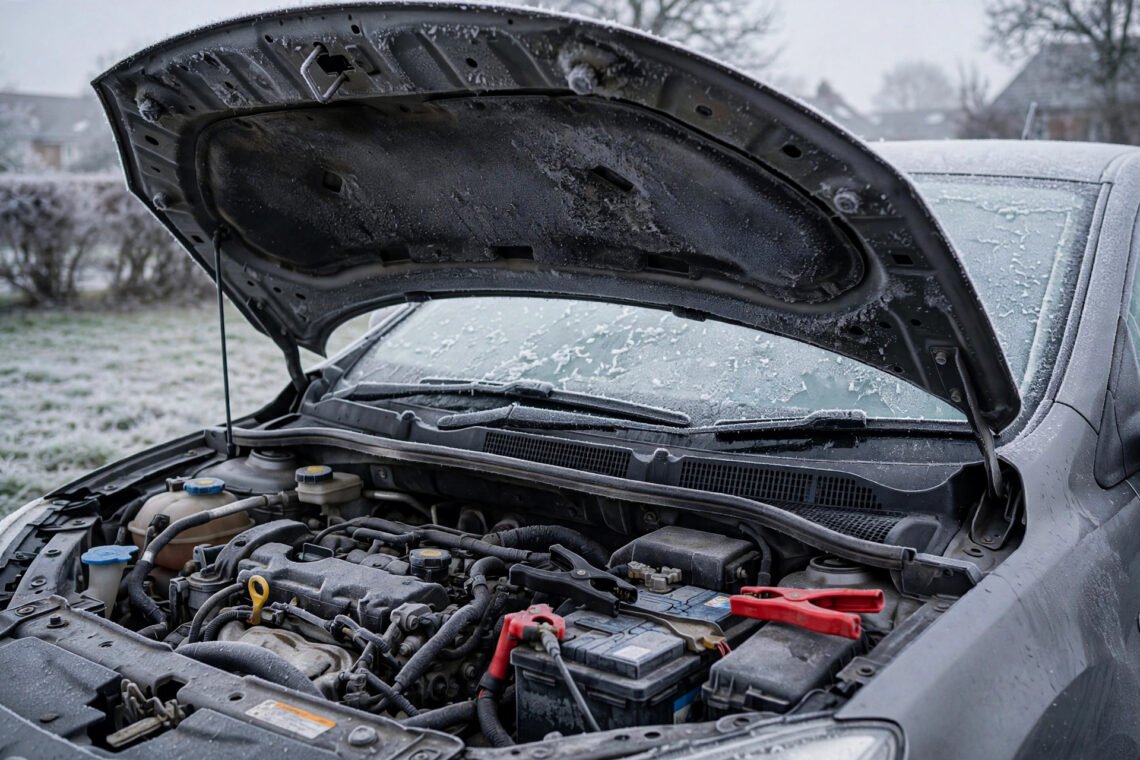
There is a special kind of January misery: turning the key on a frosty morning and hearing that dreaded slow crank — rrr-rrr-click — before silence. Car batteries fail more often in winter than in any other season, and it is not bad luck. Cold weather exposes every weakness a battery has been quietly developing all year. So why is it so hard to keep your car battery alive through winter? Because low temperatures, short dark days and changed driving habits conspire against it simultaneously — and this guide explains the science, the fixes, and the winter routine that keeps you starting first time.
The numbers tell the story. UK breakdown providers consistently report battery failures as the number one cause of winter callouts, with call volumes spiking on the first hard frost of the year. Most of those batteries were already dying in September; the cold simply delivered the final blow.
The Science: Why Cold Kills Batteries
A car battery produces power through a chemical reaction, and chemical reactions slow down in the cold. At 0°C a typical lead-acacid battery delivers roughly 20% less cranking power than at room temperature; at -10°C it can lose a third or more. Meanwhile the engine demands more power to start: cold oil is thicker and harder to turn over, so the starter motor draws a heavier current for longer. Less supply, more demand — that is the fundamental winter squeeze.
Age compounds it. Most car batteries last three to five years, and their capacity fades gradually. A four-year-old battery that coped fine in October can collapse in December because it had no reserve left to sacrifice to the cold. Short winter journeys finish the job: the starter motor drains a large chunk of charge, and a ten-minute school run does not run the alternator long enough to replace it. Repeat that daily and the battery ratchets steadily downward until one frosty morning it cannot crank at all.
The Parasitic Drains You Do Not Notice
Modern cars never fully sleep. Alarm systems, keyless-entry receivers, telematics units and dashboard clocks all sip power continuously — typically 20–50 milliamps, which is harmless when you drive daily but meaningful when the car sits. In winter, cars sit more: remote workers, Christmas holidays, and the general reluctance to drive in bad weather mean many vehicles stand unused for a week or more.
Then there are the drains you add yourself. Heated seats, heated windscreens, heated mirrors, blowers on full, headlights, wipers and phone chargers all load the electrical system heavily in winter. If your journeys are short, the alternator cannot keep up and the battery subsidises the difference. Dashcams left recording in parking mode are a notorious culprit — a dashcam can flatten a marginal battery in a few days of standing. If yours has parking mode, consider a hardwire kit with a voltage cut-off, or unplug it when the car will sit. The RAC’s battery advice pages cover these drains in detail and are worth a read before winter bites.
The Winter Battery Routine That Works
Prevention is a routine, not a product. Start with a battery health check in October — most garages and fast-fit centres test batteries free in the hope of selling you a replacement, and the test takes five minutes. If the battery is over four years old or the tester shows marginal capacity, replace it before the frosts rather than after the failure. A new battery costs £80–£200 fitted; a missed workday and a breakdown callout cost more.
Clean the terminals. Corrosion — the white or green crust on battery terminals — increases resistance and strangles both charging and cranking. Disconnect (negative first), scrub with a wire brush and a bicarbonate-of-soda solution, dry thoroughly, reconnect (positive first) and smear petroleum jelly on the terminals to slow recurrence. Check the battery is clamped securely; vibration damages internal plates over time.
Change your driving habits slightly. Combine short trips where possible so the engine runs long enough to recharge properly — twenty minutes of continuous driving is the rough minimum for a meaningful recharge. Switch off heated screens, seats and blowers for the last few minutes of a journey to let the alternator top up the battery without competing loads. And if the car will stand for more than a week, either arrange for someone to drive it for 20–30 minutes or connect a smart trickle charger, which maintains the battery safely for weeks. A decent smart charger costs £30–£60 — far less than one emergency callout.
Jump Starts and Battery Chargers: Doing It Right
When prevention fails, technique matters. With jump leads, connect in this order: red to the flat battery’s positive terminal, red to the donor car’s positive, black to the donor car’s negative, black to an unpainted metal earth point on the flat car’s engine block — away from the battery. Start the donor car, wait a few minutes, then start the flat car. Remove leads in reverse order. Connecting black directly to the flat battery’s negative terminal risks sparks near hydrogen gas the battery may be venting — the earth-point method exists for a reason.
Portable lithium jump starters (£60–£120) have made this far easier: no donor car needed, small enough for the glovebox, and genuinely effective on most petrol engines and smaller diesels. Keep yours charged — a flat jump starter helping a flat battery helps nobody. After any jump start, drive for at least 30 minutes to recharge, and treat the incident as a warning: get the battery and charging system tested, because batteries that have been deeply discharged rarely fully recover. The AA’s jump-start guidance includes model-specific cautions for stop-start and hybrid systems, which have particular requirements.
Stop-Start, Hybrids and EVs: Special Cases
If your car has stop-start, it likely uses an AGM or EFB battery — tougher and more expensive (£150–£300) than conventional ones, and they must be replaced like-for-like. Fitting a cheap conventional battery to a stop-start car will kill it within months and can confuse the battery management system. Hybrids have both a high-voltage traction battery and a conventional 12V auxiliary battery, and it is the little 12V one that strands people — it runs the computers that wake the car up. EVs, similarly, depend on a 12V battery for their electronics; a dead 12V battery in an EV produces the baffling symptom of a “fully charged” car that will not switch on. The maintenance principles are the same: test in autumn, keep it charged, replace on schedule.
Winter car care extends beyond the battery, of course. If you are heading into the hills this season, our guide to planning a road trip around Scotland in 7 days covers cold-weather journey preparation, and building solid winter routines that keep you moving through the dark months pairs well with a car that actually starts.
The Bottom Line
Keeping your car battery alive through winter is hard because cold simultaneously weakens the battery and increases the demands on it, while short days encourage the short journeys and long standstills that finish it off. The fix is unglamorous but effective: test the battery in October, clean the terminals, drive long enough to recharge, minimise parasitic drains, and use a smart charger if the car stands. Do that and the first hard frost becomes just another morning — not a callout.
Frequently Asked Questions
How long should a car battery last in the UK?
Typically three to five years. Heat, vibration and deep discharges shorten life, while regular long drives extend it. If yours is over four years old, have it tested each autumn.
Will a short drive recharge my car battery?
Barely. A ten-minute trip does not replace the charge used by starting, especially with heaters and lights on. Aim for at least 20–30 minutes of continuous driving for a meaningful recharge.
Can cold weather permanently damage a car battery?
Cold itself mainly reduces performance temporarily, but a deeply discharged battery can freeze — the electrolyte in a flat battery freezes at much higher temperatures than in a charged one — and freezing can crack the casing and destroy it permanently.
Are portable jump starters any good?
Yes, modern lithium jump starters reliably start most petrol engines and smaller diesels without a donor car. Keep the unit itself charged, and choose one rated for your engine size.
Why won’t my stop-start system work in winter?
Stop-start is deliberately disabled by the car’s computer when the battery charge or temperature is outside its operating window — it is protecting the battery. If it never activates even in mild weather, the battery may need testing.