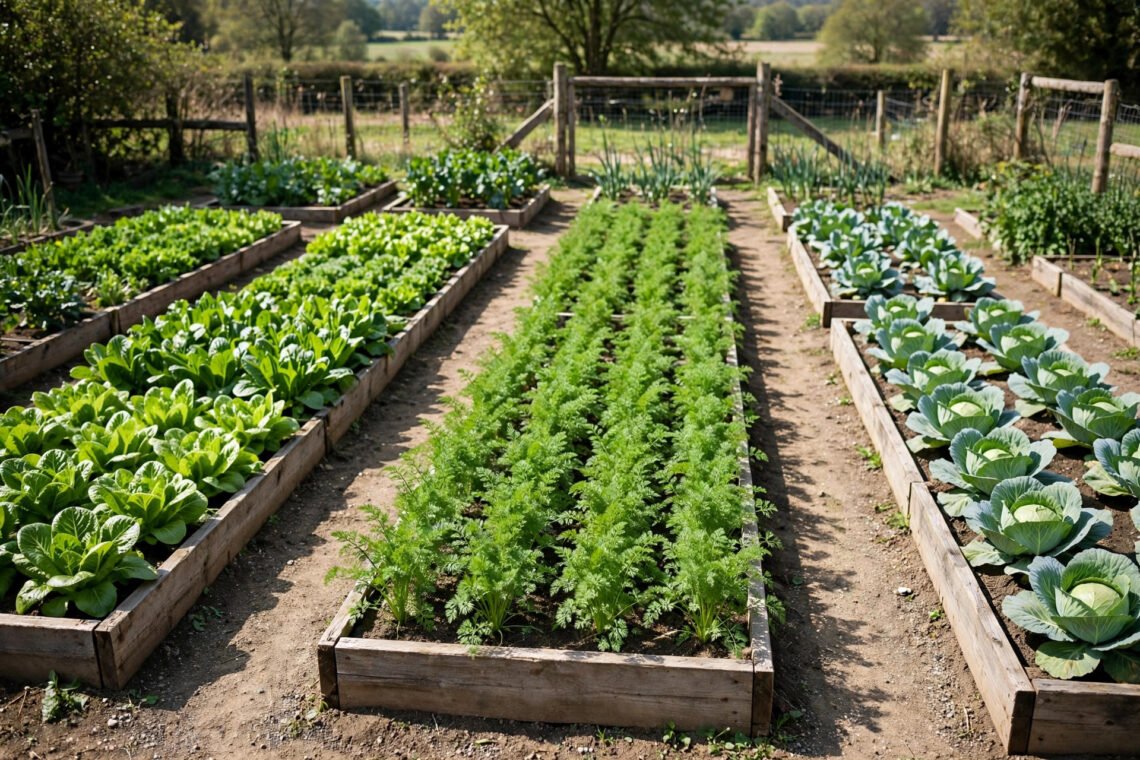
You grew magnificent potatoes last year in the bed where this year’s carrots are now sulking, yellowing and underperforming. Coincidence? Almost certainly not. Different plant families take different nutrients from the soil and host different pests and diseases — grow the same family in the same spot year after year, and problems compound. Crop rotation is the traditional answer: a simple system of moving plant families around your plot so the soil recovers and pests are starved out.
This guide explains crop rotation for small gardens from zero: why it works, the classic four-year system simplified for raised beds and modest plots, and what to do when your garden is too small for the textbook version.
Why rotation works: the three mechanisms
Nutrient management. Hungry feeders (brassicas, potatoes) guzzle nitrogen; legumes (peas, beans) actually add nitrogen via root bacteria; light feeders (carrots, herbs) ask little. Rotating balances the books instead of bankrupting one nutrient.
Pest and disease disruption. Most vegetable pests and diseases are family-specific and survive in soil. Clubroot attacks brassicas; potato blight lingers where potatoes grew. Move the host family away for 3–4 years and the pests starve out. This is rotation’s biggest win — it is free, chemical-free pest control.
Soil structure. Deep-rooted crops (parsnips) break up lower soil; shallow-rooted ones (lettuce) work the surface. Varying root depths keeps the whole profile healthy.
The plant families (simplified)
Botanical families matter more than individual vegetables. Learn these four groups and you know enough to rotate:
- Brassicas — cabbage, kale, broccoli, cauliflower, Brussels sprouts, radish, turnip. Hungry, lime-loving, clubroot-prone.
- Legumes — peas, broad beans, runner beans, French beans. Nitrogen-fixers that enrich soil for whatever follows.
- Roots and alliums — carrots, parsnips, beetroot, onions, garlic, leeks. Light feeders; carrot fly is the key pest to outrun.
- Potatoes and friends (solanums) — potatoes, tomatoes. Very hungry; blight is the disease to escape. (Sweetcorn and squash are often grouped as “miscellaneous” hungry crops.)
The classic four-year rotation
Divide your growing area into four sections and rotate groups through them in this order:
- Year 1 — Legumes: peas and beans, which fix nitrogen and leave the soil enriched.
- Year 2 — Brassicas: follow the legumes to exploit the nitrogen they left behind.
- Year 3 — Roots and alliums: light feeders that thrive on the residual fertility without needing fresh manure (fresh manure makes carrots fork).
- Year 4 — Potatoes: the hungriest crop, which gets the fresh compost/manure application — and then legumes follow, restarting the cycle.
The logic is elegant: manure goes on before potatoes, legumes rebuild nitrogen, brassicas spend it, roots coast on the leftovers. The RHS crop rotation guide illustrates this with clear diagrams.
Rotation in small gardens: the realistic version
Four equal beds is a luxury many small gardens lack. Here is how to adapt:
- Rotate within beds, not just between them. Even swapping which half of a raised bed holds brassicas versus roots disrupts pests meaningfully.
- Prioritise the problem crops. If space is tight, rotate potatoes/tomatoes and brassicas rigorously (their diseases are the worst); be relaxed about beans and salads.
- Use containers as extra “beds”. Growing potatoes in bags effectively gives you rotatable growing space with fresh compost each year — disease-free by design. If you are planning bigger changes too, our breakdown of what small garden landscaping costs in the UK helps with budgeting.
- Keep a simple plan. A notebook sketch of what grew where, updated each spring, beats any app. Memory is unreliable; a diagram is forever.
Even imperfect rotation beats none. Moving just your potatoes and brassicas to fresh spots each year captures most of the benefit.
Companion tricks that complement rotation
Rotation handles year-to-year planning; intercropping handles within-season synergy. Classic pairings: carrots with onions (each confuses the other’s fly pest), basil with tomatoes, nasturtiums as sacrificial aphid traps near brassicas. Green manures — fast-growing crops like winter rye or crimson clover sown on empty beds — protect and enrich soil between rotations. Garden Organic, the UK’s organic growing charity, has excellent guidance on both.
Choosing what to grow where also depends on your conditions — our guide to the best plants for a north-facing garden helps match crops to tricky spots.
Rotation for containers and tiny plots
Container growing sidesteps rotation elegantly: pots filled with fresh compost each year are effectively a new “field” every season. The one rule is do not reuse last year’s potato or tomato compost for this year’s potatoes or tomatoes — either use it elsewhere in the garden (it is still good compost, just not for solanums) or refresh it thoroughly. For very small plots with just one or two raised beds, try a two-year rotation instead of four: hungry crops (brassicas, potatoes) one year, everything else the next, with heavy composting between. It captures most of the disease-breaking benefit with half the bookkeeping, and for many urban gardeners it is the difference between rotating and not bothering.
Green manures: rotation’s best friend
Empty soil is wasted soil — and an invitation to weeds. Green manures are fast-growing crops sown purely to be dug back in: winter rye and field beans over winter, crimson clover or buckwheat in summer gaps. They protect soil from rain compaction, suppress weeds, and (in the case of leguminous ones) fix nitrogen. Sowing green manure on whichever bed is “resting” in your rotation turns downtime into soil-building time. It is the closest thing to free fertility in gardening, and it makes even a simplified rotation dramatically more effective.
Conclusion
Crop rotation is simply organised common sense: do not ask the same soil to feed the same hungry family every year, and do not let family-specific pests find their hosts waiting. Learn the four plant families, follow the legumes-brassicas-roots-potatoes cycle as closely as your space allows, and keep a sketch of what grew where. Your soil will stay fertile, your pest problems will shrink, and your vegetables will taste like the system is working — because it is.
Frequently Asked Questions
Do I really need to rotate crops in a small garden?
The smaller the garden, the more rotation matters — problems concentrate faster in limited soil. But “rotation” can be as simple as not growing potatoes or brassicas in the same raised bed two years running. Perfection is unnecessary; avoidance of repetition is what counts.
How many years before I can grow potatoes in the same spot?
Three to four years is the standard advice, primarily to break the cycle of potato cyst nematodes and blight. In containers with fresh compost each year, you can grow potatoes annually — the “rotation” is the fresh growing medium.
Can I grow tomatoes where potatoes grew last year?
Ideally not — they are the same family (solanums) and share blight. Treat tomatoes as honorary potatoes for rotation purposes and give them the same 3–4 year break from that spot.
What happens if I do not rotate at all?
Gradually declining yields, increasing pest and disease pressure (especially clubroot in brassicas and eelworm in potatoes), and nutrient imbalances. It is a slow decline, not a sudden collapse — which is why the cause often goes unrecognised.
Do flowers and herbs need rotating?
Generally no — rotation matters for annual vegetables, especially the hungry and disease-prone families. Perennial herbs and ornamental flowers can stay put; just mulch and feed them.