
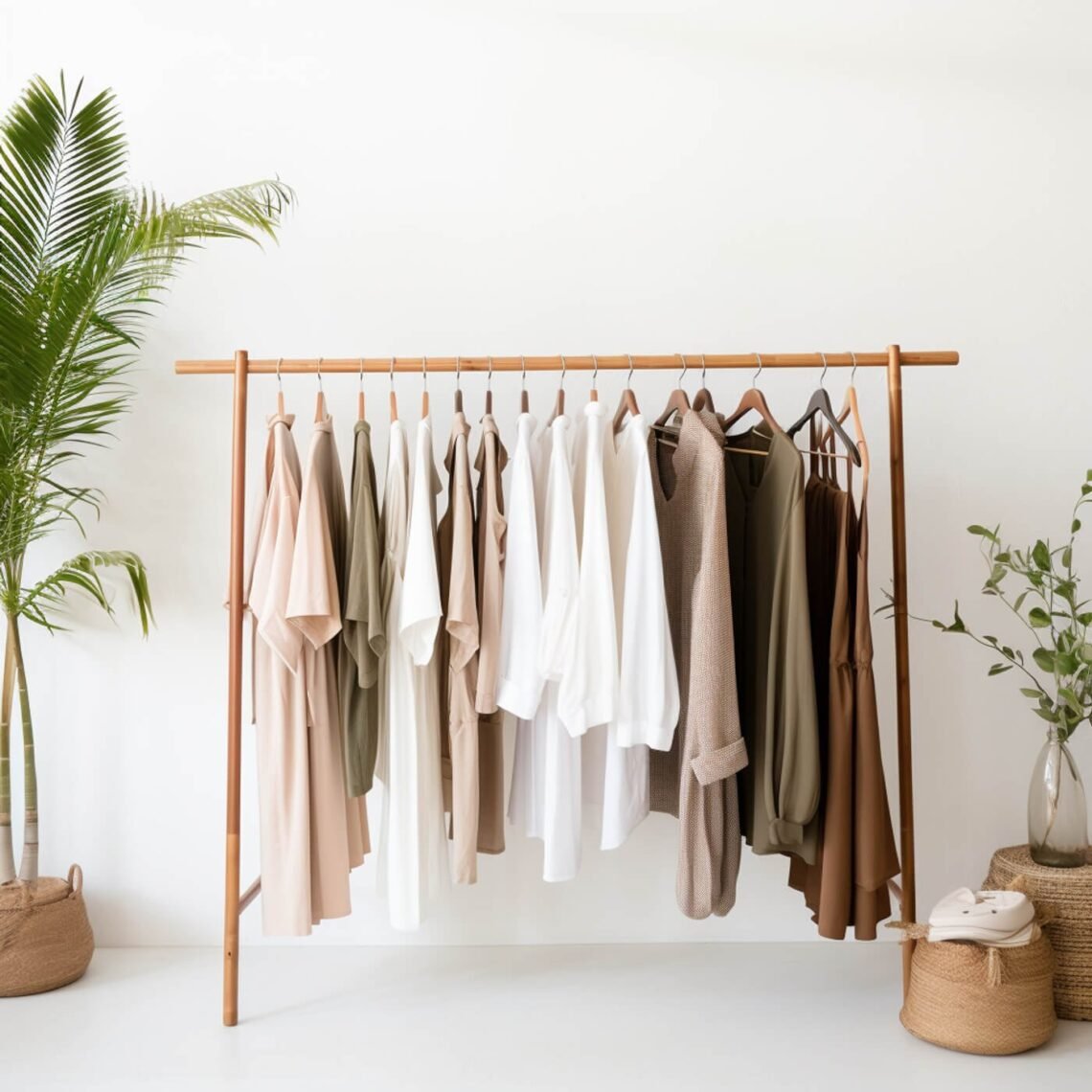
You’ve heard the terms thrown around — fast fashion bad, slow fashion good — but what do they actually mean in practice? The difference between fast fashion and slow fashion isn’t just about price or speed; it’s two fundamentally different philosophies of making, buying and wearing clothes. Understanding both helps you shop more deliberately, whatever your budget.
The difference between fast fashion and slow fashion
Fast fashion is cheap, fast and disposable; slow fashion is considered, durable and transparent. But the reality is more nuanced. Here’s what the terms really mean and how to navigate them.
What is fast fashion?
Fast fashion is the dominant model of the last two decades: brands (Primark, Shein, Boohoo, Zara and H&M’s fastest lines) that take catwalk or social media trends and turn them into cheap garments in weeks. The business model depends on volume — enormous quantities, rock-bottom prices, constant newness. A £5 top isn’t really a £5 top; it’s a top whose true costs (labour, environment, quality) have been pushed elsewhere.
The characteristics: trend-led design copied at speed, very low prices, variable-to-poor quality, synthetic fabrics (polyester is cheap), and a built-in obsolescence — both physical (it falls apart) and psychological (it’s “last month” within weeks). The environmental toll is staggering: fashion is among the world’s most polluting industries, and the UK bins hundreds of thousands of tonnes of textiles yearly.
What is slow fashion?
Slow fashion is the counter-movement: fewer, better things. It means buying less, choosing well-made pieces in timeless styles, caring for them, repairing them, and keeping them for years. It’s not a brand category — it’s a behaviour. A £30 M&S jumper worn 200 times is slow fashion; a £200 “sustainable” top worn twice is not.
The characteristics: timeless over trendy design, better materials and construction, transparent supply chains (in the genuine versions), higher prices reflecting real costs, and an emphasis on longevity — the famous “cost per wear” maths, where a £120 coat worn 300 times (£0.40/wear) beats a £30 coat worn 10 times (£3/wear).
The honest comparison
- Price: Fast fashion wins upfront, always. Slow fashion wins per-wear — but only if you actually wear things repeatedly.
- Quality: Slow fashion generally lasts longer, but “expensive” doesn’t automatically mean well-made — check seams, fabric and construction whatever the price.
- Style: Fast fashion offers endless novelty; slow fashion offers coherence. Neither is morally superior as an aesthetic — the question is whether the novelty brings you joy or just clutter.
- Sustainability: Slow fashion wins decisively — the most sustainable garment is the one already in your wardrobe. But beware greenwashing: “conscious collections” from fast fashion giants are often marketing with marginal substance.
- Accessibility: This is fast fashion’s genuine defence — not everyone can afford slow fashion prices, and telling low-income shoppers their £5 top is unethical is its own kind of snobbery. The most democratic slow fashion is second-hand: charity shops, Vinted and vintage give you quality and uniqueness at fast-fashion prices.
The practical middle ground
Few people live at either extreme, and you don’t need to. A realistic approach:
1. Buy less, full stop. The 30-wears test: will I wear this 30 times? If not, don’t buy it. This single question does more than any brand choice.
2. Go second-hand first. Charity shops, Vinted, Depop — our second-hand shopping guide shows how to find quality pre-loved pieces that are both cheap and sustainable.
3. Invest where it counts. Coats, shoes, bags — the hard-wearing, high-visibility items where quality pays. Save on trend-light basics.
4. Care for what you own. Wash less (jeans rarely need it), wash cooler, air-dry, de-pill knitwear, repair rather than replace. A £8 fabric shaver and a needle and thread extend wardrobe life enormously — see our leather care guide for the principle applied to shoes.
5. Learn your style. Impulse trend buys are fast fashion’s fuel. Knowing your three-word style (see finding your personal style) kills most bad purchases before they happen.
For finding genuinely ethical brands when you do buy new, see our guide to sustainable clothing brands in the UK.
The real difference between fast and slow fashion isn’t where you shop — it’s how you think. Buy less, choose well, wear it for years, and the labels take care of themselves.
The 30-wears test in practice
The 30-wears test (“will I wear this 30 times?”) is slow fashion’s most useful tool — here’s how to apply it honestly. Before buying, visualise 30 wears: can you name 10 outfits with it? If you struggle past 3, it’s not a 30-wear piece. Do the maths: £60 ÷ 30 wears = £2 per wear. Compare with the £15 top you’ll wear 5 times (£3/wear) — the “expensive” item is cheaper. Track it: keep a note on your phone — item, date bought, price. Tally wears for a month. The results will shock you: most wardrobes have £500+ of sub-5-wear items and a handful of heroes doing all the work.
What passes the test: jeans, white shirts, black trousers, good knitwear, coats, everyday shoes — the boring heroes. What usually fails: occasion dresses, trend pieces, “going out” tops, anything bought for a holiday. That’s fine — the test doesn’t ban fun purchases, it just makes their true cost visible. A £100 party dress worn twice is a £50/wear rental you can’t return. Knowing that, you might rent instead (Hirestreet, Hurr — from £20), buy second-hand, or just… not.
The test’s deeper lesson: it shifts your identity from “shopper” to “curator.” Every purchase becomes a deliberate addition to a working collection rather than a dopamine hit. And it makes sustainable choices automatic — 30-wear clothes are almost always better-made (cheap ones don’t survive 30 wears), which means less waste without any moral effort. You don’t need to memorise sustainability certifications or boycott brands. Just ask the question, do the maths, and buy accordingly. The planet benefits as a side effect of your own good economics.
The true cost of a £5 top: the maths nobody shows you
Production cost: a £5 retail top costs roughly £1–£1.50 to make — fabric, labour, shipping, all in. That means the garment worker received pennies, the fabric is the cheapest available, and quality control is minimal. Your cost: worn 5 times before it pills, stretches or falls apart = £1 per wear. A £25 top worn 50 times = 50p per wear. The “cheap” top costs double per wear — the maths of fast fashion is inverted.
Environmental cost: the average fast-fashion garment generates around 10kg of CO2, uses thousands of litres of water (for cotton), and sheds microplastics with every wash (for polyester). Worn 5 times and binned, that’s 2kg of CO2 per wear. Worn 50 times: 200g per wear. Longevity is the single biggest lever on fashion’s footprint — ten times more impactful than fabric choice. Human cost: the £5 price point requires poverty wages somewhere in the supply chain. There’s no version of a £5 top where everyone was paid fairly — the maths doesn’t allow it.
What to do with this knowledge: not guilt — strategy. Buy less (the 30-wears test), buy second-hand (the £5 top’s ethical twin — pre-loved, no new production), buy better for the pieces you wear most (cost-per-wear justifies it), and care for what you own (washing less, repairing more). The reframe: the question isn’t “can I afford sustainable fashion?” — it’s “can I afford to keep buying things that fall apart?” The £5 top isn’t cheap. It’s expensive, in every way that matters, except the price tag. Once you see the maths, you can’t unsee it — and your wardrobe (and conscience) will be better for it.
For the industry side of the story, WRAP’s Textiles 2030 initiative shows how UK brands are being pushed to cut the environmental cost of clothing.



One comment on “Fast Fashion vs Slow Fashion: What’s the Difference?”