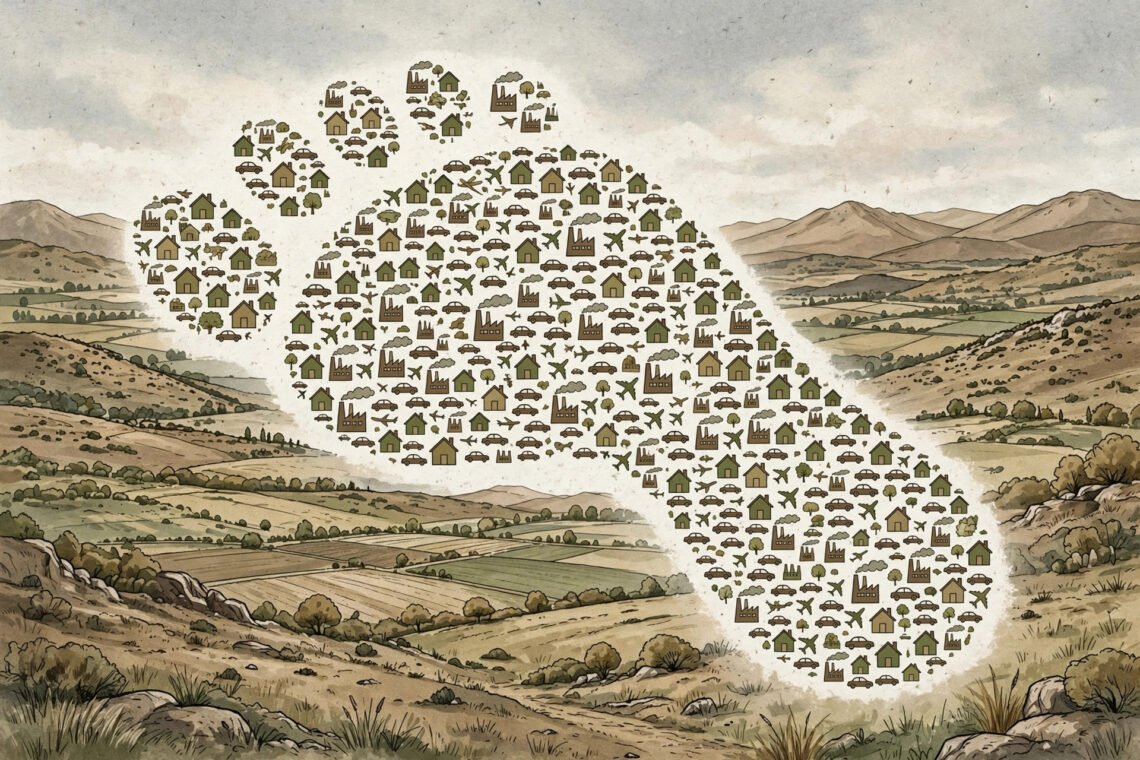
“Calculate your carbon footprint” — the phrase appears everywhere from energy bills to airline checkouts, usually accompanied by a vague sense of guilt and no real understanding of what the number means. Is it tonnes of CO2? Per year? Compared to what? And does knowing it actually change anything? This guide explains carbon footprint calculation from absolute zero: what it measures, how the maths works, what a typical British footprint looks like, and — most importantly — which reductions actually matter.
What a carbon footprint actually is
Your carbon footprint is the total greenhouse gas emissions caused by your lifestyle, expressed as tonnes of CO2-equivalent (CO2e) per year. The “equivalent” matters: it rolls methane, nitrous oxide and other gases into one comparable number based on their warming impact relative to CO2. It is an estimate, not a precise measurement — nobody follows you around with a sensor. Calculators multiply your activities (miles driven, kWh used, flights taken) by emission factors (how much CO2e each activity typically produces).
What the average Briton’s footprint looks like
The average UK per-person footprint is roughly 10–13 tonnes CO2e per year (estimates vary by methodology), against a global average of about 4–5 tonnes. A sustainable target consistent with climate goals is around 2–3 tonnes per person — so the average Briton needs to cut roughly three-quarters of current emissions. The breakdown of a typical footprint:
- Home energy: ~25–30% — heating (mostly gas in the UK) and electricity.
- Transport: ~25–30% — dominated by car use and flying. One long-haul return flight can add 2–3 tonnes alone — a quarter of the average footprint in a single trip.
- Food: ~20–25% — meat and dairy dominate; beef is an order of magnitude more carbon-intensive than chicken or beans.
- Goods and services: ~20–25% — everything you buy, from clothes to electronics, plus the services you use.
How calculators work (and their limits)
Carbon calculators ask about your home (size, heating type, energy use), travel (car miles, flights, public transport), diet, and spending — then apply emission factors. The best-known UK calculator is WWF’s WWF UK footprint calculator, which is well-designed and UK-specific. The Carbon Trust also offers business and personal tools.
Be aware of the limits: calculators estimate, and different methodologies give different answers — do not compare numbers across calculators. They also typically undercount consumption (the embodied carbon in imported goods is hard to capture) and cannot reflect the carbon intensity of your specific electricity tariff or car. Treat the result as a directional guide and a baseline for tracking your own progress year to year, not a precise measurement.
The reductions that actually matter (ranked)
Not all carbon savings are equal. Ranked by impact for a typical UK household:
- Fly less. The single biggest lever. One fewer long-haul flight per year can cut 15–25% of a typical footprint. When you do fly, economy class has roughly a third the footprint of business per passenger.
- Drive less / go electric. Switching regular car journeys to walking, cycling or public transport; when replacing a car, electric (charged on the increasingly clean UK grid) roughly halves driving emissions.
- Eat less meat, especially beef. Cutting beef and lamb — even without going vegetarian — is one of the highest-impact dietary changes available.
- Heat your home efficiently. Insulation, thermostat discipline (21°C to 19°C saves ~10% on heating), and eventually a heat pump. Fabric first: insulation beats gadgets.
- Buy less stuff. The embodied carbon in goods is enormous and invisible. Buy durable, buy second-hand, repair.
- Switch to a renewable electricity tariff — modest direct impact (the grid is shared), but it signals demand.
Notice what is not on the list: recycling (worth doing, but a small slice), reusable coffee cups (negligible in carbon terms), and most “eco swaps” marketed to consumers. Focus your energy where the tonnes are. Our guides to practical eco-friendly home changes and reducing kitchen food waste cover the household-level actions in detail.
Should you offset?
Carbon offsetting — paying for emissions reductions elsewhere to “cancel” yours — is controversial, and quality varies enormously: some projects are rigorous and additional; others would have happened anyway or do not permanently store carbon. The honest hierarchy is reduce first, offset last — offsetting is not a licence to keep emitting unchanged. If you do offset (flights are the classic case), choose Gold Standard-certified projects and treat it as a supplement to reduction, never a substitute.
Making it a household project
Carbon footprints are more fun — and more effective — as a household endeavour than a solo guilt trip. Calculate together using the WWF calculator and compare baselines without judgement; the numbers spark genuinely interesting conversations about where your household’s tonnes actually live. Pick one big lever per quarter — a meat-free month, a no-fly holiday experiment, a home energy audit — and treat it as an experiment, not a vow. Track annually, not obsessively; the year-on-year trend is what matters. And involve children: carbon literacy is a life skill now, and children are often the household’s most enthusiastic adopters once they understand the maths.
Conclusion
Your carbon footprint is simply your lifestyle translated into tonnes of CO2e per year — and for the average Briton, the number is roughly four times the sustainable level. Calculate it once for a baseline, then attack the big levers in order: flying, driving, diet, home heating, consumption. Make it a household project, track the trend annually, and let the children lead — they usually will. The small eco-swaps are fine, but the tonnes live in the big five. Understand the maths, and climate action stops being vague guilt and becomes a clear, prioritised, genuinely achievable to-do list.
Frequently Asked Questions
What is a good carbon footprint number to aim for?
Around 2–3 tonnes CO2e per person per year is broadly consistent with limiting warming to 1.5–2°C. The average Briton is at roughly 10–13 tonnes, so this means deep cuts — achievable mainly through the big levers (flying, driving, diet, heating) rather than marginal lifestyle tweaks.
Are carbon footprint calculators accurate?
Directionally, yes; precisely, no. They use average emission factors applied to your reported activities, so they capture the shape of your footprint well but miss specifics. Use one calculator consistently to track your own progress over time rather than comparing absolute numbers.
Does individual action even matter compared to corporations?
The famous “100 companies cause 71% of emissions” statistic describes fossil fuel producers — but their emissions come from fuel that individuals, businesses and governments burn. Individual action matters directly (your footprint is real) and indirectly (consumer demand and voting shape the system). It is not either/or.
What is the biggest single thing I can do?
For most Britons who fly: take one fewer long-haul flight per year. For non-flyers: cut car mileage or switch to electric, and reduce beef and lamb consumption. The answer is personal — calculate your footprint and attack your biggest slice.
Is the “carbon footprint” concept oil-industry propaganda?
The term was popularised by BP in the 2000s, which is worth knowing — but the concept (quantifying lifestyle emissions) is legitimate science used by researchers worldwide. Be aware of the framing’s origins without discarding the useful tool.