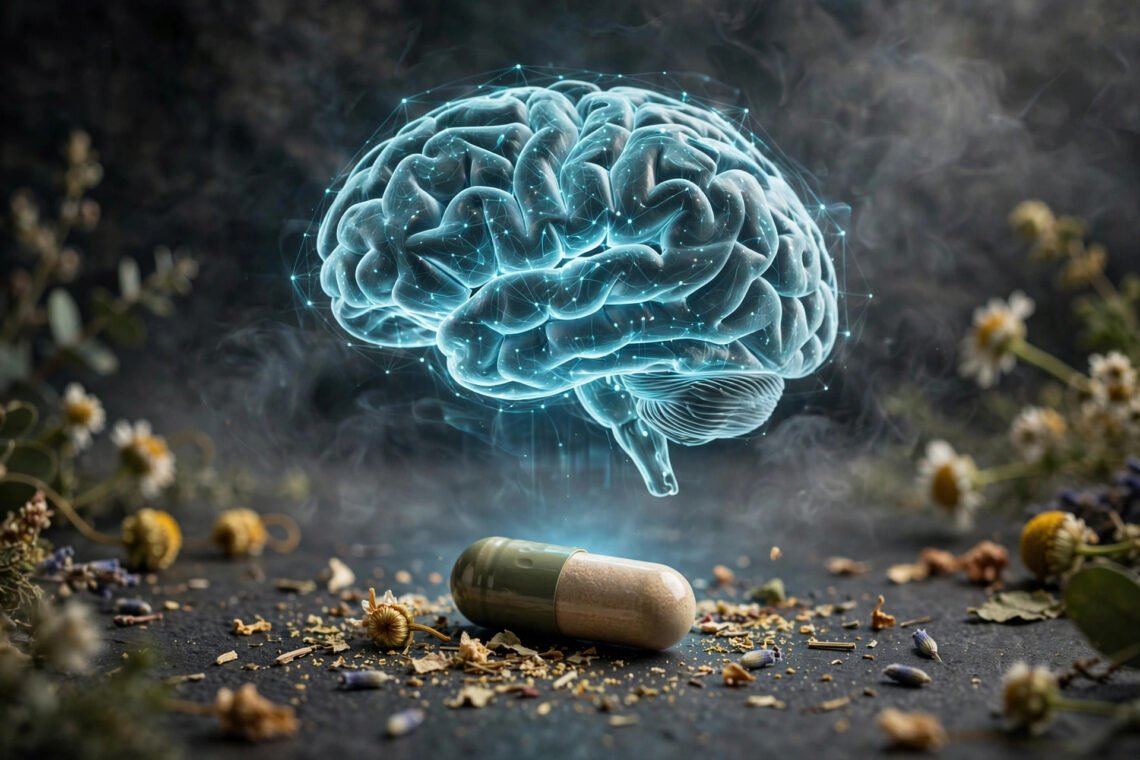
A sugar pill relieves pain. A sham surgery improves a bad knee. A doctor’s confident reassurance works better than the same words delivered uncertainly. The placebo effect — improvement from a treatment with no active ingredient — is one of medicine’s strangest and most powerful phenomena, and it is not “all in your head” in the dismissive sense. It is all in your head in the literal, neurological sense: your brain actively manufacturing relief. Understanding it changes how you think about medicine itself.
The effect is huge and rigorously documented. In clinical trials, placebos routinely produce 20–40% of the benefit of active drugs for pain, depression, Parkinson’s symptoms, IBS and many other conditions. Antidepressant trials famously show large placebo responses. This is not fraud or imagination — brain imaging shows placebo pain relief lighting up the same opioid and dopamine pathways as real analgesics. The brain, expecting relief, produces its own chemistry.
How it works: the mechanisms
Expectation: the core driver. If you believe a treatment will help, the brain primes its own healing responses — releasing endorphins for pain, dopamine for Parkinson’s symptoms. The effect scales with the impressiveness of the ritual: injections beat pills, brand-name placebos beat generic ones, two pills beat one, and expensive placebos beat cheap ones. The theatre of medicine is pharmacologically active.
Conditioning: like Pavlov’s dogs, bodies learn. If a real drug has relieved your pain many times, the ritual alone — the pill shape, the doctor’s office — starts triggering relief before any chemistry arrives. Social learning: seeing others improve (or hearing confident testimony) amplifies your own response. Regression to the mean and natural history: the unglamorous confounders — people seek treatment at their worst, so improvement would often happen anyway; careful trials separate these from true placebo effects, and true effects remain.
The nocebo: placebo’s evil twin
Expectation cuts both ways. The nocebo effect — harm from negative expectation — is equally real: patients warned extensively about side effects experience more of them, including on placebo. This creates a genuine ethical dilemma for doctors and pharmacists: informed consent requires listing side effects, but listing them increases their occurrence. How side effects are framed (“most people tolerate this well” vs a frightening list) measurably changes outcomes. Words are dosage.
What this means for you as a patient
It does not mean treatments are fake. A drug beating placebo in trials proves it adds real benefit beyond expectation — that is the whole point of placebo-controlled trials, as the NHS guide to clinical trials explains. But it does mean the context of treatment matters enormously: a trusted clinician, a clear explanation, a confident manner and a positive therapeutic relationship are not bedside niceties — they are active ingredients. Choosing a doctor you trust is a medical decision.
It explains a lot of alternative medicine. Many unproven therapies “work” for their users largely via placebo mechanisms — impressive rituals, confident practitioners, invested patients. The relief can be genuine while the theory is nonsense. The honest question is not “did you feel better?” but “does this add anything beyond placebo, and at what cost and risk?” — the question NICE asks systematically when evaluating treatments. This is also why daily vitamins feel effective to many users despite thin evidence for most people — expectation plus ritual is powerful.
You can harness it legitimately. Maximise the real placebo component of real treatment: understand your treatment (understanding boosts expectation), maintain a good relationship with your clinicians, follow rituals consistently, and cultivate reasonable optimism. None of this replaces medicine — it amplifies it. The mind-body connection is not mysticism; it is neurochemistry, as our piece on whether mindfulness reduces stress explores from another angle.
The ethics: should doctors prescribe placebos?
Deliberate deception is widely considered unethical — trust is medicine’s foundation. But open-label placebos (patients told “this is a placebo, and placebos can still help”) have shown real benefits in IBS, back pain and depression trials. Honest placebos work, which suggests much of the effect comes from the ritual and the therapeutic relationship rather than the deception. The future may be medicine that maximises honest placebo effects alongside active treatment — the best of both.
The deeper lesson
The placebo effect demolishes the neat division between “real” medicine and “psychological” effects. Every treatment you have ever taken worked partly through chemistry and partly through meaning, expectation and ritual. That is not a flaw in medicine — it is a feature of being human. The most sophisticated medical system in history still runs, in part, on the oldest technology of all: one human being, trusted by another, saying “this will help” — and the brain believing it enough to make it true.
Placebo in history: from bread pills to brain scans
The word “placebo” — Latin for “I shall please” — entered medicine in the 18th century, when doctors prescribed bread pills and coloured water to satisfy patients they could not otherwise help. For centuries this was unremarkable: before modern pharmacology, most treatments were placebos by today’s standards, and medicine ran substantially on ritual and authority. The turning point came in the 1940s–50s with the randomised controlled trial, which made the placebo effect visible as a measurable quantity for the first time — and revealed it was enormous. Henry Beevers’s famous 1955 paper “The Powerful Placebo” claimed ~35% of patients improved on placebo, launching decades of research. Modern brain imaging (1990s onward) then showed the effect was neurochemical, not imaginary. The trajectory is telling: from folk wisdom, to embarrassment, to rigorous science — the placebo effect went from medicine’s dirty secret to one of its most fascinating frontiers.
Sham surgery: the placebo at its most dramatic
The most startling placebo evidence comes from surgery. In landmark trials, patients with knee osteoarthritis randomised to sham arthroscopy (incisions made, but no actual procedure performed) improved just as much as those getting real surgery — the ritual of surgery, not the surgery, drove the benefit. Similar results emerged for vertebroplasty (spinal cement injections) and some heart procedures. These trials are ethically fraught but scientifically invaluable: they reveal which procedures work through mechanics and which through meaning. The lesson is not that surgery is fake — many procedures clearly outperform shams — but that the bar for proving a surgical benefit must be the sham-controlled trial, the same standard drugs face. Expectation, it turns out, can wield a scalpel.
Frequently Asked Questions
What is the placebo effect in simple terms?
Real, measurable improvement from a treatment with no active ingredient — driven by expectation, conditioning and the treatment ritual. Brain imaging shows it activates genuine neurochemical pathways, including the body’s own opioids.
Is the placebo effect just imagination?
No. It produces measurable physiological changes — pain relief via endorphins, dopamine release in Parkinson’s, immune and hormonal effects. “Psychological” does not mean “unreal”; the brain’s chemistry is physical.
What is the nocebo effect?
Harm caused by negative expectation — patients expecting side effects experience more of them, even on placebo. It is why how doctors frame side-effect information measurably affects how patients feel.
Can doctors ethically prescribe placebos?
Deceptive placebos are considered unethical, but open-label placebos (honestly described as placebos) have shown real benefits in trials. The ethical frontier is maximising honest placebo effects alongside active treatment.
Does the placebo effect mean alternative medicine works?
It means people can genuinely feel better through placebo mechanisms — ritual, expectation, practitioner confidence — even when the underlying theory is unproven. The key question remains whether a therapy adds benefit beyond placebo, at acceptable cost and risk.