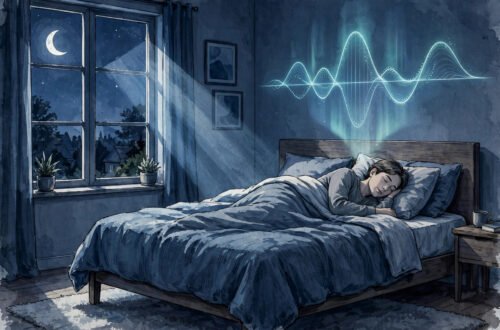
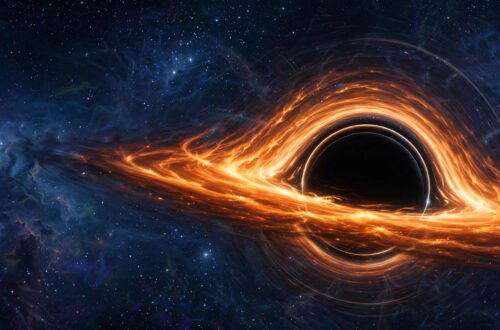
In September 2015, two black holes 1.3 billion light-years away spiralled into each other, and the collision briefly outshone the entire visible universe. Nobody saw it — but for the first time, humanity heard it: a chirp in a detector in Louisiana, as spacetime itself rippled. Gravitational waves, predicted by Einstein a century earlier, had been detected. Here is what they are, why they matter, and why you should care.
What is a gravitational wave?
Einstein’s general relativity says gravity is not a force pulling things — it is the curvature of spacetime itself, the four-dimensional fabric combining space and time. Massive objects dent this fabric (that dent is what we experience as gravity). Now: when massive objects accelerate — two black holes orbiting, neutron stars colliding — they send ripples propagating outward through spacetime at the speed of light. Those ripples are gravitational waves: literally waves in the geometry of reality, stretching and squeezing space as they pass.
You are being stretched and squeezed by them right now — by an amount thousands of times smaller than a proton. That is why they went undetected for a century: the effect is absurdly tiny, and measuring it required the most precise instruments ever built.
How do you detect something smaller than a proton?
The LIGO detectors (in Washington State and Louisiana, USA, with Virgo in Italy and KAGRA in Japan joining the network) are L-shaped vacuum tubes 4km long. Laser beams bounce between mirrors at each end; a passing gravitational wave stretches one arm and squeezes the other by ~10⁻¹⁹ metres — a ten-thousandth of a proton’s width. The lasers detect this via interference patterns. It is like measuring the distance to the nearest star to within a hair’s breadth. That it works at all is a monument to human ingenuity — and a triumph worth celebrating alongside the UK’s own scientific heritage at the Royal Society.
What have we learned?
Since 2015, detectors have logged around 100 gravitational-wave events, and each rewrote something:
Black holes are everywhere and stranger than expected. We have detected mergers of black holes far heavier than theory predicted, forcing revisions of how stars die. Neutron star collisions make gold. The 2017 event GW170817 — seen in gravitational waves and light — confirmed that colliding neutron stars forge heavy elements: the gold in your jewellery, the platinum in catalytic converters, was made in such collisions. You are wearing stardust from a kilonova. We can measure the universe’s expansion independently — gravitational waves are “standard sirens”, giving distances directly, offering a new route to resolving cosmology’s biggest controversy (the Hubble tension).
Why should you care?
Three reasons. First, a new sense. For all of history, astronomy meant light — we were deaf to the universe. Gravitational waves are hearing: they reveal the dark side of the cosmos (black holes emit no light) that was previously invisible. It is as transformative as the invention of the telescope. Second, fundamental physics. These waves test Einstein’s theory in the most extreme conditions imaginable — so far it passes every test, which is itself astonishing. Third, the long game. Today’s detectors are the first generation; the planned Einstein Telescope (Europe) and Cosmic Explorer (USA) will be ten times more sensitive, and the LISA space mission will hear supermassive black hole mergers across cosmic time. We are at the beginning of gravitational-wave astronomy, not the end.
The human story
The detection is also a story of persistence: Einstein predicted the waves in 1916 but doubted they would ever be detected; the LIGO project took decades and nearly a billion dollars, surviving scepticism and funding crises. When the signal arrived — a chirp rising in frequency as two black holes merged, converting three suns’ worth of mass into pure spacetime ripple — the team kept it secret for months while verifying. The 2017 Nobel Prize followed. If you want the full drama, it is superbly told in documentaries — see our roundup of the best documentaries to watch this month — and the cinematic treatment of black holes in the most anticipated films owes a debt to this science.
Gravitational waves matter because they are the universe speaking in a language we just learned to hear — telling us about black holes, the origin of gold, and the expansion of everything. A century after Einstein’s maths said they must exist, we built ears sensitive enough to listen. That is worth caring about.
The UK’s role in hearing the universe
Britain’s contribution to gravitational-wave astronomy is larger than most realise. UK scientists — particularly at Glasgow, Birmingham, Cardiff and Strathclyde — were central to LIGO’s development: Glasgow researchers pioneered the mirror suspension systems (fused-silica fibres holding the mirrors) that give the detectors their exquisite sensitivity, and built key optical components. The UK’s GEO600 detector in Germany served as the technology testbed for advanced LIGO. British groups lead in data analysis, signal modelling and the search for continuous waves from spinning neutron stars. With the Einstein Telescope planned in Europe, the UK is positioning for a leading role in the next generation — a fitting continuation for the country of Newton, whose theory of gravity these waves ultimately transcend. From an apple in Woolsthorpe to ripples in spacetime: quite the journey.
What LIGO hears next
The detectors keep improving, and each sensitivity upgrade multiplies the observable universe. Upcoming targets: continuous gravitational waves from rapidly spinning neutron stars (a long-sought hum beneath the noise), the stochastic background — the combined murmur of all distant mergers, and possibly echoes of the Big Bang itself — and intermediate-mass black hole mergers, a missing link between stellar and supermassive black holes. Multi-messenger astronomy is the growing frontier: catching a neutron-star merger in gravitational waves, then swivelling every telescope on Earth to watch the light show — as happened in 2017, the most observed astronomical event in history. Each new sense we grow reveals the universe had more to say than we imagined.
Frequently Asked Questions
What are gravitational waves in simple terms?
Ripples in spacetime itself, caused by accelerating massive objects like colliding black holes. They stretch and squeeze space as they travel at light speed — by amounts far smaller than a proton by the time they reach Earth.
How were gravitational waves detected?
By LIGO’s 4km-long laser interferometers, which measure distortions 10,000 times smaller than a proton. The first detection in 2015 captured two black holes merging 1.3 billion light-years away.
Why do gravitational waves matter?
They give humanity a new sense for observing the universe — revealing black holes and neutron star collisions invisible to light-based telescopes, confirming where heavy elements like gold come from, and testing Einstein’s theories in extreme conditions.
Did gravitational waves prove Einstein right?
They confirmed a century-old prediction of general relativity spectacularly — and every observation since has matched Einstein’s equations precisely, even in the most extreme gravitational environments known.
What is next for gravitational wave astronomy?
More sensitive ground detectors (Einstein Telescope, Cosmic Explorer) and the LISA space mission, which will detect supermassive black hole mergers across the universe — potentially hearing the first black holes ever formed. Together they will turn gravitational-wave astronomy from a series of remarkable detections into a continuous, high-volume observatory of the dark cosmos.