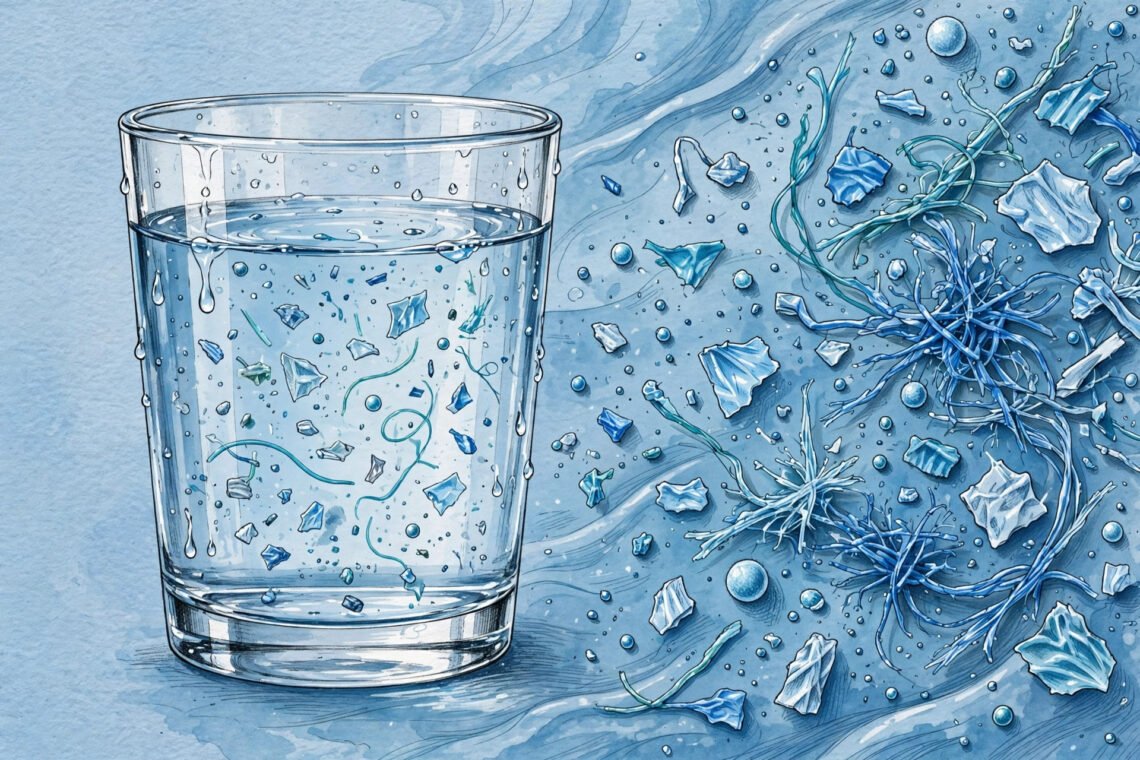
They are in the fish, in the rain, in the air over remote mountains — and, inevitably, in your drinking water. Microplastics: fragments of plastic smaller than 5mm, shed from everything from car tyres to fleece jumpers, now found in tap water and bottled water on every continent. Headlines swing between alarm and dismissal, leaving British households unsure whether to worry, what to do, or whether their filter jug is helping or theatre.
This guide explains microplastics in drinking water from zero: what they are, how they get there, what the science actually says about health, and the practical steps worth taking.
What microplastics actually are
Microplastics are plastic particles under 5 millimetres — many far smaller, down to nanoplastics under 1 micrometre (a thousandth of a millimetre). They come from two sources: primary microplastics manufactured tiny (microbeads in cosmetics — now banned in the UK — and industrial pellets), and secondary microplastics — the vastly larger share — formed when larger plastic items break down: synthetic clothing fibres in laundry water, tyre wear particles washed off roads, degrading packaging, and paint flakes.
They are now ubiquitous: detected in Arctic ice, deep ocean trenches, human blood, placentas and lungs. Drinking water is one exposure route among many — and probably not the largest.
How they get into drinking water
Tap water: microplastics enter reservoirs and rivers from wastewater (laundry fibres pass through treatment works partially), road runoff, and atmospheric deposition. UK water treatment removes a large proportion — but not all — of particles, with removal efficiency depending on size: larger microplastics are mostly captured; nanoplastics largely pass through. Studies typically find tens to hundreds of particles per litre in treated tap water, mostly fibres.
Bottled water: consistently shows higher microplastic counts than tap water in studies — the bottle and cap themselves shed particles, especially when exposed to heat or reused. One more reason the tap wins.
The UK’s Drinking Water Inspectorate monitors water quality rigorously, and the BBC’s science and environment coverage regularly reports on microplastic research — and it is worth stating clearly: UK tap water meets some of the strictest safety standards in the world for all regulated contaminants. Microplastics are not yet regulated because the science is still developing.
What the science says about health (honestly)
This is where honesty matters: we do not yet know whether microplastics in drinking water harm human health at typical exposure levels. Here is the state of evidence:
- Presence is proven; harm is not. Microplastics are definitely inside us. But detecting particles is not the same as demonstrating damage — toxicology depends on dose, particle type, size and chemistry.
- Lab studies raise flags. High-dose animal and cell studies show inflammation, oxidative stress and cellular disruption from certain microplastics. But lab doses are typically far above real-world drinking-water exposure.
- The WHO’s assessment (2019, the most authoritative review) concluded that based on limited evidence, microplastics in drinking water do not appear to pose a health risk at current levels — while calling for much more research, particularly on nanoplastics.
- Chemical additives may matter more than the plastic itself. Some plastics carry endocrine-disrupting additives (phthalates, bisphenols); the particle may be the delivery vehicle for the chemistry.
The rational position: concerned but not alarmed — reduce exposure where cheap and easy, support research and regulation, and do not panic.
What actually reduces your exposure
Drink tap, not bottled. The single biggest reduction — bottled water typically contains far more microplastics, costs ~500x more, and generates the plastic waste driving the problem.
Filter thoughtfully. Standard jug filters (activated carbon) reduce some microplastics but are not designed for them. Reverse osmosis systems remove the most (including nanoplastics) but are expensive, waste water, and strip beneficial minerals. For most households, a good carbon filter for taste plus tap water is the sensible balance — do not buy expensive “microplastic filters” without checking independent test data.
Attack the sources. Your laundry is a major microplastic source: wash synthetic clothes less often, at lower temperatures, in fuller loads; consider a microfibre-catching laundry bag or filter. Choose natural fibres when buying new. These upstream actions matter more than any filter — and they are practical eco-friendly steps with multiple benefits.
Reduce plastic food contact. Do not microwave food in plastic containers or pour boiling water into plastic bottles — heat dramatically increases particle and chemical shedding. Glass and stainless steel for hot food and drink is the simple rule. Our guide to reducing kitchen food waste pairs well with a lower-plastic kitchen generally.
The bigger picture: systemic sources matter most
Individual choices help, but microplastics are a systems problem: tyre wear (estimated the largest single source in many countries), synthetic textiles, packaging and paint. The highest-leverage actions are collective: supporting washing-machine filter regulation (France now mandates them on new machines), tyre composition standards, extended producer responsibility schemes making manufacturers fund cleanup, and single-use plastic reduction policies. The UK’s plastic bag charge cut usage by over 95% — proof that well-designed policy moves the needle vastly faster than individual virtue. Vote, respond to consultations, and support organisations campaigning on plastic pollution; your laundry bag matters, but your ballot matters more.
What to tell worried family members
When relatives ask whether the tap water is safe, the evidence-based answer is reassuring: UK tap water meets stringent safety standards, the WHO found no apparent health risk from microplastics at current levels, and switching to bottled water would increase exposure while costing a fortune. Worry is better directed at the sources — laundry, single-use plastics, tyre wear — where action genuinely helps. Calm, proportionate, and focused upstream: that is the rational response.
Conclusion
Microplastics are genuinely in British drinking water — mostly fibres, mostly tiny, mostly unregulated because the health science is incomplete. The evidence-based response is proportionate: drink tap over bottled, filter sensibly without overspending, and attack the sources (laundry, heat-plus-plastic, single-use waste) where your choices actually move the needle. Concern is warranted; panic is not. And the tap remains — by every measured standard — the best water choice in Britain.
Frequently Asked Questions
Is UK tap water safe to drink regarding microplastics?
Yes, by every current regulatory standard — UK tap water is among the most strictly monitored in the world. Microplastics are present at low levels but are not currently regulated as a health hazard; the WHO’s review found no apparent risk at current levels, while urging further research.
Do water filter jugs remove microplastics?
Partially. Standard activated-carbon jug filters reduce some larger microplastic particles but are not specifically designed or certified for them, and their effectiveness varies. They are excellent for taste and chlorine; for microplastics specifically, the evidence is modest.
Is bottled water worse than tap for microplastics?
Studies consistently find higher microplastic counts in bottled water than tap — the packaging itself sheds particles. Bottled water is also vastly more expensive and environmentally damaging. Tap water wins on every dimension.
Should I worry about microplastics in tea bags?
Some plastic-sealed tea bags release billions of microplastic particles per cup when steeped in boiling water. Switching to loose-leaf tea or plastic-free bags (many brands now use plant-based seals) is an easy, cheap reduction.
What is the government doing about microplastics?
The UK has banned plastic microbeads in cosmetics, is developing policy on other sources, and the Drinking Water Inspectorate monitors emerging contaminants. Regulation of microplastics in water is an active area of scientific and policy development — expect standards to evolve as the evidence base grows.