You want to try yoga. Then you look at the class timetable: Hatha, Vinyasa, Ashtanga, Yin, Hot, Aerial, Broga — and a 6am “Sunrise Power Flow” that sounds like a weather warning. Choosing the right yoga class as a beginner feels harder than the yoga itself, and the paradox is real: the people who would benefit most from yoga are the ones most intimidated by the menu. This guide cuts through it: what the main styles actually involve, which suits your body and goals, and how to walk into your first class without the fear that everyone will be doing headstands while you fall over.
The main styles, translated into plain English
Forget the Sanskrit for a moment; here is what actually happens in each class. Hatha: slow, gentle, poses held for several breaths — the classic beginner entry point. Vinyasa (often called “flow”): poses linked in continuous sequences, moderately athletic, the most common style in British studios. Yin: long-held, deeply stretching poses done mostly on the floor — calm, meditative, excellent for stiff bodies. Restorative: fully supported poses with bolsters and blankets — closer to structured relaxation than exercise. Ashtanga: a fixed, demanding sequence — powerful but not a beginner’s first choice. Hot/Bikram: yoga in a heated room — intense, sweaty, and inadvisable until you know how your body handles regular classes. For a complete beginner, the shortlist is: Hatha or gentle Vinyasa for general fitness, Yin for flexibility and stress relief. The NHS guide to yoga describes the health benefits conservatively and accurately — improved flexibility, balance and stress management, not miracles.
Match the class to your actual goal
Be honest about why you are going, because the right class depends on it. Want flexibility for a stiff desk body? Yin or Hatha. Want a workout that also calms you down? Vinyasa. Managing stress or poor sleep? Restorative or gentle evening Hatha. Recovering from injury? A beginner or “foundations” course, and a teacher informed in advance — never a general fast-paced class. Social and fun? The community classes at local leisure centres, which tend to be friendlier and cheaper than boutique studios. People choosing exercise as beginners over 40 often find yoga’s low-impact nature ideal, but should favour slower styles initially — the joints will thank you. There is no universally “best” yoga; there is only the best yoga for your body this year.
The level labels decoded
“All levels” usually means beginners welcome but the class will include options that challenge experienced students — fine if the teacher offers modifications. “Beginners” or “foundations” means exactly that: slower, more explanation, no assumed knowledge. “Intermediate” and “advanced” are not for your first six months, whatever your general fitness. When in doubt, email the studio — a good one will place you honestly rather than sell you a class.
What to look for in a teacher and studio
The teacher matters more than the style. In your first class, watch for: does the teacher demonstrate and offer modifications, or just perform at the front? Do they ask about injuries before starting? Do they correct with words and encouragement rather than physically pushing you deeper? (Hands-on adjustments should always be optional — a good teacher asks.) Qualifications worth noting: Yoga Alliance Professionals or British Wheel of Yoga accreditation indicate proper training. Studios versus leisure centres: studios offer atmosphere and specialisation at £12–£20 per class; leisure centres offer £5–£8 classes that are often equally well taught. Class passes and introductory offers — typically £30–£40 for a month unlimited — are the economical way to sample styles before committing.
Your first class: the practical survival guide
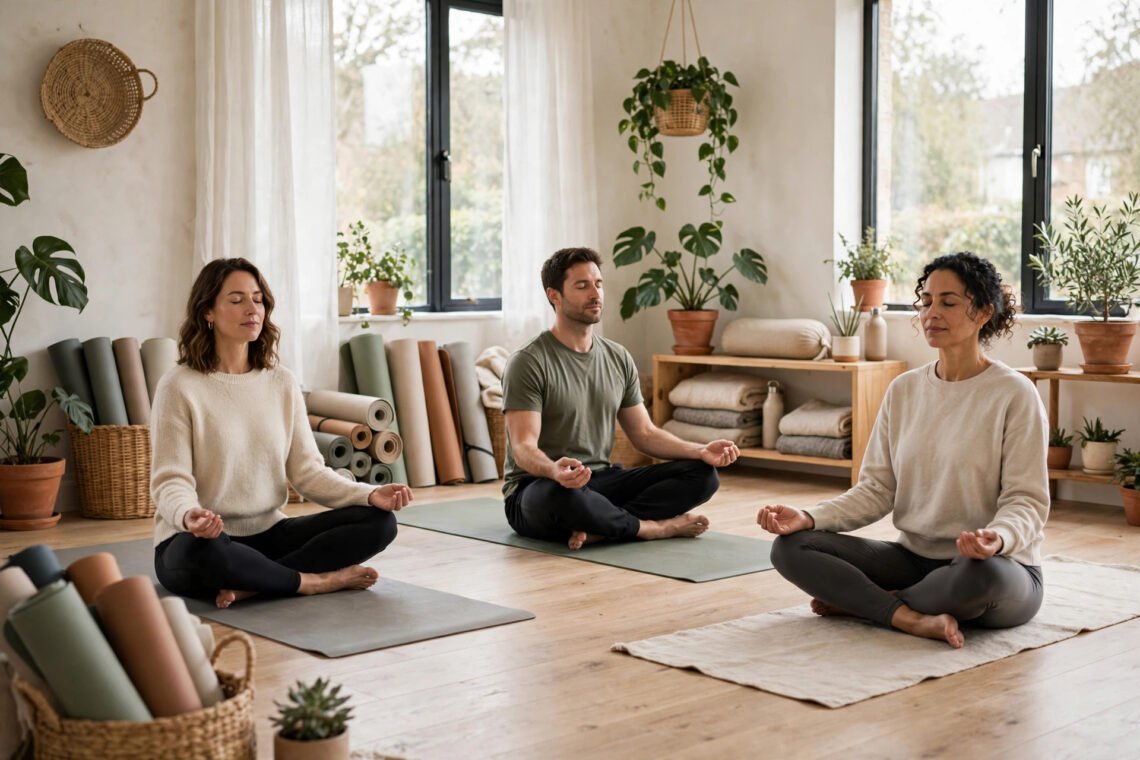
Arrive ten minutes early, introduce yourself as a beginner, and mention any injuries — teachers genuinely want to know. Eat lightly in the two hours before; a full Sunday roast and downward dog are natural enemies. Wear stretchy, fitted clothing (loose tops ride up in inversions) and bring water. Mats are usually available to borrow; buy your own (£20–£40) once you are going regularly, for hygiene and familiarity. Position yourself in the middle of the room — close enough to see the teacher, not so exposed as the front row. And the golden rule: rest whenever you need to. Child’s pose is always available, always respectable, and used by experienced practitioners too. Nobody is watching you; everyone is managing their own wobble. Gentle stretching for back comfort pairs naturally with a beginner yoga practice — many people start yoga specifically for the back benefits.
Yoga at home: the honest alternative
Studio classes are wonderful, but they are not the only path — and for some beginners, home practice is actually the better start. The case for home: zero intimidation, zero commute, sessions that fit around children and shift work, and cost (a £25 mat versus £15 per class). The case against: no teacher correcting your alignment, no community energy, and the sofa’s gravitational pull. The honest middle path that works for most people: one studio class a week for instruction and correction, supplemented by two short home sessions (20–30 minutes) following a beginner video series. Home-practice essentials: a non-slip mat, two blocks (£15 — they make half the poses accessible), a quiet corner, and a consistent time slot defended like an appointment. Safety rules for solo practice: never push into pain, skip inversions and deep backbends until a teacher has checked your form, and treat online classes labelled “beginner” sceptically — the range of difficulty is enormous. Many practitioners find that six months of this hybrid builds a stronger, more consistent practice than studio-only attendance, because the home sessions remove every excuse. The best yoga, as ever, is the yoga that happens.
Frequently Asked Questions
Do I need to be flexible to start yoga?
This is the great myth. Saying you are too stiff for yoga is like saying you are too dirty for a bath — stiffness is the reason to go, not a barrier. Teachers expect beginners to be inflexible; the poses are scalable to every body.
How often should a beginner practise?
Once or twice a week is plenty to start — enough to build familiarity without overwhelming recovery. Many practitioners settle at two to three weekly sessions long-term. Even one weekly class produces noticeable flexibility gains within two months.
Is yoga enough exercise on its own?
It depends on the style and your goals. Vigorous Vinyasa provides genuine cardiovascular and strength benefits; gentle Hatha is better viewed as flexibility, balance and stress-management training alongside other activity. The Sport England activity guidelines still recommend 150 minutes of moderate activity weekly — yoga can be part of that mix.
What if I cannot do a pose at all?
Then you do the version you can do, or you rest. Every pose has regressions — knees down, blocks under hands, shorter holds. A teacher who implies otherwise is a teacher to leave. Yoga is a practice, not a performance.
Choosing is the hardest part; after that, it is just showing up. Book the beginner Hatha or gentle flow class at the place nearest your home — proximity beats perfection, because the best yoga class is the one you actually attend. Bring water, arrive early, and take child’s pose whenever you like. In six weeks, the timetable that once looked like a foreign language will read like a menu — and you will have a favourite.