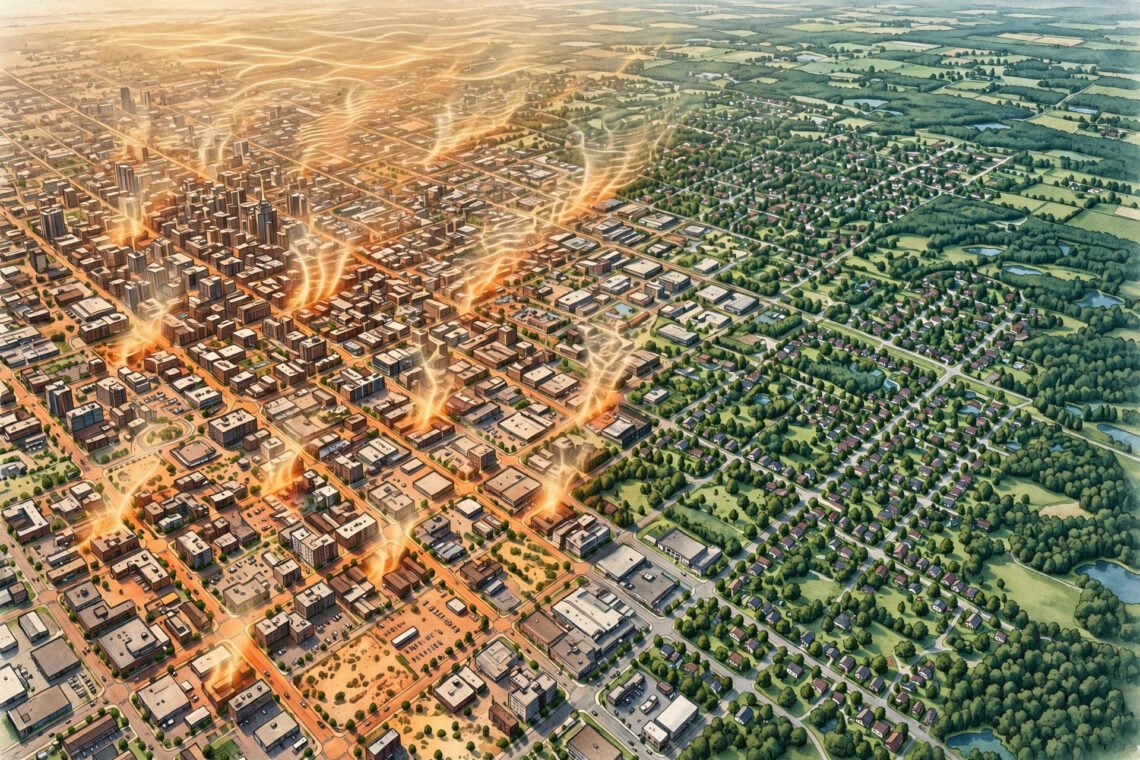
During a heatwave, central London can be 5–10°C hotter than the surrounding countryside — hot enough to seriously affect health, sleep quality, and even mortality rates. This is the urban heat island (UHI) effect: cities manufacture their own extra heat through the very materials they are built from. It is one of the most important — and least understood — climate phenomena affecting British life, and it is getting worse.
This guide explains urban heat islands from zero: what causes them, why they matter for health, and what cities and households can actually do about them.
What an urban heat island actually is
An urban heat island is a metropolitan area that is significantly warmer than its rural surroundings, especially at night. The effect is caused by several interacting factors:
- Dark, heat-absorbing surfaces. Asphalt, concrete and dark roofs absorb solar radiation all day and release it slowly at night. A city is essentially a giant heat battery.
- Lack of vegetation. Plants cool their surroundings through transpiration (evaporating water from leaves) and shade. Paved-over cities lose both.
- Waste heat. Cars, air conditioning units, industry and even human bodies pump heat into city air. Air conditioning is a cruel irony: it cools indoors by heating outdoors.
- Urban geometry. Tall buildings trap heat in “street canyons”, blocking the breezes that would carry it away, while also blocking night-time radiative cooling to the sky.
- Reduced wind and moisture. Cities are drier (rain runs off into drains rather than soaking in) and less breezy, removing two natural cooling mechanisms.
Why it matters: the health stakes
The UHI effect is not academic — it kills. The 2003 European heatwave caused an estimated 70,000 excess deaths, concentrated in cities; the UK’s 2022 heatwave (40.3°C recorded in Lincolnshire) caused thousands of excess deaths, with urban areas worst affected. Night-time heat is the critical factor: when cities stay hot overnight, bodies cannot recover from daytime heat stress. The vulnerable — elderly people, young children, those with heart conditions — are at greatest risk, and they are concentrated in the dense, paved, treeless neighbourhoods where the UHI effect is strongest.
There is a cruel inequality dimension: poorer urban areas are typically hotter — less tree cover, more concrete, fewer parks, homes harder to cool. Urban heat is a social justice issue as much as a climate one. The Met Office now issues heat-health alerts accounting for these urban effects.
What cities are doing about it
The solutions are well understood; the challenge is scale:
- Urban trees. The single most effective intervention — a mature street tree cools its surroundings by several degrees through shade and transpiration. Cities worldwide are planting millions; London’s urban forest is a genuine asset.
- Cool surfaces. Reflective “cool roofs” and lighter-coloured pavements absorb far less heat. Some cities are piloting reflective road coatings.
- Green infrastructure. Parks, green roofs, living walls, rain gardens and de-paving schemes — every square metre of vegetation helps, and corridors of green connect cooling across neighbourhoods.
- Water features. Fountains, ponds and even misting systems cool air through evaporation.
- Building design. Shading, ventilation, thermal mass and passive cooling reduce both indoor heat and the waste heat pumped outdoors.
What you can do at home
Plant things. Even a small garden helps — and a paved-over front garden converted back to planting is a genuine neighbourhood cooling contribution. Trees are best; even window boxes and climbing plants help. Our guide to the best plants for north-facing gardens suits the shaded urban plots where heat islands bite hardest.
Shade your home. External shading (awnings, shutters, deciduous planting on the sunny side) beats curtains — it stops heat entering rather than trapping it inside. Ventilate at night when the air finally cools, and close up during the day. Stay hydrated — see how much water to drink in summer — and check on elderly neighbours during heat-health alerts. The BBC Weather heat warnings now routinely flag urban heat risks.
Night-time heat: the silent killer
The most dangerous aspect of urban heat islands is not the headline daytime temperature — it is the failure to cool at night. Rural areas can drop 10–15°C overnight; dense urban cores might drop only 3–5°C. This matters because the human body recovers from heat stress during sleep: core temperature must fall for restorative sleep, and hot bedrooms prevent it. Consecutive hot nights compound the damage — mortality spikes correlate more strongly with sequences of hot nights than with single hot days. If you live in a city flat that stays warm overnight, night ventilation is critical: open windows on opposite sides once outside air cools (even slightly), use fans to create cross-draughts, and consider the bedroom the priority room — sleep quality is the health bottleneck.
The future: cities must cool by design
Urban heat islands will intensify as the climate warms — UK heatwaves are projected to become more frequent and severe. The cities that thrive will be those that design cooling in: planning rules requiring tree planting and green roofs on new developments, de-paving programmes reclaiming streets for planting, cool-surface standards for public realm works, and heat action plans protecting vulnerable residents during alerts. Individuals can push this forward: respond to planning consultations, support street-tree planting schemes, join community greening groups, and vote for the cooler city. The urban heat island is a design choice cities made accidentally over centuries — and a design choice they can remake deliberately.
Conclusion
Urban heat islands are cities cooking themselves: dark surfaces, missing vegetation, waste heat and trapped air combining to make urban nights dangerously hot. The solutions — trees, cool surfaces, green infrastructure, smarter buildings — are proven; they need scale and speed. And at household level, every planted square metre, every shaded window, every checked-on neighbour is a small pushback against the island. The city of the future must be cooler by design, not hotter by accident — and that redesign starts with understanding the island we have built — and acting on that understanding street by street.
Frequently Asked Questions
How much hotter are cities than countryside?
Typically 2–5°C on average, peaking at 5–10°C on calm, clear nights during heatwaves. London’s UHI is among the strongest in the UK due to its size and density. The night-time difference matters most for health.
Do urban heat islands affect winter too?
Yes, but benignly — cities are milder in winter, which slightly reduces heating demand. The problem is overwhelmingly a summer phenomenon, and it is intensifying as heatwaves become more frequent.
Can air conditioning solve it?
For individuals indoors, temporarily — but AC units dump waste heat outdoors, worsening the street-level problem, and they fail the most vulnerable who cannot afford them. Passive cooling (shading, ventilation, insulation) is the sustainable answer.
Which UK cities are worst affected?
London by far, due to size and density, followed by other large conurbations (Birmingham, Manchester, Leeds). But even smaller towns show measurable UHI effects — anywhere extensively paved runs hotter than surrounding fields.
Will planting one tree really make a difference?
Locally, yes — measurably. A mature tree cools its immediate surroundings by 2–8°C through shade and transpiration. Multiplied across streets and neighbourhoods, the effect is transformative. Urban forestry is the highest-return heat intervention available.