You have made budgets before. Detailed, colour-coded, full of good intentions — abandoned by the third week of January. The problem was never your willpower; it was the budget itself. Most budgets fail because they are built like diets: rigid, joyless, and designed for a fantasy version of your life. A budget that actually sticks is built differently — around your real behaviour, with room to breathe.
This guide answers how often to revisit your budget and — more importantly — how to build one you will still be following in December.
How often should you create (or redo) your budget?
Build it once, properly. Review it monthly. Rebuild it when life changes. That is the whole cadence. The monthly review takes 20–30 minutes: compare actual spending to plan, adjust categories that were unrealistic, and roll forward. The full rebuild happens only at life inflection points — new job, new home, new baby, new debt, or a income change of 10%+. Budgeting is not a monthly creative writing exercise; it is a system you maintain.
Weekly check-ins (five minutes, Sunday evening) help in the first two to three months while the habit forms — a quick glance at category balances prevents the month-end “where did it all go?” shock. After that, monthly is plenty for most households.
Why budgets fail: the four design flaws
- No fun money. A budget with zero discretionary spending is a diet with zero calories — technically perfect, humanly impossible. Every sustainable budget includes guilt-free personal spending.
- Fantasy numbers. Budgeting £200 for groceries when you have never spent less than £350 is not a plan; it is a wish. Base your first budget on actual past spending, then trim gradually.
- Too many categories. Forty micro-categories create forty opportunities to fail. Start with broad buckets (housing, food, transport, personal, savings) and subdivide only where a category is genuinely out of control.
- No irregular expenses. The budget-killer: car insurance, Christmas, holidays, annual subscriptions — all “surprises” that were entirely predictable. Budget 1/12 of each annual cost monthly into a separate pot.
The method that sticks: pay-yourself-first budgeting
Traditional budgeting allocates every pound then hopes savings survive. Pay-yourself-first reverses it: the moment income arrives, scheduled transfers move your savings target and bill money out of reach — then you live on the rest. Savings become the first bill, not the leftover. Automate it so willpower is never involved: standing orders on payday to savings, bills and the irregular-expenses pot. What remains in your current account is genuinely spendable, which removes the anxiety of “can I afford this?” from every small purchase.
MoneyHelper’s free budget planner is the UK’s best starting tool, while MoneySavingExpert’s budgeting guides offer complementary money-saving tactics — impartial, comprehensive, and it saves your plan. For a tech-assisted approach, our guide to AI help with budgeting and saving money covers the new generation of tools.
The 50/30/20 rule (adapted for Britain)
The classic framework: 50% needs, 30% wants, 20% savings. In high-cost areas of the UK (London, the South East), housing alone can break the 50% — adapt honestly rather than abandoning the framework: 60/20/20, or whatever reflects your reality while protecting the savings slice. The percentages are guidelines; the principle is non-negotiable: needs capped, wants bounded, savings first. If savings are currently zero, start at 5% — the habit matters more than the amount, and you will scale it as the system proves itself.
Making it stick: the behavioural tricks
Name your pots emotionally. “Holiday in Cornwall” beats “Savings Account 3” — labelled money gets spent as intended. Use separate accounts for bills, spending and savings; friction between pots prevents accidental raiding. Budget with your partner, not at them — money is a leading cause of relationship stress, and a shared monthly review (with wine, not warfare) aligns you both. Forgive the bad months — one overspent month does not break a budget; abandoning the review does. And keep simple everyday savings in the mix — small leaks sink budgets.
Sinking funds: the irregular-expense killer
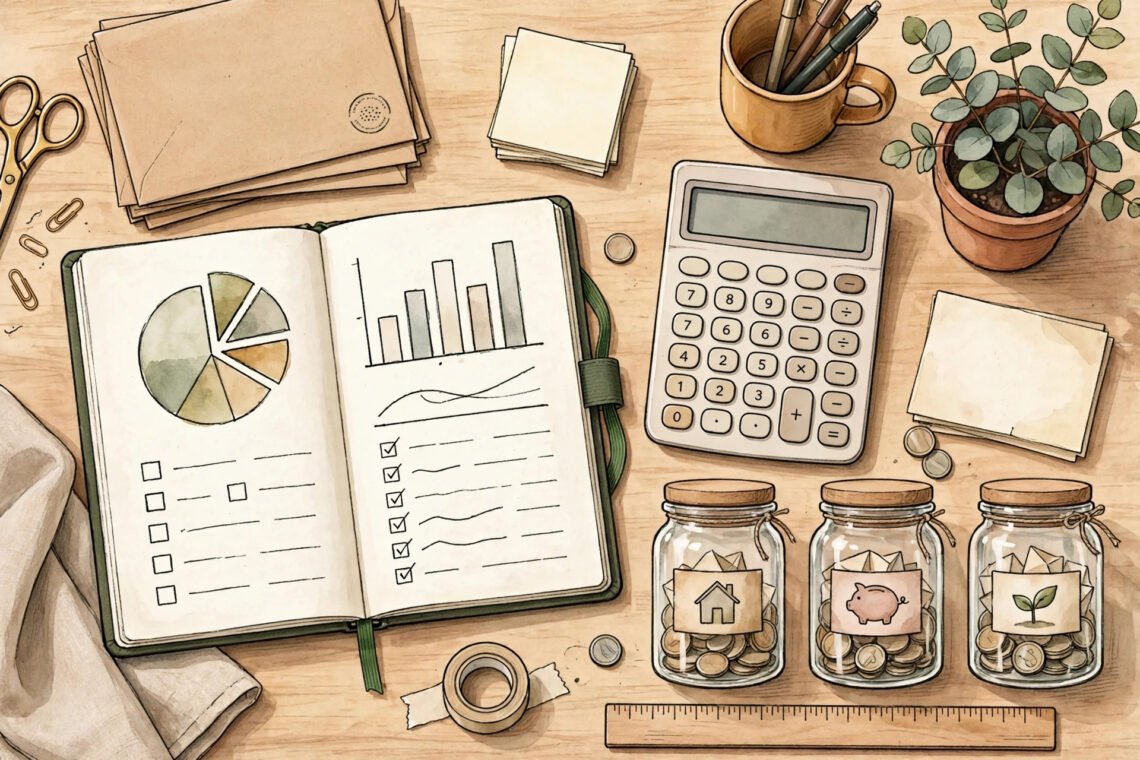
The most transformative budgeting concept for most households is the sinking fund: a separate pot (or pots) into which you pay 1/12 of every predictable irregular expense, monthly, automatically. Car insurance £600/year → £50/month. Christmas £600 → £50/month. Holiday £1,200 → £100/month. Annual subscriptions, car servicing, school uniforms — all of them. When the bill arrives, the money is sitting there waiting, and the “surprise” that used to detonate budgets becomes a non-event. Households that implement sinking funds report it as the single biggest reduction in money stress they have ever experienced — bigger than earning more.
Budgeting apps vs spreadsheets vs paper
The tool matters less than the habit, but choose deliberately. Spreadsheets (or MoneyHelper’s planner) are free, flexible and private — ideal for hands-on planners. Budgeting apps (Snoop, Plum, Moneybox, bank-native tools) automate categorisation and suit the time-poor, but check data-sharing terms. Paper (a notebook, an envelope system) suits tactile thinkers and the digitally wary — the physical act of allocating cash is powerfully real. Whichever you choose, commit for three months before judging; every system feels clunky in week one and natural by week twelve.
The emergency fund: budget’s bodyguard
No budget survives first contact with a broken boiler unless an emergency fund exists. Build £500–£1,000 first — before investing, before overpaying low-rate debt — kept in an instant-access account and touched only for genuine emergencies (not sales, not holidays). This fund is what stops life’s surprises from becoming credit card debt, which is what stops budgets from collapsing. It is the least exciting and most important money you will ever save.
Conclusion
A budget that sticks is reviewed monthly, rebuilt only when life changes, and designed for humans: pay yourself first, automate everything, include fun money, budget the irregular expenses, and forgive imperfection. Build it once on real numbers, maintain it in twenty minutes a month, and it will still be working in December — which is more than any January colour-coded fantasy ever managed.
Frequently Asked Questions
How often should I redo my budget from scratch?
Only when life changes materially — new job, move, baby, or ±10% income change. Otherwise, monthly 20-minute reviews with small adjustments keep the original budget accurate indefinitely. Constant rebuilding is procrastination disguised as planning.
What is the best budgeting method for beginners?
Pay-yourself-first with broad categories: automate savings and bills on payday, live on the rest, review monthly. It requires the least ongoing effort and survives imperfect discipline — which is why it sticks where detailed zero-based budgets collapse.
Should couples budget together or separately?
Together for shared expenses and goals, with separate personal “fun money” allowances neither partner questions. The shared review aligns you; the personal allowances prevent resentment. Full financial merging or full separation both create more problems than this hybrid.
How much should I save each month?
The classic target is 20% of take-home pay, but start where you are — 5% saved consistently beats 20% planned and abandoned. Increase by 1% every few months; you will not feel the increments, but the balance will show them.
What if my income is irregular?
Budget on your lowest typical month, treat above-average months as bonus savings, and keep a larger buffer (2–3 months of essentials) than salaried workers. Zero-based budgeting — allocating every pound of actual received income — suits irregular earners better than fixed-percentage rules.