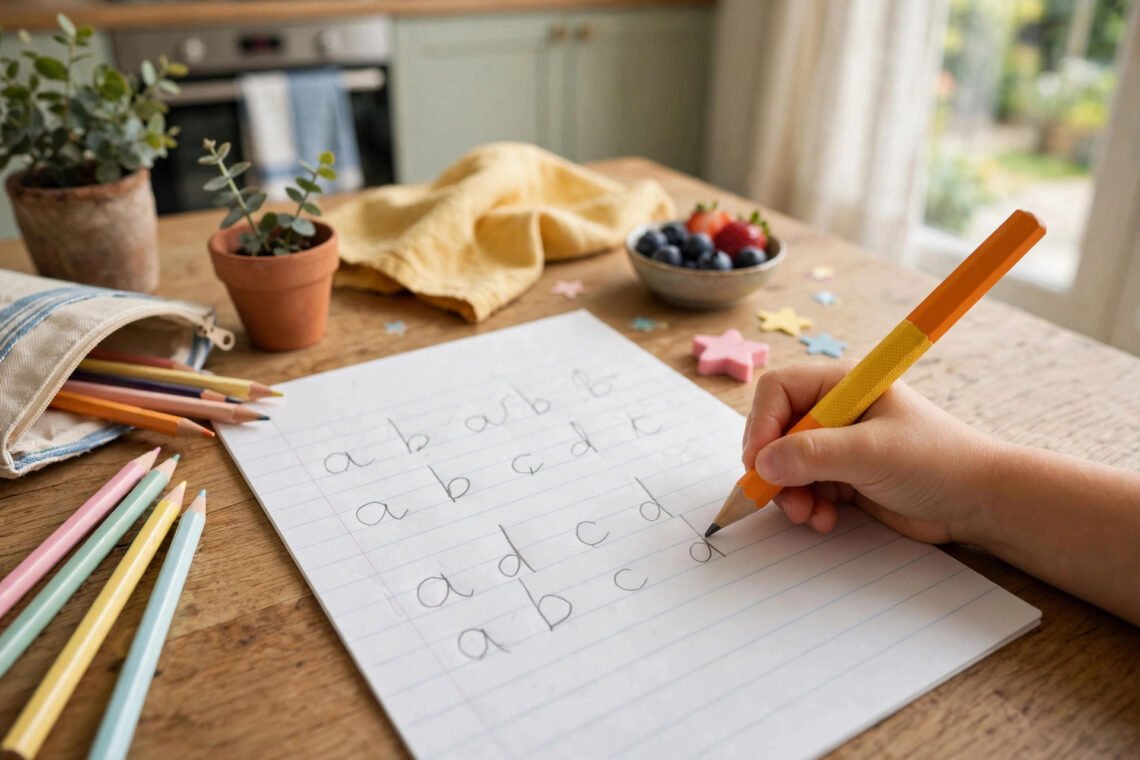
The birthday card your seven-year-old wrote says “HAPY BURTHDAY MUM” in letters that appear to have been arranged by a small earthquake. You laugh, you treasure it — and then the teacher mentions at parents’ evening that handwriting is “an area for development.” In an age of tablets and voice notes, does handwriting still matter? The evidence says yes, more than most parents realise — and the good news is that improving a primary-school child’s handwriting is one of the most fixable problems in education. This Lake District-tested guide (it works identically in Leeds or London) gives you the safe, pressure-free method.
Why handwriting still matters in 2026
It is tempting to declare handwriting obsolete. It is not. Research consistently links fluent handwriting to better spelling retention, stronger composition skills and — critically — exam performance: in timed written exams, children whose handwriting is slow or illegible literally cannot show what they know. The cognitive science is neat: forming letters by hand activates memory pathways that typing does not, which is why Department for Education guidance still treats handwriting as a foundational skill. None of this means drilling your child like a Victorian schoolmaster. It means treating handwriting as a physical skill — like swimming — that improves with short, playful, regular practice. Ten minutes a day beats an hour on Sunday, every time.
Start with the body, not the letters
Most handwriting problems are not handwriting problems — they are posture, grip and core-strength problems. Before a single letter is practised, check the foundations. Feet flat on the floor, chair at a height where elbows rest comfortably on the table, paper angled slightly (right-handers tilt it left, left-handers tilt it right). The grip: the dynamic tripod — thumb and index finger holding the pencil, middle finger supporting underneath. If your child grips with a full fist or the pencil points skyward, fix the grip first with short, fat triangular pencils or grip aids; no amount of letter practice overcomes a grip that fights the hand. Shoulder and core strength matter too — children who slump and tire quickly often need more climbing, crawling and playground time, not more worksheets. The NHS children’s health resources note that fine motor development follows gross motor development; the monkey bars are handwriting homework.
Letter formation: the order that actually works
Schools teach letter families, not alphabetical order — and you should too. Start with the “down and around” family (a, d, g, q, c, o), then the “down and flick” group (i, t, l, u, w), then the trickier ones (s, r, k, f, z). The key principles: correct starting points (almost every letter starts at the top), consistent size relative to the lines, and — the one parents miss — spacing between words, which is what makes writing readable even when individual letters wobble. Practise on lined paper with a clear x-height guide. One letter family per session, five minutes, then stop while it is still fun. And model it yourself: write shopping lists and notes in your best handwriting where your child can see. Children copy what is modelled far more than what is instructed.
Make it play, not work
The fastest way to kill handwriting progress is to make it feel like punishment. Alternatives that build the same muscles: writing secret messages in “invisible” lemon-juice ink, labelling everything in the house with sticky notes, keeping a holiday diary, writing the family’s takeaway order, forming letters in shaving foam on a tray (gloriously messy, brilliantly effective for formation practice). A child who writes voluntarily for fun will outpace a drilled child within months — motivation is the multiplier on every technique here.
When to worry (and when not to)
Normal development is gloriously uneven: mirror writing at five is normal, inconsistent sizing at seven is normal, hating writing at eight is extremely normal. Genuine red flags worth discussing with the teacher or GP: a child who cannot hold a pencil functionally by age six, extreme avoidance accompanied by distress, handwriting that markedly deteriorates, or difficulties far beyond peers despite practice. Dysgraphia — a specific learning difficulty affecting writing — is real and diagnosable, and early support transforms outcomes. But for the vast majority of children, “area for development” means exactly what it says: an area that develops, with a little consistent help. If reading is also part of the picture, building a family reading culture supports writing indirectly — children who read widely absorb sentence patterns and vocabulary that flow back into their written work.
When handwriting meets homework: supporting school writing
Handwriting practice pays off most visibly when it connects to real schoolwork — the spelling lists, the story writing, the science diagrams. The bridge: turn homework into handwriting practice without announcing it. Spelling words? Write each one three times in best handwriting rather than typing them. Story homework? First draft on paper, focusing on formation, before any typing. The trick is framing — “let’s make this look brilliant” beats “do your handwriting practice” every time. Talk to the teacher about what matters most: usually it is consistency and legibility under time pressure, not copperplate perfection. And protect the joy of writing itself: the child who keeps a diary, writes comics, or pens letters to grandparents is practising handwriting voluntarily — which, as every teacher knows, beats every worksheet. Keeping a daily journal is the grown-up version of the same principle, and starting a shared family journal — everyone writes one line a day — turns handwriting from a school task into a family ritual. The goal was never perfect letters; it was a child who can get thoughts onto paper fluently enough that the writing never blocks the thinking.
Frequently Asked Questions
Should I teach cursive or print?
Follow the school’s approach — consistency between home and school matters more than the style itself. Most UK primary schools now teach cursive (joined) formation from early on, as it improves writing flow once mastered.
How long should handwriting practice last?
Five to ten minutes daily for primary-age children. Short, frequent sessions build motor memory; long sessions build resentment. Stop while it is still going well.
Do left-handed children need different help?
Slightly: tilt the paper the other way (top-right corner higher), position the child to the left of right-handed siblings to avoid elbow collisions, and consider a left-handed nib or pen. Otherwise the same principles apply.
Are handwriting apps useful?
As supplements, modestly — tracing apps can help with formation practice. But they cannot replace pencil-on-paper: the friction, pressure and motor feedback of real writing are the point. Use apps as the game, paper as the training.
Your child’s handwriting will not transform in a week, and it does not need to. Fix the grip, practise one letter family at a time, keep it playful, and trust the compounding. By the next parents’ evening, the teacher’s comment will read differently — and the birthday cards, earthquakes and all, will still be the ones you keep forever. One final tip: celebrate the small wins visibly. When the teacher notes improvement, share it with your child; when a birthday card becomes legible, say so. Children persist at what gets noticed, and handwriting — like every skill — grows fastest in the warmth of genuine praise.