You are watching the World Championship at the Crucible, the crowd holds its breath, and the commentator says something about “a maximum” while everyone around you nods knowingly. You nod too. You have no idea what just happened. Snooker looks simple — coloured balls, a table, a man in a waistcoat — but its rules are a quiet labyrinth of fouls, re-spots and arcane rituals. This beginner’s guide explains snooker rules from scratch: the scoring, the turn structure, the fouls that confuse everyone, and enough vocabulary to survive the next frame night at the club without embarrassment.
The table, the balls, and the point of it all
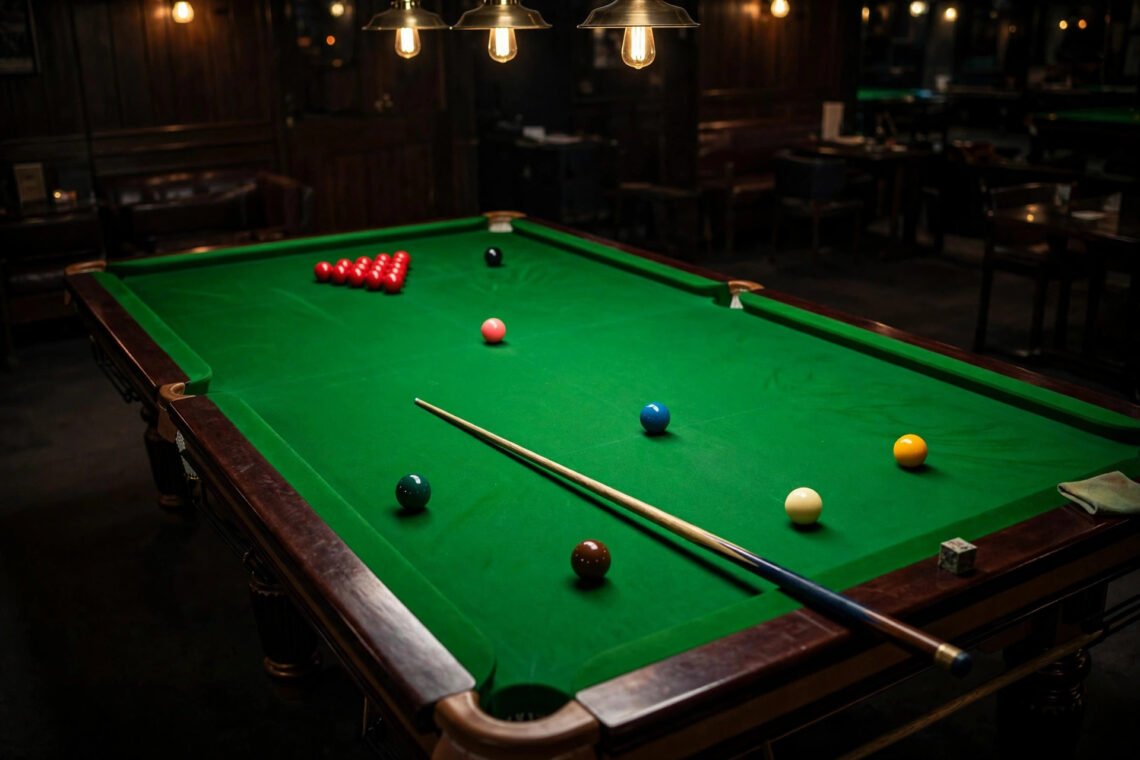
A snooker table is enormous — 12 feet by 6 feet, nearly twice the size of a pool table — covered in finely woven cloth. There are 22 balls: 15 reds worth 1 point each, and six colours — yellow (2), green (3), brown (4), blue (5), pink (6) and black (7). The white cue ball is the one you strike. The game’s objective is simple: score more points than your opponent across a set number of frames (a frame being one complete game, from break-off to the final black). Matches are played as best-of a number of frames — the World Championship final is best of 35, which is why it takes two days. At your local club, a friendly is usually best of 3 or 5. The BBC’s snooker coverage is an excellent free way to watch the rules in action once you know what to look for.
How a turn works: reds, colours, repeat
This is the core mechanic, and once it clicks, everything else follows. On your turn, you must first pot a red. After potting a red, you nominate a colour — any colour — and pot it; the colour is then re-spotted (returned to its spot on the table) and you go back to a red. Red, colour, red, colour — that alternating rhythm is the heartbeat of snooker. The sequence continues until all reds are gone (with a colour after the final red), and then the six colours are potted in ascending order — yellow through black — without re-spotting. Your turn ends when you miss, commit a foul, or clear the table. A single visit to the table where a player scores repeatedly is called a “break,” and the number — “a break of 68” — is the points scored in that visit.
The maximum: 147 and why it matters
A “maximum break” of 147 is snooker’s perfect game: 15 reds each followed by the black (15 × 8 = 120), then the six colours in order (27). Total: 147. It requires potting the black after every single red — no safety-first pinks allowed. Maximums are rare enough that they still make national news, and the Crucible crowd’s reaction when one is on will now make complete sense to you.
Fouls: the part that confuses everyone
A foul occurs when you hit the wrong ball first, pot the cue ball (called “in-off”), hit no ball at all, or touch a ball with anything but the cue tip. The penalty: your opponent gets points — between 4 and 7 depending on the balls involved — and, crucially, may ask you to play again from the resulting position or take the shot themselves. The famous “snooker” itself is not a foul but a tactic: leaving the cue ball positioned so your opponent cannot directly hit the required ball, forcing a difficult escape. Deliberate snookers are the chess of the game. Beginners should know one mercy rule: in casual club play, nobody enforces the full professional rulebook — but knowing the basics earns you instant respect.
Scoring quirks worth knowing
A few situations baffle newcomers. The free ball: if your opponent fouls and leaves you snookered, you may nominate any colour as a “free ball” — it counts as a red for one shot, worth 1 point, then is re-spotted. The re-spotted black: if a frame ends tied, the black is re-spotted and players draw lots for who plays it — sudden death, one ball, enormous tension. And conceding: when a player needs more points than remain on the table, they need “snookers” — they must force fouls to get back in it. When that becomes impossible, the frame is conceded with a handshake. Watching live sport without an expensive subscription is perfectly possible for snooker — much of the season’s biggest drama is on free-to-air television.
Your first visit to a snooker club
Now the practical bit. Most British towns have a snooker club with tables bookable by the hour — typically £6–£12 per hour per table, cues provided. Etiquette: wait until the neighbouring table’s player has finished their shot before walking past, keep conversation low during play, and never touch another player’s balls. Start with the short game: many clubs have smaller tables or you can simply play first-to-30-points rather than full frames while learning. Like any sport, taking care of your body when playing sport applies — hours leaning over a table punish the lower back, so stand and stretch between frames.
The amateur game: why you should play, not just watch
Understanding the rules is only half the pleasure — the other half is feeling, in your own hands, how absurdly difficult it is to do what the professionals make look easy. Your first visit to the table will be humbling: the cue ball will go everywhere except where intended, and a simple red into the middle pocket will feel like threading a needle. That is the point. Playing transforms watching — once you have tried to screw the cue ball back three feet, you will watch the professionals’ cue-ball control with genuine awe rather than polite interest. Most clubs offer off-peak table rates that make an evening’s play cheaper than the cinema, and many run beginner-friendly competitions — handicapped tournaments where newcomers genuinely compete. The social side is the hidden prize: snooker clubs are among the last truly mixed-age, mixed-background social spaces in many British towns, where a teenager and a retiree will happily spend three hours in friendly combat. World Snooker Tour’s official site lists the professional calendar if watching the masters at work appeals — but the real education, and the real joy, is at your local club, cue in hand, learning why that “easy” red was never easy at all.
Frequently Asked Questions
How long does a frame of snooker take?
Anything from 10 minutes to over an hour at professional level. Casual club frames between beginners typically run 20–40 minutes. This is why matches are measured in frames, not time.
What is the difference between snooker and pool?
Table size (snooker tables are much bigger), ball count (22 versus 16), and structure — snooker’s alternating red-colour sequence versus pool’s stripes-and-solids or 9-ball rotation. The cueing skills transfer, but they are distinct games.
Can I play snooker left-handed or with any special equipment?
Absolutely — many top players switch hands for awkward shots. Beginners need nothing beyond the club’s house cues; a personal cue is a purchase for when you are hooked, typically £50–£150 for a decent starter.
Why do players keep chalking the cue?
Chalk increases friction between the cue tip and the ball, preventing miscues (the cue sliding off the ball). It is ritual as much as science at the top level — but the science is real.
That is genuinely most of it: reds and colours alternating, fouls punished, the table cleared in order. Next time the Crucible crowd gasps, you will know whether it was the maximum attempt, the impossible snooker escape, or the re-spotted black — and the nodding will be real. The rest, as every club player will tell you, you learn with a cue in your hand.