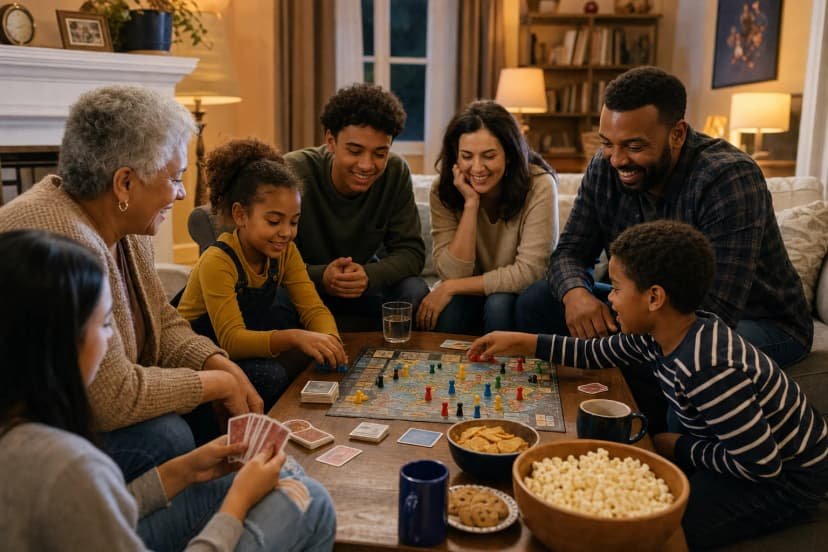
There’s a moment in every family games night when someone flips the board, someone else is accused of cheating, and the whole thing descends into beautiful chaos. That’s not a failed games night — that’s a successful one. Choosing the best board games for a family games night is about finding games that create those moments: easy to learn, quick to play, and fun even when you’re losing.
The golden rule: the best family game is one you’ll actually get to the table. A brilliant 3-hour epic that never gets played loses to a 20-minute card game you play weekly. With that in mind, here are the games that earn their shelf space.
The best board games for a family games night
For all ages (kids 6+)
- Ticket to Ride — Build train routes across the map. Simple enough for a 7-year-old, strategic enough for adults. The gateway game that starts board game obsessions. (£30–£35)
- Codenames — A word-guessing team game that’s part game, part mind-reading your family. Brilliant with 4+ players, hilarious with grandparents. (£12–£15)
- Dobble — Spot the matching symbol, shout it out. Five minutes to learn, endlessly replayable, and kids are often faster than adults. (£10)
- King of Tokyo — Giant monsters punching each other in Tokyo. Dice, cards, mayhem. Kids adore it; adults get surprisingly competitive. (£25)
- Sushi Go! — Cute card-drafting game about collecting sushi sets. Takes 15 minutes, teaches strategy without anyone noticing. (£10)
For families with teens and adults
- Catan — The modern classic: trade, build, settle. Every family should play Catan at least once. Warning: it ruins friendships in the best way. (£35)
- Azul — Beautiful tile-laying game that’s deceptively strategic. Looks like art, plays like chess with pretty pieces. (£30)
- Wavelength — A party game about reading minds: is a hot dog a sandwich? Teams debate, everyone shouts. The conversations it sparks are the real game. (£25)
- The Crew — A cooperative trick-taking card game (yes, really) that’s weirdly thrilling. Great for families who like working together rather than against each other. (£12)
- Just One — Cooperative word-guessing party game. Simple, funny, and over in 20 minutes. (£15)
The classics (still unbeatable)
- Articulate! — Describe words without saying them. The family shouting game. Timeless.
- Cluedo — Murder mystery deduction. Kids love the detective work; the nostalgia is free.
- Scrabble — The thinking family’s game. Play with a dictionary nearby and no hard feelings.
- Monopoly — Divisive, long, but undeniably a rite of passage. Use the speed rules (no auctions dragging on) to keep it under 90 minutes.
Running a games night that actually happens
The games matter less than the habit. A few things that make family games night stick:
- Same night weekly. Friday is the classic. Protect it like an appointment.
- Let the kids choose (in rotation). A child who picked the game is invested in the game.
- Snacks. Non-negotiable. Finger food that doesn’t grease up the cards — my snack ideas work for game tables too.
- Keep it to 60–90 minutes. End while everyone’s still having fun, not after.
- No phones at the table. The whole point is being present together.
Where to buy without overpaying
Board games are often cheapest online — check prices across Amazon, Zatu Games (a UK specialist with excellent prices) and your local independent game shop (which will also demo games and give recommendations). Charity shops are goldmines for classic games at £2–£3 — just check all the pieces are there. And many libraries now lend board games, which is the ultimate try-before-you-buy.
Games for two players (couples’ night)
Most “family” games need 3+. For couples or pairs, these are the standouts:
- Patchwork — A Tetris-like quilting duel. Simple, beautiful, surprisingly cutthroat. The best 2-player game ever made, in many people’s opinion. (£20)
- 7 Wonders Duel — The 2-player version of the civilization-building classic. Draft cards, build wonders, outmanoeuvre your partner. (£25)
- Jaipur — Fast, elegant trading game. 30 minutes, endlessly replayable, and it fits in a handbag. (£15)
- Schotten Totten — Card-based tug of war. Tiny box, huge depth. (£12)
- Codenames Duet — The cooperative 2-player version of Codenames. Work together instead of competing — better for date night.
Travel games (planes, trains and holidays)
- Love Letter — 16 cards, 20 minutes, infinite replayability. The ultimate travel game — it fits in a pocket.
- Hanabi — Cooperative card game where you can’t see your own cards. Brilliant, infuriating, tiny.
- The Mind — Play numbered cards in order without communicating. Sounds impossible, feels like telepathy when it works. Almost no components.
- Bananagrams — Scrabble without the board. Fast, portable, and the banana-shaped pouch is iconic.
Building the collection (without going overboard)
Start with 3–4 games covering different moods: one party game (Wavelength), one strategy game (Ticket to Ride or Catan), one quick card game (Sushi Go or Love Letter), and one cooperative game (The Crew or Just One). That’s a complete games-night arsenal for under £80. Add one or two a year — birthdays and Christmas are the natural moments.
And the charity-shop strategy deserves emphasis: board games are among the best charity shop finds — often unplayed, usually £2–£3. Check the pieces (count cards, check for the rulebook), and you’ve got a £30 game for the price of a coffee. Car boot sales in summer are equally fruitful.
For more family night ideas beyond the table, my guides to planning a movie night and organising a quiz night at home keep the tradition going. The best board games for a family games night aren’t the most expensive or complex — they’re the ones that get everyone round the table, laughing, week after week.
Board games for different group sizes
Just two players? Skip the big-box games designed for six — they fall flat with two. Look for games built for pairs: Patchwork (quilting-themed, deceptively strategic), 7 Wonders Duel, or the two-player version of Codenames. Card games like Jaipur are cheap and endlessly replayable.
Big groups of six or more? This is party-game territory. Wavelength gets everyone shouting, Just One is cooperative and takes five minutes to learn, and Telestrations (telephone meets drawing) produces the kind of laughter that hurts. Avoid anything with long turns — with eight people, a five-minute turn means 35 minutes of waiting.
Mixed ages? Cooperative games remove the sting of losing for younger players — Forbidden Island and Outfoxed! let everyone win or lose together. And dexterity games (Jenga, Rhino Hero) level the playing field completely: a six-year-old can beat a grandparent, which is exactly as it should be.