It is the most boring two minutes in motoring — crouching at a petrol station air pump — and also one of the most profitable. Under-inflated tyres can increase your fuel consumption by 3–5%, wear out thousands of miles early, and lengthen braking distances dangerously. Yet surveys suggest nearly half of British drivers rarely or never check their pressures. Understanding the link between tyre pressure and fuel economy is free money hiding in plain sight.
The physics is simple: a soft tyre has a bigger contact patch with the road, which means more rolling resistance — your engine works harder to push the car along, burning more fuel. The effect is linear and measurable: roughly 1% extra fuel for every 3–4 PSI below the recommended pressure. Run 8 PSI low (common for neglected tyres) and you are burning 2–3% more fuel every single mile, while the tyre shoulders wear prematurely and handling dulls.
Finding your correct pressures
Your car’s correct pressures are not a matter of opinion — they are printed on a sticker inside the driver’s door jamb, inside the fuel filler flap, or in the owner’s manual. They are given in PSI or bar, usually with two figures: normal load and full load (or “ECO” pressures on some cars). Use the figure matching how you drive; the full-load figure for a car full of holiday luggage is typically 3–5 PSI higher.
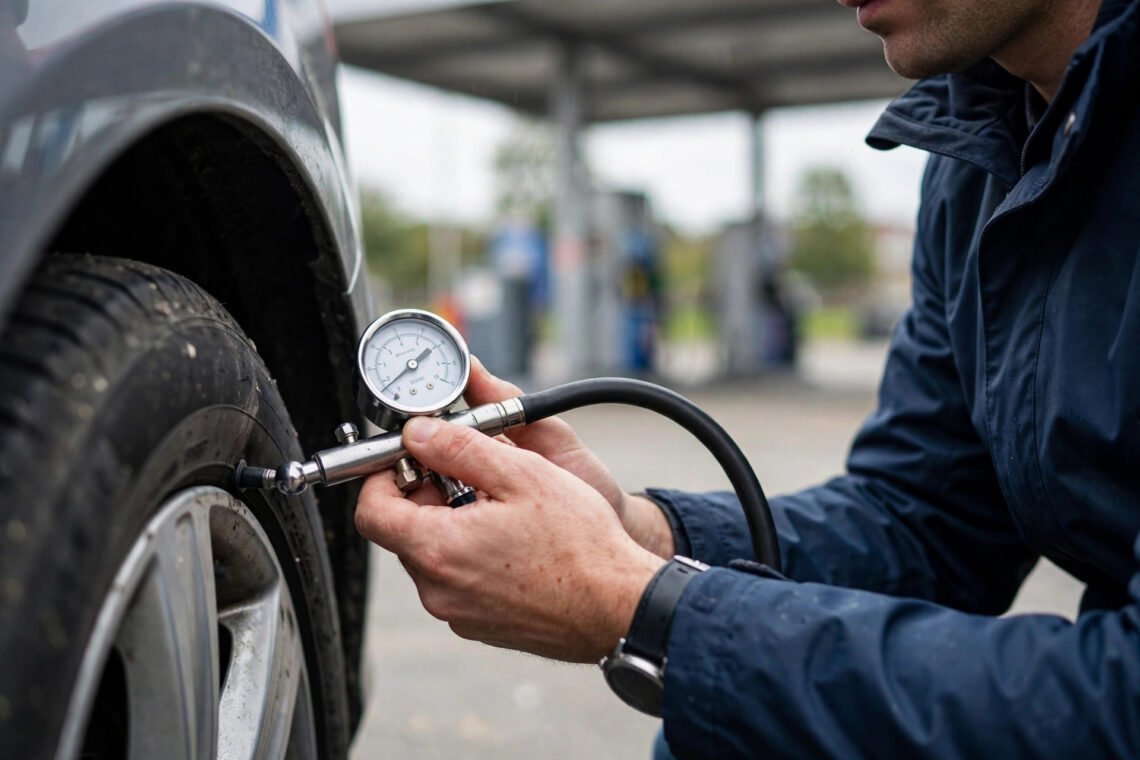
Check pressures when tyres are cold — before driving or within a couple of miles — because driving heats the air and raises the reading. A £10–£15 digital gauge kept in the glovebox is more accurate than most petrol-station pumps, though those are fine for routine top-ups. Check monthly and before any long journey; a planned road trip around Scotland deserves correctly inflated tyres from mile one.
Do not over-inflate either
More is not better. Over-inflated tyres shrink the contact patch, reducing grip — particularly in the wet — and wear the centre of the tread while making the ride harsh. Some drivers add 2–3 PSI above recommended for motorway economy, which is a defensible trade-off on long runs, but running 10 PSI over is dangerous, not thrifty. Stick near the manufacturer’s figure; they engineered it.
The real money: what correct pressures save
Do the maths for a typical car doing 10,000 miles a year at 40 mpg. Fuel costs roughly £1,700 a year at current prices. Running 6 PSI low wastes about 2% — £34 a year — which sounds trivial until you add premature tyre wear: a set of tyres worn out 5,000 miles early costs you £100+ in accelerated replacement. Combined, neglected pressures easily cost £100–£150 a year, for two minutes a month. It is the highest hourly rate in car maintenance.
The safety dividend matters more. Under-inflated tyres overheat at motorway speeds — the leading cause of blowouts — and increase braking distances measurably. Correctly inflated tyres also handle predictably in emergency manoeuvres. The AA lists tyre checks among its essential pre-journey routines for good reason. The RAC similarly calls monthly pressure checks the single most cost-effective maintenance task a driver can do. If you are heading abroad, the same discipline applies — see what to know before driving in France for the first time.
Beyond pressure: the full economy picture
Pressure is the headline, but related factors multiply the effect. Wheel alignment: misaligned wheels drag sideways, wasting fuel and chewing tyres — get it checked if the car pulls or tyres wear unevenly (£30–£60). Tyre choice: EU tyre labels rate fuel efficiency from A to E; moving from E to B-rated tyres can save 5–7% on fuel, worth specifying at replacement time. Weight: every 50kg of clutter costs ~1% in fuel — empty the boot. Roof boxes: remove them when not in use; they can add 10–20% to consumption at motorway speeds.
Driving style still dominates everything: smooth acceleration, anticipating traffic to avoid braking, and sticking to 70 mph rather than 80 (which uses ~15–20% more fuel) dwarf tyre effects. But tyres are the foundation — no driving technique compensates for soft rubber.
A two-minute monthly routine
Keep a digital gauge and a note of your pressures in the glovebox. Once a month, cold tyres, check all four plus a glance at tread depth (legal minimum 1.6mm; replace at 3mm for meaningful wet grip) and a visual check for cuts, bulges or embedded nails. Top up at the petrol station or with a £25 12V compressor at home. Two minutes, monthly, £100+ a year saved — and measurably safer journeys.
Seasonal pressure changes
Tyre pressure drops about 1 PSI for every 5–6°C of temperature fall — so a car correctly inflated in September can be 4–5 PSI low by January without losing a molecule of air. British autumn is the danger season: drivers set pressures in summer warmth and never recheck as temperatures slide. Check pressures as the clocks go back and again in the depths of winter. Conversely, a tyre set correctly on a frosty morning will read higher after motorway driving — that is heat, not over-inflation, and you should never bleed air from a hot tyre. The discipline is simple: cold checks, seasonal rechecks, and an extra check before any winter long-distance driving when under-inflation’s safety penalty (longer braking on cold wet roads) is at its worst.
Nitrogen inflation: worth it?
Some tyre shops offer nitrogen fills (£5–£10 per tyre) claiming slower pressure loss and more stable temperatures. The science is real but marginal — nitrogen molecules are slightly larger and less permeable than oxygen, so pressure drops a little slower. For ordinary drivers who check monthly anyway, the benefit is negligible; for the chronically neglectful, it buys a small margin. Regular air plus regular checks beats nitrogen plus neglect every time.
TPMS: your car’s built-in watchdog
Most cars built after 2014 have Tyre Pressure Monitoring Systems (TPMS) — dashboard warnings when a tyre drops significantly. Useful, but limited: TPMS typically only alerts at 20–25% under-inflation, long after fuel waste and wear have begun, and it cannot tell you the actual pressure or which small top-up is needed. Treat TPMS as an emergency alarm, not a maintenance system. The manual monthly check remains essential — and when the TPMS light appears, check all four tyres immediately rather than assuming which one, since slow punctures often trigger it before the tyre looks visibly soft.
Frequently Asked Questions
How much fuel do under-inflated tyres waste?
Roughly 1% extra fuel consumption for every 3–4 PSI below the recommended pressure. Running 8 PSI low — common for neglected tyres — wastes 2–3% of fuel, plus accelerates tyre wear significantly.
Where do I find the correct tyre pressure for my car?
On the sticker inside the driver’s door jamb, inside the fuel filler flap, or in the owner’s manual. Use the figure for your typical load, and always check when tyres are cold.
How often should I check tyre pressure?
At least monthly, and before any long journey. Tyres naturally lose 1–2 PSI per month, and temperature changes with the seasons affect readings too.
Is it bad to over-inflate tyres for better economy?
Yes, beyond a couple of PSI. Over-inflation reduces grip (especially in the wet), wears the centre of the tread and harshens the ride. Stick close to the manufacturer’s recommended figure.
Do tyre efficiency ratings really matter?
Yes. EU tyre labels grade fuel efficiency from A to E, and moving from E-rated to B-rated tyres can improve fuel economy by 5–7% — worth considering when you replace tyres.