You can swim — you learned as a child, you manage a few lengths on holiday — but your technique has not evolved since you were twelve. You thrash, you tire after two lengths, your shoulders ache, and the serene swimmers in the next lane glide past like seals while you flounder. Improving your swimming technique as an adult is one of the highest-return fitness investments available: swimming is low-impact, full-body, and kind to joints — but only if your technique stops fighting the water.
This guide covers how to genuinely improve: the fundamentals that matter most, how often to train, drills that fix common faults, and how to structure your pool time.
Why technique matters more than fitness in swimming
Swimming is the most technique-dominated mainstream sport. On land, fitness can brute-force poor form; in water — 800 times denser than air — drag punishes inefficiency exponentially. A fit beginner thrashing with poor technique will be exhausted in 100 metres; a moderately fit swimmer with good technique cruises for an hour. This is liberating: improvement comes from skill, not suffering. The water rewards smoothness and punishes effort — the opposite of running, and the reason so many runners-turned-swimmers initially hate the pool.
How often should you swim to improve?
Twice a week minimum, three times ideally. Swimming is a feel-based skill — “feel for the water” degrades between sessions, and once-weekly swimming is mostly relearning what you forgot. Two 30–45 minute sessions weekly produce steady improvement; three sessions accelerate it markedly. Sessions beyond 60 minutes have diminishing returns for technique work — quality beats quantity. Expect noticeable improvement in 6–8 weeks of consistent twice-weekly swimming, and transformation in 4–6 months. Patience is mandatory; water feel develops on its own schedule.
Motivation through the plateau months matters — our guide to staying motivated to exercise through winter applies perfectly to dark-morning pool sessions.
The fundamentals, in order of importance
1. Body position: be a torpedo, not a barge
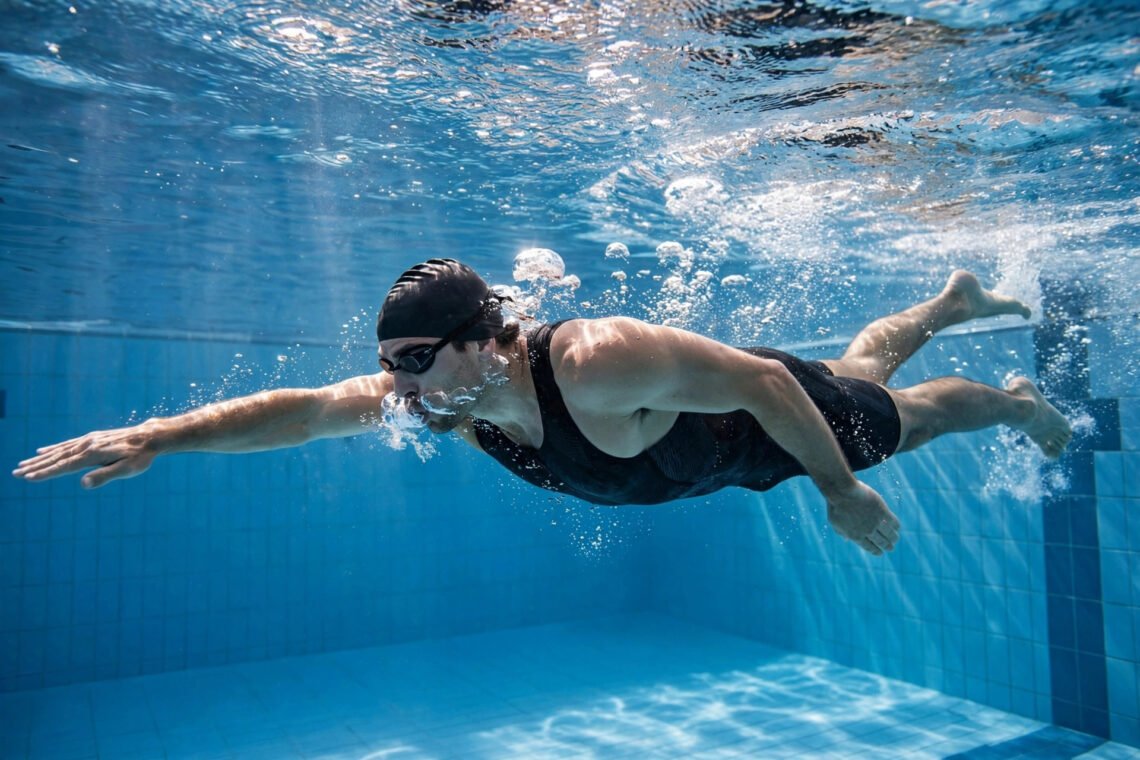
The number one fault: swimming “uphill” with legs dragging low, creating enormous drag. Fix it by pressing your chest down (counterintuitively, this lifts the hips), looking at the pool floor (not forward), and keeping a gentle, continuous kick from the hips — not the knees. Think long and level.
2. Breathing: the real beginner barrier
Breathlessness in beginners is rarely fitness — it is not exhaling underwater. Holding your breath then gasping creates panic and CO2 buildup. The fix: breathe out continuously through nose/mouth while your face is down, so inhalation is a quick sip during the breath stroke. Bilateral breathing (every three strokes) balances your stroke; start with every two if needed and progress.
3. The catch and pull: hold the water
Fast arms do nothing if the hands slip through the water. Think of each stroke as anchoring your hand and pulling your body past it — high elbow, fingertips down, forearm vertical early. The classic drill: swim with fists closed (forces forearm engagement), then open hands and feel the difference.
4. Rotation: swim on your sides, not flat
Good freestyle rotates along the body’s long axis — you swim through the water like a rotisserie, not a plank. Rotation engages back and core muscles (stronger than shoulders alone) and makes breathing dramatically easier.
Drills that actually fix things
- Catch-up drill: one hand waits for the other before stroking — exaggerates rotation and length. Fixes rushed, short strokes.
- 6-1-6 / 6-3-6: kick on your side for six counts, take 1–3 strokes, repeat on the other side. The single best drill for body position and rotation.
- Fist swimming: swim with closed fists to develop forearm feel for the water.
- Single-arm freestyle: isolates each arm’s pull; the non-working arm stays at your side. Brutally revealing of asymmetries.
- Slow swimming: swim a length as slowly as possible without stopping. Balance and efficiency distilled.
Dedicate the first 10–15 minutes of every session to drills, then swim. Drills without mileage do not stick; mileage without drills ingrains faults.
Getting help: lessons are worth it
A single one-to-one lesson (£25–£40 at most UK pools) with video feedback can identify in ten minutes what months of solo swimming will not reveal — you cannot feel what you cannot see. Many pools offer adult improver courses; Swim England lists qualified teachers and programmes nationwide. Even one lesson per quarter, combined with drill-focused solo sessions, transforms progress. Swimming’s joint-friendly nature makes it ideal long-term exercise — see the benefits of swimming for joint pain — and the NHS highlights swimming among the best exercises for overall health.
Open water: the next frontier
Once pool technique is solid, many swimmers discover open water — lakes, rivers and sea swims, now booming across the UK. The skills transfer, with additions: sighting (lifting eyes to navigate), bilateral comfort (chop comes from both sides), and cold-water acclimatisation (enter gradually, never swim alone). Wetsuits add buoyancy that flatters technique but changes body position — practise in yours before event day. Organised venues with lifeguards and marked courses make the transition safe; wild swimming demands respect for currents, cold and water quality. It is the most liberating extension of pool fitness available.
Fuelling and recovery for swimmers
Swimming’s appetite effect is legendary — the post-pool hunger is real and physiological (cold water and energy expenditure combine). Eat a proper meal within an hour rather than grazing all evening; protein plus complex carbohydrates supports the technique adaptations your nervous system is making. Hydrate despite being in water — you sweat while swimming, and dehydration impairs coordination exactly when you need it. And protect your shoulders: technique flaws load the shoulder joint badly, so any persistent pain is a signal to get coached feedback, not to push through. Longevity in swimming comes from efficiency, not endurance.
Conclusion
Improving adult swimming technique is a skill project, not a fitness project: swim 2–3 times weekly, dedicate the first fifteen minutes to drills, fix body position first (press the chest, level the hips), learn to exhale underwater, and invest in occasional coached feedback. The water stops being an adversary and becomes what it should be — the lowest-impact, most meditative full-body workout available. The seals in the next lane started exactly where you are.
Frequently Asked Questions
How long does it take to improve swimming technique as an adult?
Noticeable improvement in 6–8 weeks of twice-weekly sessions; substantial transformation in 4–6 months. “Feel for the water” develops gradually — consistency matters far more than session length or intensity.
Is swimming good exercise for weight loss?
Yes — a vigorous 30-minute swim burns 200–400 calories with essentially zero joint impact. But swimming also stimulates appetite significantly; pair it with sensible nutrition rather than relying on the pool alone.
Why do I get out of breath so quickly when swimming?
Almost always breath control, not fitness: holding your breath underwater then gasping. Exhale continuously while your face is down, and the panic-breathlessness vanishes within a session or two of practice.
Should I learn other strokes or just freestyle?
Master freestyle first — it is the foundation. Then add backstroke (excellent for balance and shoulder health) and breaststroke (useful, social, and the survival stroke). Butterfly is optional unless you enjoy suffering beautifully.
What equipment do I actually need?
Goggles that fit (the single essential), a pull buoy and kickboard for drills (most pools lend them), and optionally short fins for technique work. Skip the paddles until your technique is solid — they amplify both good and bad habits.