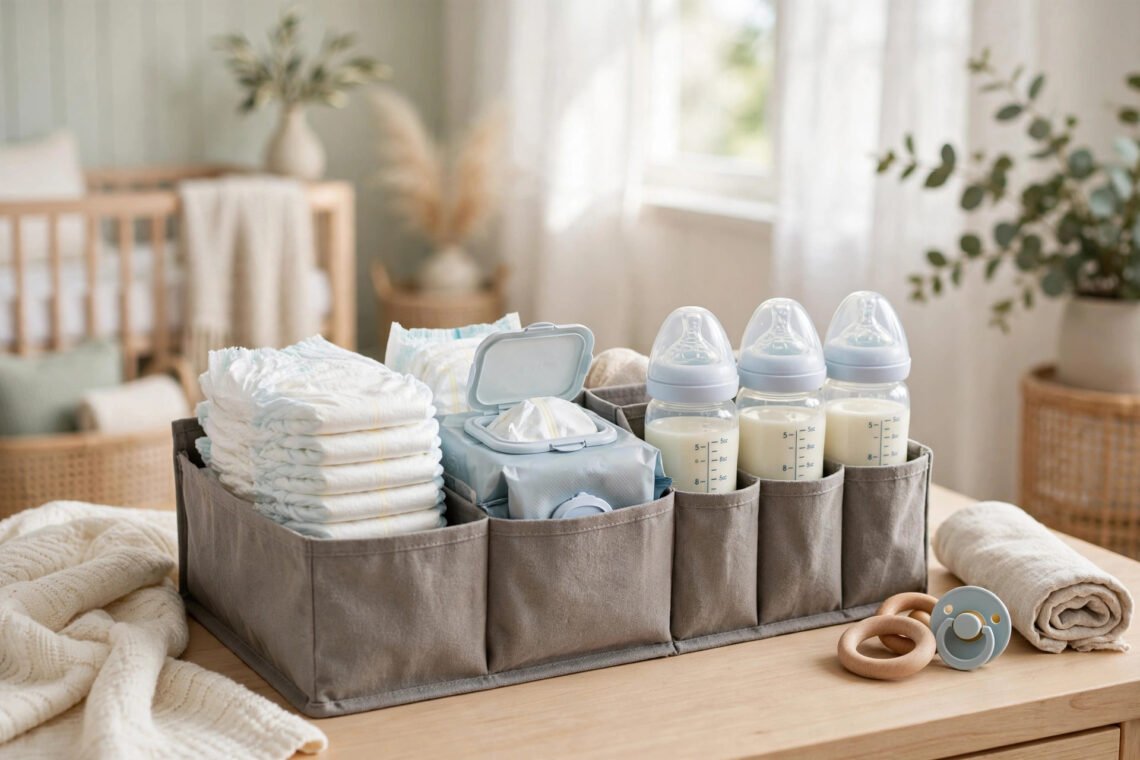
Quick Answer: Pack a diaper caddy with diapers (6–10 for newborns), wipes, nappy cream, a changing mat, spare vests and sleepsuits, muslins, hand sanitiser, and a couple of nappy bags — arranged so the most-used items sit in the centre compartments. Restock it every evening so it is always grab-and-go ready. The whole point of a caddy is that everything lives in one portable spot instead of scattered across the house.
A diaper caddy — a portable organiser with divided compartments — is one of those unglamorous baby buys that earns its keep daily. Instead of trekking to the nursery for every change, you keep a stocked station wherever you are: the living room, your bedside, or the car. Here is exactly what to put in it and how to organise it.
What You Will Need
Before packing, gather your supplies. For a newborn caddy:
- Diapers: 6–10 newborn nappies (you will use 8–12 a day in the early weeks)
- Wipes: One full pack, plus a travel pack for top-ups
- Nappy cream: Barrier cream for every change (the [NHS](https://www.nhs.uk/) has guidance on treating nappy rash)
- Changing mat: A foldable travel mat — many caddies include one
- Spare clothes: 2 vests and 1–2 sleepsuits in the current size
- Muslins: 2–3 for spills and under baby’s head
- Nappy bags: A roll of scented disposal bags
- Hand sanitiser: For changes away from a sink
- A spare top for you: Newborn explosions respect no one
For babies past 3 months, drop to 4–6 nappies and add a small toy or teether for distraction during changes.
Step-by-Step: Packing Your Caddy
Step 1: Start with the bulky items
File diapers upright in the largest compartment, spines out — you can see how many are left and grab one single-handed. Tuck the changing mat along one side or underneath everything.
Step 2: Centre the high-frequency items
Wipes, nappy cream and nappy bags go in the central compartments — the three things you reach for at every change. Keep the wipes pack open and ready, not sealed in its wrapper.
Step 3: Add clothes and muslins
Roll spare vests, sleepsuits and muslins into a side compartment. Rolling saves space and lets you pull one item without unfolding the stack.
Step 4: Fill the gaps with small essentials
Hand sanitiser, a dummy and clip if you use one, and a spare hair tie for you. These live in the small outer pockets most caddies have.
Step 5: Do the one-handed test
Try to find wipes, a nappy and cream one-handed while holding a (real or imaginary) baby in the other. If you fumble, rearrange — you will do every change one-handed, often in the dark.
Newborn vs Older Baby: What Changes
| Item | Newborn (0–3 months) | Older baby (3–12 months) |
|—|—|—|
| Nappies | 8–10 | 4–6 |
| Wipes vs cotton wool | Cotton wool + water for first weeks | Wipes |
| Spare outfits | 2 vests + 2 sleepsuits | 1 vest + 1 outfit |
| Extras | Dummy, nipple cream for mum | Snacks, sippy cup, toy/teether |
| Creams | Barrier cream always | Only if redness appears |
As your baby grows, the caddy evolves from a nappy-change station into a general outing kit. Many parents keep using it well into toddlerhood.
The Night-Time Caddy
Consider a second, minimal caddy for your bedside: 3–4 nappies, wipes, cream, one spare vest and a dim night light. Night changes should be boring — low light, no talking — so the baby learns night is for sleep.
Packing a Travel / Car Version
Keep a slimmed-down caddy in the car or pram basket:
- 3–4 nappies in the next size up
- Travel wipes pack
- 1 spare outfit in a sealed bag (the bag doubles as a laundry bag for soiled clothes)
- 2 nappy bags
- Foldable changing mat
Restock it the moment you get home, not “later” — later is how you end up improvising with a petrol station paper towel. The [NCT](https://www.nct.org.uk/) publishes checklists for travelling with a baby if you want a second opinion on your kit.
Organisation Tips That Actually Help
- Restock every evening: count nappies, top up wipes, replace used clothes. A caddy with three nappies left is a trap.
- Size up before you think you need to. Move to the next nappy size when red marks appear or leaks increase.
- Decant creams into travel tubes to save space.
- Keep medicines separate from nappy supplies where older siblings cannot reach.
- One caddy per floor if you have stairs.
Common Mistakes to Avoid
- Overpacking toys and gadgets — the caddy is a workstation, not a toy box.
- Forgetting your own supplies — a water bottle and snack for you belong in there during the early weeks.
- Leaving wipes to dry out — reseal the pack or use a refillable dispenser.
- No nappy bags — the single most-forgotten item, and the one you miss most in someone else’s house.
Frequently Asked Questions
What is the difference between a diaper caddy and a diaper bag?
A caddy is an open-top organiser for use around the house — everything visible and grabbable. A diaper bag is a closed bag for leaving the house. Many parents use both: the caddy as the home base, packing the bag from it when going out.
How many diapers should I keep in the caddy?
For newborns, 6–10 — enough for a full day without restocking, since newborns need 8–12 changes daily. For older babies, 4–6 is plenty. The file-upright method makes it easy to see when you are running low. [Which?](https://www.which.co.uk/) independently tests disposable nappies for leakage and absorbency if you want help choosing a brand.
Do I need a caddy if I have a changing table?
Yes — the caddy is what makes the changing table optional. Most parents find they change the baby wherever is convenient (sofa, bed, floor) far more often than they trek to a dedicated table. The caddy goes where the baby is.
What size diaper caddy should I buy?
A medium caddy (around 35 × 25 × 18 cm) suits most families — big enough for a day’s supplies, small enough to carry one-handed and fit on a shelf. Larger ones become clutter magnets; smaller ones need constant restocking.
When can I stop using a diaper caddy?
When nappy changes stop dominating your day — often around 12–18 months, when changes drop to 4–6 a day and happen in predictable spots. Many parents repurpose the caddy for toilet-training supplies or car organisation. It rarely goes to waste.
Conclusion
A well-packed diaper caddy turns nappy changes from a scavenger hunt into a 90-second operation: diapers filed upright, wipes and cream in the centre, clothes rolled to the side, and everything findable one-handed in the dark. Pack it once properly, restock it every evening, and keep a slim version in the car. Small organisation, paid back a dozen times a day — exactly the kind of win that counts in the newborn months.