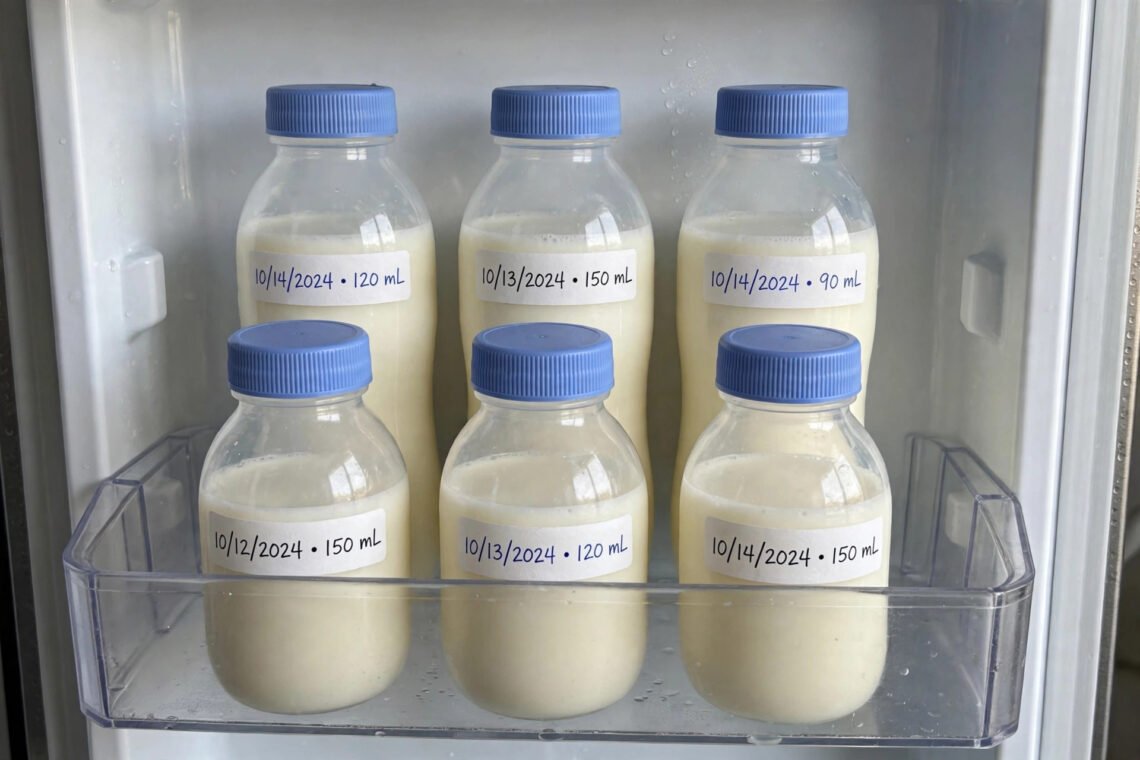
Quick Answer: Freshly expressed breast milk lasts up to 5 days in the refrigerator at 4°C or below, though using it within 3 days is best practice per NHS guidance. Store it at the back of the fridge (not in the door), in clean sealed containers, and never mix freshly expressed warm milk with already-chilled milk — cool it first.
NHS Storage Guidelines at a Glance
The [NHS guidance on storing breast milk](https://www.nhs.uk/conditions/baby/breastfeeding-and-bottle-feeding/breastfeeding/expressing-and-storing-breast-milk/) gives these limits:
| Location | Maximum storage time |
|—|—|
| Room temperature (up to 25°C) | Up to 6 hours |
| Refrigerator (4°C or below) | Up to 5 days (ideally 3) |
| Freezer compartment inside fridge | 2 weeks |
| Standalone freezer (-18°C or below) | Up to 6 months |
These are conservative, safety-first limits. Milk stored towards the maximum is still safe, but nutrient quality is best when used sooner.
Where Exactly to Store It in the Fridge
Temperature stability matters as much as the headline number. The fridge door is the warmest spot, swinging several degrees every time it opens. Store milk:
- At the back of the main compartment, where temperature is most stable
- In sealed, food-grade containers — BPA-free bottles or dedicated breast milk storage bags
- Labelled with the date and time of expressing
- Away from raw meat and strong-smelling foods
Check your fridge is genuinely at 4°C or below with a fridge thermometer; many domestic fridges run warmer than their dial suggests.
The “Cool Before Combining” Rule
A common mistake is pouring warm, freshly expressed milk directly into a container of chilled milk. This raises the temperature of the whole batch and resets the safety clock. Instead:
- Express and seal the new milk
- Chill it in the fridge for 30–60 minutes
- Then combine it with the earlier batch if you wish
Use the date of the oldest milk in the combined container as your use-by reference.
How to Tell If Refrigerated Breast Milk Has Gone Off
Breast milk is a living fluid and behaves differently from cow’s milk:
- Separation is normal. The cream rises to the top; swirl gently (don’t shake vigorously) to recombine.
- Soapy or metallic smell: Often caused by lipase, a naturally occurring enzyme. It is harmless, though some babies refuse it. Scalding milk before storing deactivates lipase.
- Sour smell or taste: This means it has turned — discard it.
- Clumps that won’t mix: Another sign to throw it away.
When in doubt, taste a drop yourself. Sour breast milk is unmistakable.
Warming Refrigerated Breast Milk
- Warm the sealed container in a bowl of warm (not hot) water
- Never microwave — it creates dangerous hot spots and destroys nutrients
- Test the temperature on your wrist; it should feel lukewarm, not hot
- Use warmed milk within 2 hours; discard leftovers the baby didn’t finish within 2 hours
Expressing Hygiene Basics
Good storage starts with clean expressing:
- Wash hands thoroughly before expressing or handling milk
- Sterilise pump parts and containers before first use, then wash in hot soapy water after each use
- Breast milk storage bags are single-use; bottles can be reused after proper washing
FAQs
Can I put breast milk straight in the fridge after expressing?
Yes — refrigerate as soon as possible, ideally within an hour. If you cannot refrigerate immediately, it is safe at room temperature for up to 6 hours.
Is 5-day-old refrigerated breast milk safe?
Per NHS guidance, yes, if stored at 4°C or below the whole time. Using within 3 days is preferable for nutrient quality.
Can I refreeze thawed breast milk?
No. Once fully thawed, use within 24 hours and never refreeze.
Why does my stored milk smell soapy?
High lipase activity. It is safe but can taste off. Scalding freshly expressed milk (heat to just bubbling, then cool quickly) before refrigerating prevents it.
Can I store breast milk in the fridge door?
You can, but it is not ideal — the door is the warmest, least stable part of the fridge. The back of a middle shelf is better.