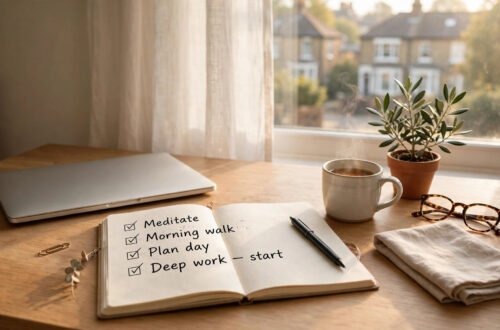
January: you are unstoppable — new gym kit, meal prep containers, a journal full of plans. March: the gym kit is in a drawer, the journal is a guilt object, and you are wondering what is wrong with you. Nothing is wrong with you. Motivation is a feeling, and feelings are weather — they change daily and cannot be relied upon. What carries people through is not motivation but discipline: systems that work when feelings do not.
This guide is about building discipline that survives motivation’s inevitable fade — honestly, practically, and without the toxic “just try harder” nonsense.
Why motivation always fades (and why that is fine)
Motivation is highest at the start of anything because of novelty and fantasy: the new routine is exciting, and you are in love with the imagined future self. Then reality arrives — the work is repetitive, progress is slow, life interferes — and the feeling evaporates. This is not failure; it is neurochemistry. Dopamine fires for novelty and anticipated reward, not for Tuesday’s identical workout number forty.
The critical reframe: motivation is for starting; discipline is for continuing. Expecting motivation to carry you through is like expecting the excitement of buying a car to fuel it. You need a different fuel — and that fuel is systems.
Do you need a professional? The honest answer
For most people, no — not as a first step. Coaches, therapists and accountability programmes help enormously when: you have tried structured self-directed approaches for several months without traction; you suspect underlying issues (depression, ADHD, anxiety) are blocking you — in which case a GP or therapist is the right professional, not a life coach; or you need expertise for a specific domain (a personal trainer for safe lifting technique, for example).
But hiring a professional to supply motivation you have not built systems for rarely works — you become dependent on the external push, and it fades like all motivation. Build the systems first; add professionals to optimise them, not to replace them. If low mood or persistent inability to function is part of the picture, the NHS Every Mind Matters resources are a better first stop than any coach, while James Clear’s writing on habits offers research-backed behaviour-change systems.
System 1: shrink the commitment until it is unskippable
Discipline fails when the daily ask is too big for a bad day. So design for bad days: the workout becomes “put on gym clothes and do five minutes”; the writing becomes “open the document and write one sentence”. On good days you will do more; on terrible days you still show up — and showing up is the mechanism. A 200-day streak of tiny efforts beats three heroic weeks followed by quitting. This is the two-minute rule applied to discipline, and it is the foundation everything else rests on.
System 2: design your environment, not your willpower
Willpower is weakest when you are tired — which is exactly when discipline matters. So remove willpower from the equation: lay out workout clothes the night before; delete the apps that eat your evenings; keep the guitar on a stand in the living room, not in a case under the bed; meal-prep on Sunday so weeknight dinners require zero decisions. Every friction removed from the good behaviour — and added to the bad one — is discipline you do not have to manufacture daily. Our guide to building a morning exercise routine at home is essentially environment design applied to fitness.
System 3: track visibly and review weekly
What gets measured gets managed — but more importantly, what gets seen gets continued. A wall calendar with X marks, a habit-tracking app, a simple spreadsheet: the method does not matter, the visibility does. Add a weekly review (ten minutes, Sunday evening): what worked, what broke, one adjustment for next week. This review is where discipline becomes intelligent — without it, you repeat the same failures; with it, your system evolves to fit your actual life.
System 4: plan for failure in advance
The difference between people who sustain discipline and those who do not is not fewer bad days — it is pre-planned recovery. Decide in advance: “If I miss a day, I resume the next day — no doubling up, no guilt spiral.” The research is clear: missing once has no impact on long-term outcomes; the collapse comes from the ‘what the hell’ effect — one missed day becoming a missed month. Write your recovery rule down now, while motivation is high, so discipline-you can follow it when motivation-you has left the building.
Seasonal dips are predictable — winter motivation crashes are so common they are almost scheduled. Our guide to staying motivated to exercise through winter tackles the year’s hardest stretch specifically.
The 40% rule: you are capable of more than you feel
Navy SEALs popularised the “40% rule”: when your mind says you are done, you are really only 40% done. The science is softer than the slogan, but the underlying truth is solid — perceived effort and actual capacity diverge widely, especially when motivation is low. Your brain’s “stop” signal is conservative by design; it fires long before your body or mind is truly spent. Discipline is partly the skill of recognising that signal as information (“I feel tired”) rather than instruction (“I must stop”). When you feel like quitting a session, commit to just five more minutes — you will rarely want to stop at the end of them.
Conclusion
Discipline is not a personality trait — it is a set of systems: commitments shrunk until unskippable, environments designed so willpower is unnecessary, visible tracking with weekly reviews, and pre-planned recovery from inevitable bad days. Motivation will fade; that was always the plan. Build for the fade, and you will still be going long after the January energy is a distant memory.
Frequently Asked Questions
Is discipline more important than motivation?
For long-term results, yes — overwhelmingly. Motivation initiates behaviour; discipline (systems, environment, habits) sustains it. Studies of habit formation consistently show that automaticity, not enthusiasm, predicts who is still going after six months.
How long does it take to build discipline?
The popular “21 days” is a myth; research suggests habit automaticity takes 18–254 days depending on complexity, averaging around 66. But you do not need full automaticity to benefit — even partial systematisation beats relying on motivation within weeks.
What if I have ADHD and systems never stick?
ADHD genuinely makes standard habit advice harder — working memory and reward-processing differences are real. Strategies that help: externalise everything (alarms, visual cues, body doubling), make systems interesting rather than rigid (novelty sustains ADHD attention), and consider professional assessment — medication and ADHD-specific coaching transform what is possible.
Should I tell people my goals for accountability?
Selectively. Announcing goals can create a premature sense of accomplishment that reduces effort (the “social reality” effect). Accountability works best as ongoing check-ins with one trusted person, not broadcast announcements.
How do I restart after completely falling off?
Shrink to the smallest possible version and restart today — not Monday, not January. One push-up, one sentence, one minute. The comeback does not need to be impressive; it needs to be now. Momentum rebuilds faster than you expect once the streak restarts.