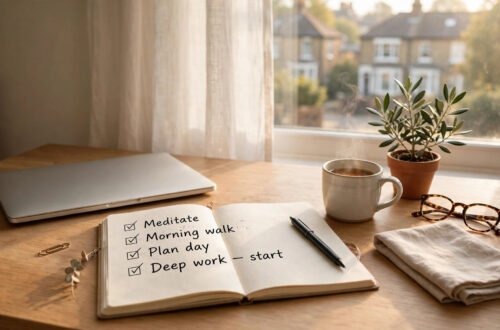
By 9am you have already made dozens of decisions: what to wear, what to eat, which emails to answer, which route to take, what to buy for dinner. By 6pm, choosing between two nearly identical pasta sauces feels existentially exhausting, and you order takeaway instead of cooking — not because you are lazy, but because your decision-making capacity is spent. This is decision fatigue: the well-documented deterioration of decision quality after a long session of deciding.
This guide explains the science from scratch and — more usefully — the practical systems that beat it, designed for real British household life.
What decision fatigue actually is
The concept comes from psychologist Roy Baumeister’s research on ego depletion: self-control and decision-making draw on a limited mental resource that depletes with use. Judges grant parole less often before lunch; shoppers make worse choices after long browsing sessions; you snap at your partner over nothing at 9pm. As decisions accumulate, the brain shifts from careful analysis to shortcuts: choosing the default option, avoiding decisions entirely, or deciding impulsively.
A nuance worth knowing: later research has complicated the “depletable resource” model — motivation and beliefs about willpower matter too. But the practical phenomenon is robust: decision quality declines across a day of deciding, whatever the precise mechanism. Tired deciders decide badly. That much is not in dispute.
Where it hits British households hardest
- The supermarket: 40,000 products, hundreds of micro-decisions. No wonder the “big shop” leaves you drained — and vulnerable to the strategically placed treats at the till.
- Evenings: what to cook, what to watch, whether to exercise — all competing for a depleted brain. This is why takeaway apps thrive after 7pm.
- Work: back-to-back decisions all day, then “quick” evening choices made on fumes.
- Parenting: a parent makes an estimated hundreds of child-related decisions daily. Decision fatigue is a significant driver of parental burnout.
- Money: comparing energy tariffs, insurance quotes, phone contracts — high-stakes decisions often made in depleted evening hours.
Strategy 1: decide once, not daily
The most powerful antidote is eliminating repeat decisions. Meal-plan weekly so “what’s for dinner” is decided once, on Sunday, with a fresh brain. Lay out clothes the night before. Automate savings and bills. Create a capsule wardrobe — fewer, coordinating clothes means trivial morning decisions; our guide to building a capsule wardrobe on a budget shows how. Every recurring decision you systematise is mental energy returned to you daily, forever.
Strategy 2: front-load important decisions
Schedule significant decisions for morning hours when your capacity is freshest. Do the budget review at 10am, not 10pm. Have the difficult conversation on Saturday morning, not Sunday night. This is not about being a “morning person” — it is about matching decision importance to decision capacity, whenever your personal peak falls.
Strategy 3: reduce the choice set
More options do not make better decisions — beyond a point, they make worse ones (the paradox of choice). Deliberately constrain options: pick from three energy suppliers, not thirty; shortlist two holiday destinations, not ten. Set personal defaults: “I always buy this brand of coffee”, “Fridays are always pasta night”. Defaults are not boring — they are freedom from a thousand tiny decisions.
Strategy 4: protect the decision-maker
Decision capacity is physical. Sleep deprivation, hunger and stress all accelerate fatigue — the classic “do not grocery-shop hungry” is decision science. Guard the basics: consistent sleep, regular meals, and genuine downtime. When you are depleted, defer: “I will decide tomorrow morning” is almost always better than a midnight decision you will regret. And build recovery into evenings — ways to unwind after a stressful day that genuinely restore you, rather than merely distracting you.
The BBC has covered decision fatigue research extensively, and the Guardian’s psychology coverage regularly explores the science of choice overload.
The 10-10-10 rule for better tired decisions
When you must decide while depleted, use the 10-10-10 rule: how will you feel about this choice in 10 minutes, 10 months, and 10 years? The three timeframes force your tired brain out of immediate-gratification mode and into perspective. The takeaway at 9pm is rarely worth it at the 10-month view; the difficult conversation you are avoiding looks different at 10 years. It is not a perfect decision procedure — it is a fatigue-resistant one, simple enough to use when your brain has nothing left.
Designing a low-decision household
The ultimate goal is structural: a household that runs on systems rather than daily willpower. Weekly meal plans pinned to the fridge. A cleaning rota instead of nightly negotiations. Automated finances. A capsule wardrobe. Standard responses for recurring situations (“we always…”). Each system permanently retires a category of decisions, and the cumulative effect is transformative — families report the mental quiet as the biggest benefit, more than any time saved. Start with the decision that annoys you most (for most households: dinner), systematise it completely, then move to the next. Within months, your evenings feel different: calmer, because the deciding is done.
Batching: the calendar trick that halves decisions
Decision batching means grouping similar decisions into dedicated sessions rather than scattering them through the week. Pay all bills in one monthly sitting. Plan all meals on Sunday. Answer non-urgent emails in two daily batches, not fifty interruptions. Batching works because context-switching between decision types is itself fatiguing — deciding dinner, then insurance, then holiday plans in rotation is far more draining than deciding all dinners at once. Your calendar becomes the system: themed blocks for themed decisions, and genuinely free evenings where no deciding is required at all.
Conclusion
Decision fatigue is not a character flaw — it is a design flaw in how we organise our days. Beat it structurally: decide recurring things once, make important decisions with a fresh brain, deliberately shrink your choice sets, and protect the physical foundations of good judgement. You cannot eliminate decisions, but you can stop spending your best thinking on pasta sauce.
Frequently Asked Questions
Is decision fatigue scientifically proven?
The core phenomenon — declining decision quality after sustained deciding — is well-replicated. The original “ego depletion as a limited resource” theory has faced replication challenges, with newer models emphasising motivation and attention. Practically, the advice is identical either way: tired brains decide worse.
What is the difference between decision fatigue and burnout?
Decision fatigue is acute and daily — it resets with rest. Burnout is chronic — a state of exhaustion from prolonged stress that rest alone does not fix. Persistent decision fatigue without recovery contributes to burnout, which is why the structural fixes matter.
Do successful people really wear the same clothes daily?
Some do (the famous examples are real), but the principle matters more than the uniform: reduce low-value decisions to preserve capacity for high-value ones. A capsule wardrobe or a weekly meal plan achieves the same effect without the turtleneck.
How quickly does decision capacity recover?
Meaningfully with food and short rest; substantially with sleep. A 20-minute break with a snack restores a surprising amount of function — which is why the worst decisions cluster in the pre-dinner, pre-rest evening window.
Can children get decision fatigue?
Absolutely — and they show it as meltdowns, defiance, or shutdown rather than poor analysis. Limiting children’s choices (“red shirt or blue shirt?” not “what do you want to wear?”) is decision-fatigue management, and it works.