Somewhere around your fiftieth birthday, your body starts sending invoices for decades of sitting: the ankle that wobbles on uneven pavement, the hip that complains when you get up from the floor, the moment you realise you can’t comfortably reach the top shelf without a small performance. Balance and flexibility aren’t vanity projects after 50 — they’re the difference between an active sixties and a cautious one.
The encouraging news is that both respond to training at any age. Studies of adults over 50 consistently show meaningful improvements in balance within 8–12 weeks of targeted practice, and flexibility gains arrive even faster. Whether you’re in London with its endless parks and leisure centres or anywhere else, here’s how to rebuild both safely in 2026.
Why Balance Declines — and Why It Matters More Than Strength
Balance relies on three systems working together: vision, the vestibular system in your inner ear, and proprioception — your body’s sense of where it is in space. All three dull with age, and modern life accelerates the decline: flat floors, supportive shoes, and chairs everywhere mean your stabiliser muscles rarely get challenged.
The stakes are real. Falls are the leading cause of injury-related hospital admissions in older adults in the UK, and the NHS guidance on preventing falls puts balance training alongside strength work as the two most effective interventions. Poor balance also shrinks your world quietly — you stop taking the stairs, avoid uneven paths, decline the walking holiday. Training it back is really about keeping your options open.
The 15-Minute Daily Balance Routine
You don’t need equipment or a class to start. This simple progression, done daily, covers the essentials:
Weeks 1–2: Foundational stability
Stand on one leg while brushing your teeth — 30 seconds each side, fingertips on the counter for safety. Walk heel-to-toe along a hallway line, arms out. These sound trivial; done daily, they wake up dormant stabilisers fast.
Weeks 3–6: Adding challenge
Close your eyes during the single-leg stand (stay near a wall). Try standing on a cushion. Add slow weight shifts — rock gently forward, back, and side to side on one leg. If you’re already exercising regularly, slot these in as a warm-up rather than a separate session.
Weeks 7+: Dynamic balance
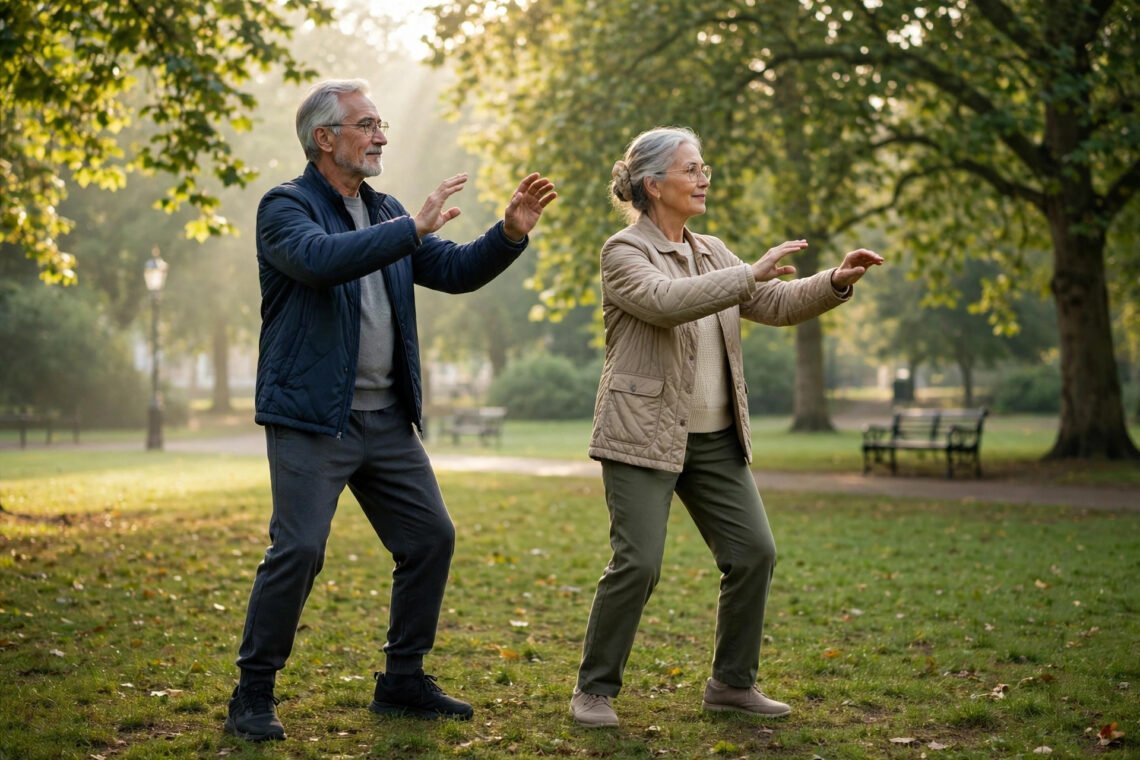
Step-ups onto a low step, slow marching with high knees, and gentle tai chi sequences. Tai chi deserves special mention: multiple trials show it cuts fall risk in older adults by around 20–30%, and London alone has dozens of free or low-cost outdoor morning sessions in parks from Hyde Park to Greenwich.
Flexibility After 50: What Actually Works
Forget the idea that you need to touch your toes. Functional flexibility means: hips open enough to get in and out of a car comfortably, shoulders mobile enough to reach overhead, ankles flexible enough for stairs. Two approaches dominate the evidence:
Static stretching — holding a stretch 20–30 seconds, 2–3 rounds, after activity or in the evening. Focus on hip flexors (tight from sitting), hamstrings, chest, and calves. Targeted stretching for the lower back is especially valuable, since stiffness there cascades into everything else.
Yoga and Pilates — both combine flexibility with the balance and core strength work you need anyway. Chair yoga and gentle Hatha classes are designed precisely for stiff beginners; most London leisure centres run over-50s sessions, and the Sport England activity finder can locate one near you. Two sessions a week produces noticeable change within two months.
How Often Should You Train Each?
The evidence-based prescription: balance work 3+ days a week (daily is ideal since sessions are short), flexibility work 2–3 days a week, and strength training twice weekly — because balance without leg strength is like brakes without tyres. Protecting your joints as you age matters here too: low-impact options like swimming and cycling build the supporting strength without the pounding.
A realistic weekly template: Monday and Thursday — 30-minute strength plus 10 minutes of balance; Tuesday and Saturday — yoga or stretching; daily — the toothbrush single-leg stand. Total extra time: about two hours a week.
Safety Rules Nobody Should Skip
Always have something sturdy within reach during balance work — a wall, a chair, a kitchen counter. Wear supportive, flat shoes or go barefoot on a non-slip surface. If you feel dizzy, sit down; dizziness that persists deserves a GP visit, since it can signal blood pressure or inner-ear issues rather than simple deconditioning. And progress gradually: the goal is a wobble you control, not a fall you don’t.
Fuelling Better Balance: Food, Drink, and Medication Awareness
Balance isn’t only trained — it’s also fuelled. Dehydration impairs concentration and reaction time, making you measurably less steady; older adults often drink too little without realising, so keep water visible and sip through the day. Adequate protein supports the muscle maintenance that balance depends on — aim for a proper protein source at each meal rather than loading it all at dinner.
Vitamin D deserves attention: deficiency is common in Britain’s darker months and is linked to muscle weakness and poorer balance. The NHS recommends everyone consider a daily 10-microgram supplement from October to March. Just as important is a medication review: blood pressure drugs, sedatives, and several common prescriptions list dizziness as a side effect. If your unsteadiness coincided with a new medication, that’s a GP conversation, not a balance-exercise problem — never stop prescribed medication without medical advice, but do ask whether alternatives exist.
Alcohol also matters more than people admit: even moderate drinking impairs proprioception and reaction time for hours, and the effect strengthens with age. Nobody’s suggesting abstinence, but scheduling balance practice — and tricky outings — for clear-headed mornings is simple wisdom.
The Bottom Line
Improving balance and flexibility after 50 isn’t about reclaiming your twenties — it’s about protecting your sixties and seventies. Fifteen minutes a day of single-leg stands, heel-to-toe walks, and targeted stretching, plus a weekly yoga or tai chi class, will make you steadier on stairs, looser getting out of cars, and more confident on uneven ground within a couple of months. In a city like London, the parks, pools, and low-cost classes are all around you. The only equipment you truly need is a wall to lean on and the decision to start.
Frequently Asked Questions
Can you really improve balance after 60?
Yes. Research consistently shows balance improves with practice at any age — the nervous system remains trainable throughout life. Most people notice steadier footing within 4–6 weeks of daily practice.
Is yoga or tai chi better for balance over 50?
Both work well. Tai chi has the strongest evidence specifically for fall prevention; yoga adds more flexibility and upper-body strength. If forced to choose one, pick the class you’ll actually attend twice a week.
How long should I hold stretches after 50?
Hold each stretch for 20–30 seconds, repeating 2–3 times per muscle group. Longer holds don’t add much benefit, and bouncing stretches should be avoided as they can cause micro-tears in stiffer tissue.
Do I need special equipment for balance training?
No. A wall or sturdy chair, a hallway, and optionally a cushion are enough for months of progression. Balance boards and wobble cushions are fun later but unnecessary at the start.
When should I see a GP about balance problems?
If you experience persistent dizziness, have fallen more than once in a year, or notice sudden changes in balance, see your GP. These can indicate treatable issues like blood pressure changes, medication side effects, or inner-ear problems.