You cannot run to the end of your street. The last time you “exercised” was carrying a sofa up two flights of stairs in 2019, and your knees filed a formal complaint. Meanwhile, everyone on your feed is posting 10K selfies. Here is what the running world rarely admits: almost every runner started exactly where you are — breathless, embarrassed, and convinced their body was not built for this. It was. This guide is the complete beginner’s method for starting running when you are completely unfit: the run-walk system that actually works, the injury prevention that matters, and the honest timeline from sofa to 30 minutes.
Forget “just go for a run” — use the run-walk method
The number one reason unfit beginners quit running is that they try to run continuously from day one. That is like trying to lift your max on your first gym visit. The run-walk method, popularised by coach Jeff Galloway and validated by decades of beginner programmes, alternates short running intervals with walking recovery — for example, 1 minute jogging followed by 2 minutes brisk walking, repeated for 20 minutes. Over weeks, the running intervals lengthen and the walking shrinks. The NHS exercise guidance backs this graduated approach: Couch to 5K, the NHS’s own free programme, is built on exactly this principle and has carried millions of Britons from zero to 5K. Your only job in week one is to complete the session, however slow. Speed is irrelevant. Completion is everything.
The first four weeks: what to actually do
Week one: three sessions of 20 minutes, alternating 1 minute of gentle jogging with 2 minutes of walking. The jogging should be slow enough that you could hold a conversation — if you cannot speak, you are going too fast. Week two: same structure, 25 minutes. Week three: 2 minutes jogging, 2 minutes walking, 25–30 minutes total. Week four: 3 minutes jogging, 90 seconds walking. Always start each session with five minutes of brisk walking to warm up, and finish with five minutes easy walking plus gentle stretching. Rest days between sessions are non-negotiable — your cardiovascular system adapts during recovery, not during the run. People worried about running and their knees should know the evidence surprises most people: recreational running does not damage healthy knees and is associated with lower rates of arthritis than a sedentary life.
The talk test beats every gadget
You do not need a heart-rate monitor, a GPS watch or a subscription app to start. The talk test — run at a pace where you can speak in short sentences — keeps you in the aerobic zone where fitness is built. Gadgets are wonderful later; at the start they are just expensive ways to feel inadequate. One free tool worth having: a simple interval timer app so you are not clock-watching.
Kit: what you need versus what the industry wants to sell you
The running industry would like you to believe you need £400 of equipment. You need two things: decent shoes and weather-appropriate clothing you already own. Shoes matter most — not expensive shoes, but shoes that fit and suit your gait. A proper running shop will watch you jog on a treadmill and recommend accordingly; expect £60–£100 for a solid beginner pair, and replace them roughly every 500 miles. Everything else — the moisture-wicking this, the compression that — can wait until you are running regularly. Sports bra wearers: this is the one item where proper support from day one genuinely matters for comfort. And in a British winter, a cheap reflective vest and a head torch turn dark-evening sessions from miserable to magical.
Preventing the injuries that stop beginners
Most beginner running injuries share one cause: too much, too soon. The 10% rule — never increase weekly running time by more than about 10% — exists because tendons and bones adapt slower than lungs and heart. Your cardio will feel ready for more long before your shins agree. Sharp pain is a stop signal, always; dull fatigue is usually fine. Strength work twice a week — bodyweight squats, lunges, calf raises, ten minutes — protects knees and Achilles tendons more than any shoe technology. And eating properly around your workouts matters even at beginner level: you cannot adapt to training you are not fuelling, and “I ran, therefore I earned a whole pizza” is the accounting error that stalls most beginners’ weight goals.
The mental game: embarrassment, boredom, and the wall at week three
Let us address the real barriers. Embarrassment: nobody is watching. Experienced runners feel solidarity with struggling beginners, not contempt — they remember being you. Run early morning or in quiet areas if self-consciousness is the blocker; parkrun’s brilliant innovation is that the slowest finisher gets the same applause as the fastest. Boredom: podcasts and audiobooks make easy sessions fly; save the gripping thriller exclusively for runs and you will find yourself looking forward to them. The week-three wall: motivation dips just as novelty fades and before fitness arrives. This is normal, predictable, and survivable — schedule sessions like appointments, lay out kit the night before, and find one running buddy or community. parkrun’s free weekly 5K events, held in parks across the UK every Saturday, are the single best beginner-running institution in the country: free, untimed-pressure, all abilities.
The parkrun effect: your free weekly milestone
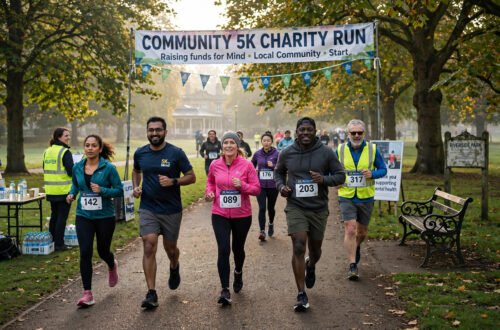
There comes a point in every beginner’s journey — usually around week six — when solo sessions start feeling lonely and progress feels invisible. That is when parkrun changes everything. Every Saturday morning, in hundreds of parks across Britain, thousands of people run, jog or walk 5K together, entirely free, with your time recorded and your progress tracked week to week. For the beginner, parkrun solves three problems at once: it provides a regular, low-pressure goal to train toward; it surrounds you with people at every pace imaginable, demolishing the “I’m too slow” fear; and the barcode-scanned results give you objective proof of improvement that motivation feeds on. Walk the whole thing if you need to — parkrun explicitly welcomes walkers, and the tail walker ensures nobody finishes last. Many runners trace their entire habit to a single parkrun morning when a stranger’s encouragement carried them through the final kilometre. It costs nothing, it happens everywhere, and it might be the most important institution in British recreational running. Your training plan builds the fitness; parkrun builds the runner.
Frequently Asked Questions
How unfit is too unfit to start running?
If you can walk briskly for 20 minutes, you can start the run-walk method. If walking itself is difficult, build walking fitness first — there is no shame in a walking phase, and it protects your joints. Anyone with heart conditions, chest pain or serious joint issues should check with their GP first.
How long until I can run 30 minutes non-stop?
Most complete beginners reach 30 minutes of continuous easy running in 8–12 weeks following a graduated plan like Couch to 5K. Some take longer; the timeline that matters is yours.
Should I run every day?
No — not as a beginner. Three sessions a week with rest days between builds fitness faster than daily running, because adaptation happens during recovery. Daily running is an advanced practice.
Is running bad for overweight beginners?
Running is excellent for overweight beginners provided the progression is gradual — the run-walk method, good shoes, and attention to pain signals. Many successful runners started at a high weight; the key is patience with the build-up, not avoidance.
You will not feel like a runner for the first month. Then one ordinary Tuesday, mid-session, you will realise you are jogging and breathing and thinking about dinner simultaneously — and that you have become, without ceremony, a person who runs. Start this week: three sessions, walk-jog, conversational pace. The end of your street is closer than it looks.