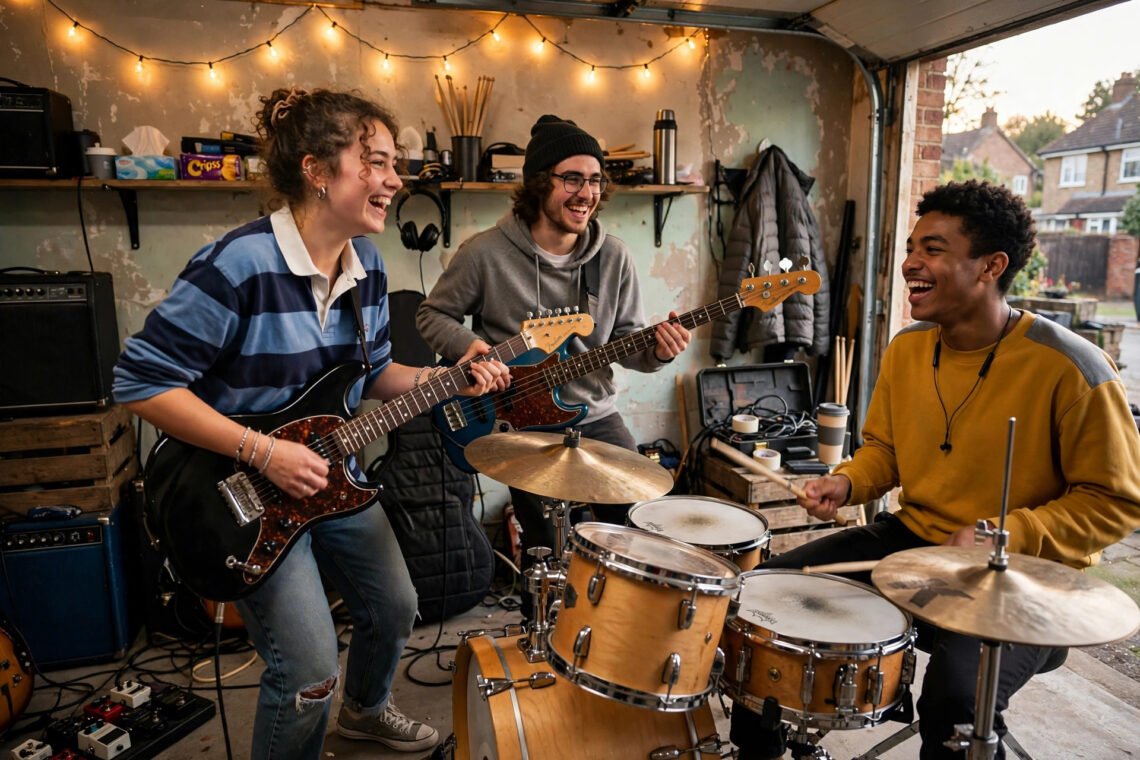
You have never played a gig, you can barely play your instrument, and your mates are in roughly the same boat. Perfect — you are ready to start a band. Every great British band started as people who could not really play, in a room that smelled of damp, making a joyful noise. The Beatles were terrible before they were the Beatles. This guide is the complete beginner’s manual for starting a band in London with no experience: finding people, choosing what to play, rehearsing without killing each other, and getting your first gig.
Find your people (the band is the instrument)
The musicians matter less than the humans. You need people who: show up reliably, share roughly your taste and ambition level, and are pleasant to be stuck in a small room with for hours. Skill gaps are fixable; flakiness and ego are not. Where to find them in London: university and college music societies (even as a non-student, many welcome outsiders), open mic nights (go, play badly, talk to everyone), online musician-finder boards and local social media groups, and — underrated — work colleagues and neighbours. Be radically honest in your ad: “Beginner guitarist (8 months), into indie/rock, want to play covers then write, free weekends, South London.” Honesty filters for compatible people; pretending you are better than you are creates the band’s first resentment. Aim for the classic flexible lineup: guitar, bass, drums, vocals — with members doubling up where possible. And making new friends as an adult in a new city follows the same principles as finding bandmates — shared activity, regular contact, low-pressure beginnings.
Decide what you are (before the first rehearsal)
Bands die from unspoken disagreements, so speak them early. Covers or originals? (Start with covers — they teach you to play together fast; originals come when the chemistry exists.) What genre, honestly? (The metalhead and the folk singer will not survive each other.) What is the ambition — pub gigs for fun, or world domination? (Both are valid; mixing one of each is fatal.) How often will you rehearse, and what does it cost? London rehearsal rooms run £10–£25 per hour for a basic room — split four ways, that is the price of a pint each. Agree the money rules now: equal splits on costs, a shared pot for gig income, receipts for everything. The bands that last treat the boring admin seriously from day one.
The first rehearsal: keep it simple, keep it fun
Pick three easy songs everyone can learn — “Seven Nation Army,” “Horse With No Name,” “Zombie” — the beginner-band canon exists because the parts are simple and they sound like real music immediately. Do not attempt your magnum opus on day one. The goal of rehearsal one is not perfection; it is discovering whether you enjoy being in a room together. End while it is still fun.
Rehearse like a band, not four soloists
Beginner bands rehearse wrong: everyone plays at full volume simultaneously, nobody listens, and it sounds like a traffic jam. The disciplines that fix it: one person counts in, everyone starts together. Listen more than you play — leave space; the notes you do not play matter as much as the ones you do. Record every rehearsal on a phone (placed centrally, not in a pocket) and listen back — the recording reveals timing drift, volume wars and the fact that nobody was actually together, all fixable once heard. Practise transitions and endings, not just the middles — audiences forgive wobbly verses but remember train-wreck endings. And dynamics: play quieter than you think. The loudest band in the rehearsal room is rarely the best; control is what separates bands from noise. Rehearse weekly if possible — fortnightly is the minimum for momentum; monthly bands are social clubs with instruments.
Get the first gig (it is easier than you think)
London’s live circuit runs on beginner bands — pubs, open mics graduating to support slots, charity nights, and the great British tradition of the battle of the bands. The path: 2–3 months of rehearsal until you have a tight 30-minute set (8–10 songs), a phone-recorded demo (rehearsal recordings are fine at this stage), then approach venues directly — polite email, demo link, suggested dates. Say yes to everything at first: the Tuesday night pub gig for ten people is where you learn stagecraft. The gig-day disciplines: arrive early, be nice to the sound engineer (they control your destiny), bring spare everything (strings, sticks, cables), and play the set you rehearsed — gigs are not for experiments. Afterwards, thank the venue, collect contacts, and post the photos. Finding local live music nights as an audience member doubles as scouting — watch how working bands handle the room, and steal everything.
Releasing your first music: the DIY route in 2026
Once the band is tight, the question arises: should we record? In 2026, the answer is easier than ever — and cheaper. The DIY recording path: a basic audio interface (£100–£150), one decent microphone (£80–£120), free recording software, and your rehearsal room. Record live first — the band playing together captures the energy that multi-tracking often kills — then overdub vocals and fixes. The result will not be Abbey Road, but it will be yours, and “ours” beats “perfect” for a first release. Distribution is effectively free: aggregators put your music on every streaming platform for under £30 a year, keeping your rights. Promotion is the real work: the local press, community radio, gig flyers (still effective), and — the modern essential — short performance videos, because the algorithm rewards bands that show themselves playing. BBC Introducing exists precisely to champion unsigned acts — upload your best track; the success stories started exactly where you are. And PRS for Music collects the royalties your songs earn when played publicly or broadcast — register as a writer (free) before the gigs start paying. Record the songs, release them properly, register the rights: the band becomes real the day its music exists in the world, not just in the rehearsal room.
Frequently Asked Questions
How good do we need to be before gigging?
Tight and confident on 30 minutes of material — not virtuosic. Audiences forgive simple playing performed with conviction; they do not forgive a band that looks like it would rather be elsewhere. Energy and togetherness beat complexity.
How do we split songwriting credits and money?
Agree it in writing before there is money to argue about. The simplest fair model: equal split of band income regardless of who wrote what, with songwriting royalties (if any ever materialise) following the writers. Discuss it over a pint, write it down, move on.
What equipment do we need to start?
Your instruments, plus a PA for vocals (rehearsal rooms provide these; for gigs, most small venues have house PAs). Do not buy a PA before you need one regularly. A shared band fund for strings, sticks and cables prevents resentment.
How do we handle creative disagreements?
Vote, with the songwriter getting casting vote on their song. The meta-rule: anyone can veto being in the band, but no one can veto a song twice. Bands are democracies with a sunset clause — if the fundamentals diverge, split kindly.
Find the people, agree the mission, learn three songs, rehearse weekly, gig monthly. That is a band. It will be shambolic and glorious in exactly the proportions that make it yours — and somewhere in London tonight, in a room that smells of damp, the next great British band is having its terrible, wonderful first rehearsal. Make yours this week.