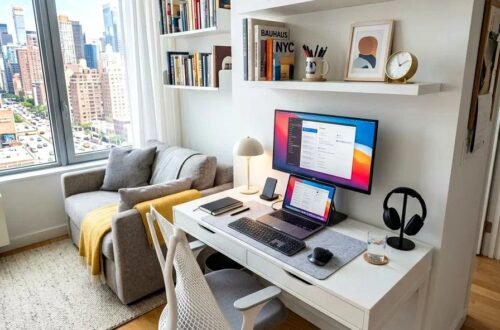
The spare room is now an office, the kitchen table is a packing station, and you’re your own boss. Starting a small business from home in the UK has never been more achievable — over half of UK small businesses are home-based. But between the dream and the reality sit legal requirements, tax obligations and practical decisions that nobody tells you about upfront. Here’s how to start a small business from home in the UK properly, step by step.
Step 1: validate the idea before spending a penny
Enthusiasm is great; customers paying you is better. Before registering anything:
- Talk to potential customers. Not friends and family (they’ll be encouraging and useless) — real potential buyers. Would they pay? How much? What would make them choose you?
- Check the competition. Search for what you’d offer. If ten people do it locally, what’s your edge? If nobody does it, ask why — sometimes it’s an opportunity, sometimes it’s a warning.
- Test small. Sell to five people before building a website. Run a market stall before renting a unit. The businesses that survive are the ones that found customers before they found overheads. Our guide to getting your first customers covers this in depth.
Step 2: choose your business structure
This is the first official decision, and it shapes your tax and liability:
- Sole trader — simplest. You are the business; profits are your income. Minimal paperwork, but you’re personally liable for debts. Right for most home businesses starting out. See our guide on registering as a sole trader.
- Limited company — the business is a separate legal entity. More admin and accounting, but limited liability and often more tax-efficient once profits grow. Our comparison of limited company vs sole trader breaks down when to switch.
- Partnership — if starting with someone else. Get a written partnership agreement even if they’re your best friend. Especially if they’re your best friend.
Most home businesses start as sole traders and incorporate later when it makes financial sense. There’s no prize for incorporating on day one.
Step 3: register with HMRC (it’s free and quick)
As a sole trader, register for Self Assessment with HMRC — you must do this by 5 October in your business’s second tax year, but do it early. It takes about 10 minutes online and costs nothing. You’ll get a Unique Taxpayer Reference, and you’ll file a tax return each year. If you form a limited company, register with Companies House (£50 online) — see our guide to the cheapest way to register a company.
Step 4: sort the home-specific practicalities
Running a business from home has rules people forget:
- Check your tenancy/mortgage. Some tenancy agreements and mortgage terms restrict business use. Most tolerate quiet desk-based work; customer footfall, signage or manufacturing may breach terms. Check before, not after.
- Council tax and business rates. Most home businesses don’t pay business rates — small business rate relief usually covers it, and working from home doesn’t trigger business rates unless you’ve converted part of the home significantly or have visiting customers. Check your council’s guidance if unsure.
- Planning permission. Rarely needed for home offices, but required if the business changes the property’s primary use, causes significant traffic, or involves industrial processes.
- Insurance. Your home contents policy likely doesn’t cover business equipment or stock. You may need business insurance for working from home — often £100–£200 a year for basic cover.
- Claim home expenses. As a sole trader, claim a proportion of household costs (heating, electricity, broadband) or use HMRC’s simplified flat-rate expenses. Keep records from day one.
Step 5: money — separate, track, save for tax
Open a separate bank account for the business — it doesn’t have to be a formal business bank account initially, just a separate personal account keeps things clean. Track every penny in and out from day one (free tools in our accounting software guide). And the golden rule: put 25–30% of profit aside for tax immediately. The first tax bill arrives as a shock to everyone; the second, with payments on account, is worse. Save as you go and neither will hurt.
Start a small business from home: get your first customers
A business without customers is a hobby with paperwork. The unglamorous truth: your first customers come from your existing network, local visibility, and direct outreach — not from a beautiful website nobody visits. Tell everyone what you do. List on Google Business Profile (free). Join local business groups. Do good work and ask for reviews. Marketing can wait; momentum can’t.
Common mistakes to avoid
- Waiting until everything’s perfect. Launch scrappy. You’ll learn more in a month of trading than a year of planning.
- Underpricing. New businesses chronically undercharge. Price for profit from day one — see our guide on pricing handmade products for the maths.
- Ignoring the admin. Tax returns, records, insurance — boring, mandatory, and painful if neglected.
- No boundaries. Working from home blurs everything. Set hours, have a dedicated workspace (even a corner), and switch off. Burnout is the silent killer of home businesses.
How much does it cost to start?
Honestly? As a sole trader working from home with a service business: under £100 (domain name, basic insurance, maybe some initial materials). Product businesses need stock money. The biggest cost is your time. Don’t let anyone sell you expensive courses, premium registrations or “essential” packages — the official routes (HMRC, Companies House, gov.uk) are cheap or free.
The bottom line
Working from home with family around
The unspoken challenge of a home business: the people you live with. Set expectations early — “working from home” doesn’t mean “available for chats, errands and childcare”. A closed door (or headphones on) means do not disturb; set core hours and communicate them. If you have young children, align deep work with nap times or school hours and save admin for the chaos hours. And protect your own boundaries too: the laptop on the kitchen table at 10pm is how home businesses colonise entire lives. A shutdown ritual — closing the office door, changing clothes, a short walk — signals to your brain that work is over. The businesses that last are run by people who didn’t burn out in year one.
Useful free support for UK startups
You don’t have to figure this out alone. Gov.uk’s business support finder matches you with local schemes; Business Gateway (Scotland), Business Wales and Invest NI offer free advice and workshops; local Chambers of Commerce run networking events; and the Prince’s Trust supports 18–30 year-olds with mentoring and low-interest loans. Your local council may offer free startup workshops. None of this costs anything, and a one-hour conversation with an adviser who’s seen a hundred startups can save you months of mistakes. Successful founders ask for help early and often — it’s the struggling ones who go it alone.
To start a small business from home in the UK: validate the idea with real customers, register as a sole trader with HMRC (free), check your tenancy and insurance, separate your money and save for tax, and get selling before you’re “ready”. The barriers are lower than they look — the paperwork takes an afternoon, and the rest is just doing the work. Thousands of people do this every month. There’s no reason you can’t be one of them.