
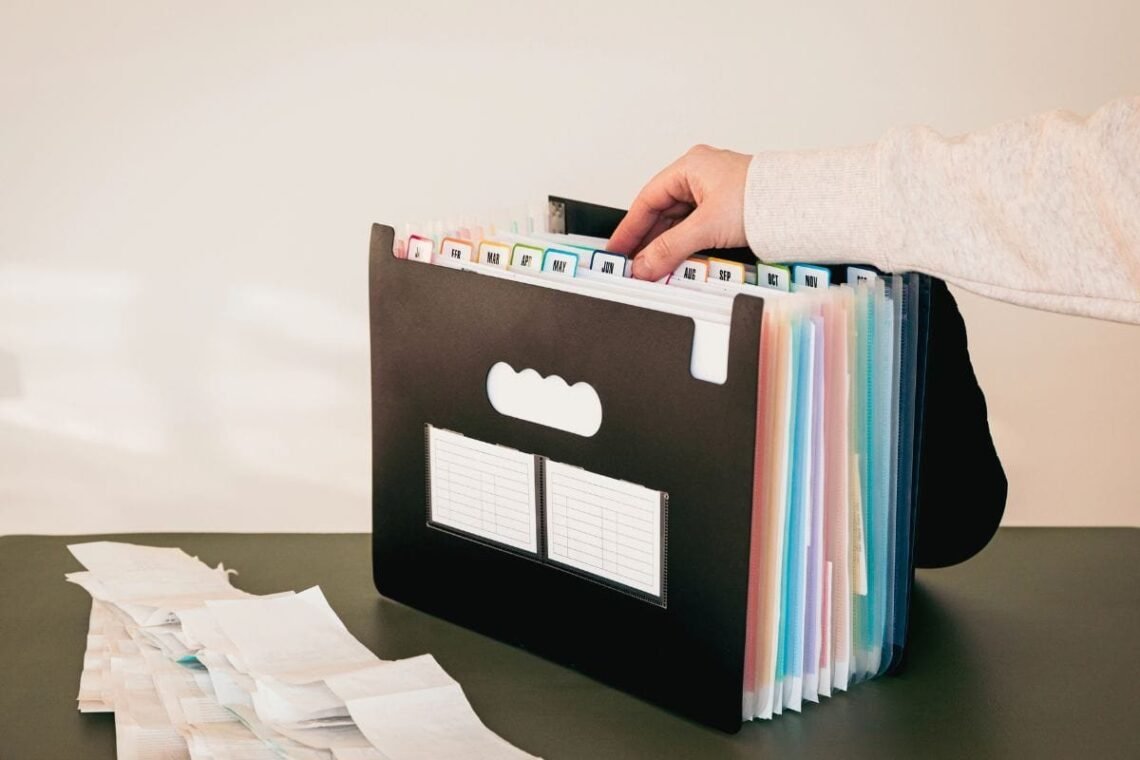
Every home has one: the drawer, box, or pile where important paperwork goes to be forgotten. Insurance documents, the tenancy agreement, birth certificates, warranty cards, that letter from HMRC you should probably keep — all mingling with takeaway menus and dead batteries. Then the boiler breaks, the insurer asks for the policy number, or you need your passport details, and the archaeological dig begins. If you’re asking about the best way to organise important household paperwork, the answer is a simple system with three parts: a home for everything, a digital backup, and a routine that keeps it current. Set it up once, in an afternoon, and never dig again.
The goal isn’t a Pinterest-worthy filing cabinet. It’s being able to lay your hands on any important document within two minutes. That’s the only standard that matters.
The Core System: One Filing Box
Forget elaborate multi-drawer cabinets. For most households, a single A4 filing box with hanging folders (£12–£18) is plenty. Label the folders by category:
- Property — tenancy agreement or mortgage documents, buildings/contents insurance, EPC, gas safety certificate, boiler service records
- Vehicles — V5C logbook, insurance, MOT certificates, service history
- Personal ID — copies (never originals loose) of passports, driving licences, birth certificates, National Insurance numbers. Originals go somewhere secure — a fireproof document bag (£15–£25) is a wise investment.
- Financial — bank account details, pension statements, investment summaries, loan agreements
- Medical — NHS numbers, vaccination records, prescriptions, dentist/optician details
- Household — warranties, appliance manuals (or just the model numbers — manuals are all online now), utility account numbers
- Work — employment contracts, payslips (keep a year’s worth), P60s, tax documents
- Action needed — the in-tray. Anything requiring a response lives here, visible, until dealt with. This folder is the system’s beating heart.
Within each folder, newest at the front. Purge yearly: shred anything past its keep-date (see below). The whole box should fit on one shelf — if it’s overflowing, you’re keeping too much.
Go Digital (The Backup That Saves You)
Paper is vulnerable — fire, flood, loss. Digital copies are your insurance:
- Scan the essentials. A phone scanning app (free options are excellent now) turns your phone into a scanner. Scan: passports, driving licences, insurance policies, tenancy/mortgage docs, birth certificates, and anything in the “action needed” folder once resolved.
- Store securely. An encrypted cloud folder (iCloud, Google Drive, OneDrive — all fine) plus, for the truly critical, an encrypted USB stick kept separately. Name files clearly: “2026-Buildings-Insurance-Policy.pdf” beats “scan0032.pdf.”
- Password-protect the sensitive stuff. ID documents in a password-protected zip or an encrypted note. Cloud storage is convenient; don’t make identity theft convenient too.
- Go paperless where offered. Bank statements, utility bills, council tax — opt into paperless everywhere. Less incoming paper means less to file. What arrives digitally, file digitally in matching folders.
The Weekly 10-Minute Routine (What Keeps It Working)
Systems die without maintenance. The maintenance here is tiny:
- The landing tray. One tray or folder by the door for all incoming post and paperwork. Everything lands here — nothing goes straight into a pile “for later.”
- Weekly sort (10 minutes, pick a day). Open the tray. For each item: action it now (2-minute jobs), file it in “action needed” (bigger jobs, with a calendar reminder), file it permanently, scan-and-shred it, or recycle it. The tray should be empty when you finish.
- Shred ruthlessly. Anything with personal details that you’re discarding gets shredded or torn up — identity fraud from bin-diving is real. A basic cross-cut shredder is £25–£35 and lasts years.
This pairs naturally with our cleaning schedule — add “paperwork sort” to the same weekly rhythm and it becomes automatic.
What to Keep and For How Long
The most common question, answered:
- Forever: birth/marriage/death certificates, property deeds, wills, pension records
- 6 years: tax records, payslips, P60s (HMRC can investigate back this far)
- Until replaced + 1 year: insurance policies, bank statements, utility bills
- Duration of ownership + warranty: receipts for major purchases, warranties, appliance manuals
- 1 year: general correspondence, resolved “action needed” items
- Shred immediately: junk mail, duplicate statements, expired offers, anything you can access online
When in doubt, scan it and shred the paper — the digital copy satisfies almost every “just in case” scenario without the physical clutter. Our decluttering guide covers the paper mountain specifically.
Special Cases Worth Handling Now
- Emergency file. One page (physical, on the fridge or by the door) with: emergency contacts, GP details, allergies, insurance policy numbers, and where the filing box is. If something happens to you, this page speaks for you.
- Shared access. Your partner should know where everything is and how the system works. Walk them through it once. A system only one person understands is a single point of failure.
- Tenants: keep the tenancy agreement, deposit protection certificate, inventory, and all landlord correspondence. Deposit disputes are won on paperwork.
- Going travelling? Digital copies of everything essential, accessible offline on your phone. Our lost passport abroad guide explains why this matters.
The Citizens Advice website has solid guidance on which documents you legally need to keep, and gov.uk’s tax records guidance covers the HMRC side.
The Annual Purge (Keep the System Lean)
Once a year — pick a quiet weekend in January — empty the filing box and purge. Shred anything past its keep-date, scan anything you’re keeping “just in case” but haven’t touched in two years, and check that the digital backups are actually current. This takes about an hour and prevents the slow creep that turns organised systems into cluttered ones. It’s also the moment to update the emergency file (new policy numbers, changed contacts) and to check that your partner still knows where everything is.
A useful rule for the purge: if you haven’t looked at a document in three years and it’s available online (bank statements, utility bills, payslips), shred the paper. The digital original lives with the provider; your copy is just anxiety in paper form. The only papers that truly need to exist physically are the ones with original signatures or seals — wills, property deeds, and some certificates. Everything else can be scanned and shredded with confidence.
The takeaway: organise household paperwork with one labelled filing box (property, vehicles, ID, financial, medical, household, work, action-needed), digital scans of everything critical stored securely, a weekly 10-minute sort of the incoming tray, and a yearly purge. An afternoon to set up, ten minutes a week to maintain, and the end of the archaeological dig forever.


