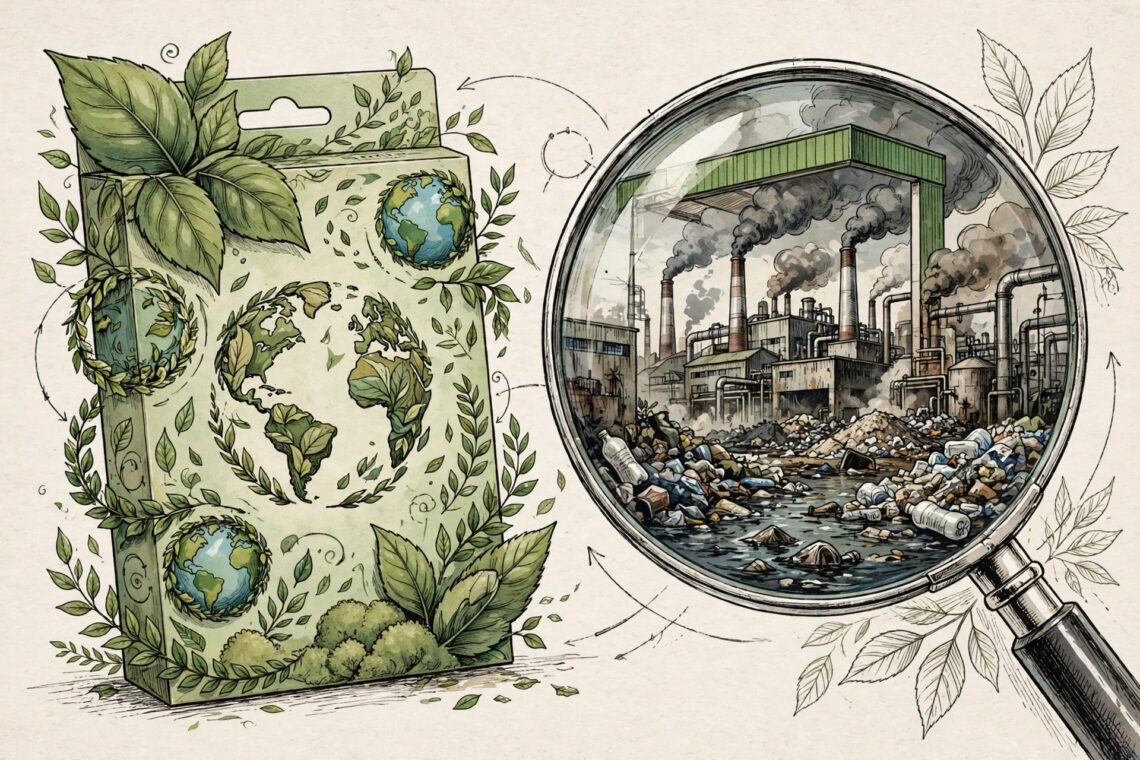
The packaging says “eco-friendly”. The advert shows rolling green hills. The brand has a leaf in its logo and a whole page about “our planet promise”. But is the product actually greener — or are you looking at greenwashing: marketing that makes something sound environmentally friendly without the substance to back it up? For British households trying to shop responsibly, greenwashing is the fog that makes every genuinely green choice harder.
This guide explains what greenwashing is, the seven classic tricks to recognise, your rights under UK law, and how to see through the fog.
What greenwashing actually is
Greenwashing is misleading environmental marketing — claims, labels, imagery or omissions that make a product, service or company appear more environmentally friendly than it is. It ranges from the cynical (a fossil fuel company rebranding as “beyond petroleum”) to the careless (a “natural” label on a product full of synthetic chemicals) to the structural (offsetting marketed as erasing emissions).
Why should you care? Because greenwashing does three harms: it steals your money (green-premium pricing for non-green products), it steals your impact (you buy the “eco” option feeling virtuous while the genuinely better choice sits unsold), and it poisons trust — when everything claims to be green, nothing is believed, and real sustainability efforts drown in cynicism.
The seven classic greenwashing tricks
- Vague language. “Eco-friendly”, “green”, “natural”, “planet-friendly” — words with no defined meaning and no verification. Meaningless by design.
- The halo image. Green packaging, leaves, earth imagery, wind turbines on the advert — visual suggestions of greenness with zero substantive claim (and therefore nothing falsifiable).
- Hidden trade-offs. “Recyclable packaging!” on a product whose manufacture is enormously polluting. One green attribute highlighted; the other ninety-nine ignored.
- Irrelevant claims. “CFC-free!” — CFCs have been banned for decades; the claim is true and meaningless. “Non-toxic” on products never toxic in the first place.
- Lesser-of-two-evils. “Greener cigarettes”, “eco-friendly” SUVs — marginally less bad within a harmful category, presented as positively good.
- Fibbing. Outright false claims — rarer, but it happens, and it is illegal.
- Worshipping false labels. Fake-looking eco-certification badges invented by the brand itself, designed to mimic genuine third-party certifications.
Your rights: UK law is on your side
Britain has unusually strong protection here. The Competition and Markets Authority’s Green Claims Code (see gov.uk’s CMA guidance) sets out six principles environmental claims must meet: truthful, clear, substantiated, considering the full lifecycle, and more. The Advertising Standards Authority actively bans misleading green ads — it has ruled against major airlines, car manufacturers and energy companies for greenwashing, and you can report suspect ads at asa.org.uk. Consumer protection law prohibits misleading commercial practices generally. If a green claim influenced your purchase and turns out to be false, you have rights.
How to see through it: the five-question test
For any green claim, ask:
- Specific or vague? “Made with 80% recycled plastic, certified by X” is specific; “eco-friendly” is fog.
- Who verifies it? Genuine third-party certifications (Soil Association, FSC, B Corp, EU Ecolabel) beat brand-invented badges every time.
- Full lifecycle or cherry-picked? A “recyclable” product made in a coal-powered factory is not green — the claim hides the trade-off.
- Compared to what? “50% less plastic” than what — their own previous excess? Demand baselines.
- Does the imagery match the substance? Leaves on the packaging of a fundamentally unsustainable product is the halo trick — ignore the pictures, read the claims.
And remember the hierarchy: the greenest product is usually the one you do not buy. Second-hand, repair, and buying less beat even the most genuinely green new product. Our guide to finding good quality second-hand clothes online is greenwashing-proof shopping — no claims needed when the item already exists. For the genuinely impactful household changes, see practical eco-friendly home changes.
Greenwashing in finance and energy: the high-stakes version
Greenwashing is not just about shampoo bottles — the highest-stakes version is in finance and energy, where the sums are enormous. “Green” investment funds that hold fossil fuel companies, “100% renewable” energy tariffs backed by cheap certificates rather than actual renewable generation, airline “carbon neutral” claims based on dubious offsets — these move billions and shape the energy transition. The UK’s Financial Conduct Authority has introduced anti-greenwashing rules for financial products precisely because the harm scales with the money. Apply the five-question test ruthlessly here: which fund holdings, which certificates, which offsets, verified by whom? If the answers are vague, the green is too.
Supporting the genuine articles
The antidote to cynicism is rewarding the real thing. Buy from B Corps and certified businesses when you can — the certification is independently audited. Choose repairable, durable products over disposable ones regardless of green claims; longevity beats marketing. Support second-hand and circular businesses — the charity shop, the repair café, the refill station — which are structurally green rather than cosmetically so. And praise good practice publicly: reviews and recommendations for genuinely sustainable businesses help them compete against the greenwashers. Cynicism helps no one; informed support changes markets.
Teaching others to spot it
Greenwashing literacy is contagious in the best way. When you learn the seven tricks and the five-question test, share them — at the school gate, in the office kitchen, on social media. Every person who can spot a halo image or demand a baseline makes greenwashing slightly less profitable, and markets respond to informed consumers faster than to regulation. The fog lifts one sceptical shopper at a time, and the view underneath is worth seeing.
Conclusion
Greenwashing thrives on vague words, pretty pictures and our genuine desire to do the right thing. Beat it with the five-question test — specificity, verification, full lifecycle, baselines, and scepticism toward halos — and know that UK law (the CMA’s Green Claims Code and the ASA) is firmly on your side. The most radical anti-greenwashing act is also the simplest: buy less, buy second-hand, and let the fog clear.
Frequently Asked Questions
Is greenwashing illegal in the UK?
Misleading green claims breach consumer protection law, the CMA’s Green Claims Code, and advertising codes enforced by the ASA. The ASA has banned numerous ads for greenwashing, and the CMA can take enforcement action against businesses. So yes — when it misleads, it is unlawful.
What is the difference between greenwashing and genuine sustainability marketing?
Specificity and verification. Genuine claims are precise (“100% renewable electricity, certified by X”), cover the full product lifecycle, and are backed by independent third-party certification. Greenwashing is vague, self-certified, cherry-picked, or purely visual.
Which certifications can I actually trust?
Soil Association (organic), FSC (sustainable timber/paper), B Corp (whole-company standards), EU Ecolabel, Fairtrade, and MSC (sustainable seafood) are all robust independent certifications. Be wary of badges you have never heard of — check who awards them.
Can I report greenwashing?
Yes — report misleading ads to the ASA at asa.org.uk, and misleading business practices to the CMA or Trading Standards via Citizens Advice. Reports genuinely lead to rulings and enforcement.
Is carbon offsetting greenwashing?
Not inherently, but often in practice. Offsets marketed as “erasing” your footprint or making a product “carbon neutral” without deep emissions cuts first are classic greenwashing territory. Credible use means reduce first, offset last, with certified projects — and honest communication about what offsetting does and does not achieve.