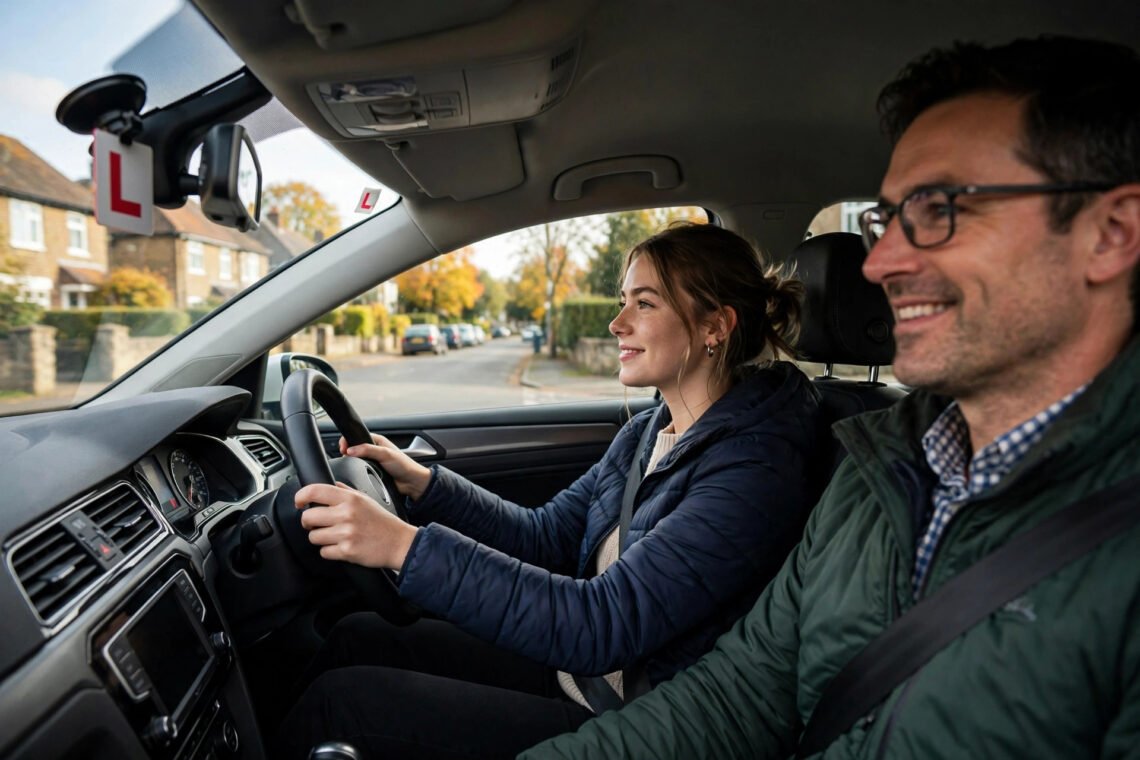
Somewhere in Britain today, a seventeen-year-old will stall at a roundabout, burst into tears, and become a statistic. The UK driving test pass rate hovers around 48% — meaning more than half of candidates fail, most of them on the day, most of them avoidably. Passing first time is not about luck or “natural” driving ability. It is about preparation strategy: what examiners actually mark, the mistakes that fail most tests, and the unglamorous logistics that separate first-time passers from third-time veterans. This is the complete guide.
What the examiner is actually marking
Demystify the test and half the fear evaporates. The practical test lasts about 40 minutes and has five parts: an eyesight check (read a number plate from 20 metres), two “show me, tell me” vehicle safety questions, general driving ability on varied roads, one reversing manoeuvre, and roughly 20 minutes of independent driving following signs or a sat nav. You can accumulate up to 15 minor faults (now called “driving faults”) and still pass. One serious or dangerous fault — anything that is actually unsafe or would have caused an accident without the examiner’s intervention — fails you instantly. The official GOV.UK driving test pages describe the format precisely; read them, because candidates who fail often turn out to have misunderstood what was being asked of them. Examiners are not trying to trick you. They are checking one thing: can this person drive safely without supervision?
The top five fail reasons (and how to kill each one)
The DVSA publishes the most common serious faults every year, and the list barely changes — which means it is entirely preparable. One: observation at junctions — not looking properly before emerging. Fix it with an exaggerated, deliberate look-both-ways routine on every single junction during lessons until it is muscle memory. Two: mirrors before signalling and manoeuvring — the MSM routine, in that order, every time. Three: control of the steering — mounting the pavement or poor lane discipline, especially on narrow Lake District lanes. Four: positioning at roundabouts — wrong lane, wrong signal. Five: response to signs and signals — the classic being the 30mph zone you never noticed. Ask your instructor to drill your weakest two relentlessly in the final month. Candidates who follow the official learning-to-drive syllabus step by step fail less often than those who just “have lessons” — structure beats hours.
The mock test: the highest-value hour of your preparation
Book at least two full mock tests with your instructor in the final fortnight — full 40 minutes, no hints, no chatting, marked properly at the end. The mock does three things: it exposes your fail-pattern faults under pressure, it makes the real test feel familiar rather than alien, and it calibrates your readiness honestly. If you cannot pass a mock, you are not ready — and postponing is cheaper than failing. An instructor who refuses to do mocks is an instructor to replace.
Choosing the instructor and the hours that matter
The average learner needs around 45 hours of professional lessons plus 20 hours of private practice — but averages hide the strategy. What matters more than total hours: an instructor whose teaching style fits you (ask for a trial lesson; a good instructor explains the why, not just the what), private practice with a supervising driver to multiply your hours cheaply (anyone over 21 with three years’ licence-holding, with proper learner insurance), and varied conditions — night driving, rain, dual carriageways, town centres. Learners who only ever drive the same three routes around the test centre develop brittle skills that shatter on an unfamiliar road. Driving abroad for the first time is a later adventure — for now, master the roads the examiner will actually use.
Test day: the logistics of passing
Most test-day failures are decided before the engine starts. Book a morning slot if you are a morning person — alertness matters. Take a one-hour lesson immediately before the test: it warms up your driving brain and settles nerves. Arrive ten minutes early with your provisional licence (no licence, no test, no refund — it happens constantly). Eat normally; do not experiment with caffeine doses. During the test: narrate nothing, but drive like the examiner is a nervous passenger — smooth, deliberate, visibly checking mirrors (exaggerate the head movement slightly; examiners can only mark what they see). If you make a mistake, let it go instantly — one error only becomes a fail if you compound it with panic. And the independent driving section: if you take a wrong turn following the sat nav, it does not matter. You are marked on safe driving, not navigation.
After the pass: the first year of driving
Passing the test is the beginning, not the end — statistically, new drivers are at their highest risk in the first year, and the skills that matter now are the ones the test never examined. The golden rules for year one: keep driving regularly (skills decay fast in the first months — the licence in a drawer is a wasted licence), avoid the classic new-driver traps (night driving on unfamiliar rural roads, motorways before you are ready, and the overconfidence that arrives around month six), and consider Pass Plus or motorway lessons — six hours that cover the driving the test skips. Insurance will be painful in year one; it falls dramatically with each claim-free year, so protecting your no-claims bonus matters more than it ever will again. Maintain the car properly from the start — the habits of checking tyres, oil and lights monthly, learned now, prevent the breakdowns and bills later. And when work eventually demands wheels of your own, understanding whether buying or leasing suits your situation saves thousands — the new driver who researches before signing is the one who does not learn about depreciation the expensive way. Drive like everyone is still examining you, and within a year, you will be the experienced driver the next learner is nervous about.
Frequently Asked Questions
How many lessons do I need before the test?
The DVSA average is 45 professional hours plus 20 private, but readiness varies enormously. The honest indicator is not hours but consistency: can you drive a full 40 minutes, on unfamiliar roads, with no prompts and no serious faults? Your instructor’s judgement — backed by mock test results — is the real measure.
Is it better to take the test in a quiet area?
“Easier” test centres exist in folklore more than statistics — pass rates vary, but so do road types, and an unfamiliar quiet area has its own hazards. Take the test where you learned; familiarity with the area’s quirks outweighs marginal pass-rate differences.
What happens if I fail?
You get a full debrief of every fault, which is genuinely valuable feedback. You must wait 10 working days before rebooking. Most people who fail once pass on the second attempt — the unknown has become known.
Can I use my instructor’s car for the test?
Yes — most candidates do, and it is strongly recommended. The car must be roadworthy, insured for the test, and fitted with an extra interior mirror for the examiner. Your instructor will arrange this as routine.
Passing first time is a project, not a lottery: understand the marking, assassinate your top fail reasons, mock-test until it is boring, and treat test day as logistics. Do that, and you will be in the 48% — licence in hand, roundabouts un-stalled, and the whole country open.