Your front tyres are balding on the edges while the rears look nearly new. You will replace the fronts in a year, the rears in three — and you will have paid for it in worse grip, longer braking distances and earlier replacement bills. Tyre rotation — moving each tyre to a different position on a schedule — is the simplest, cheapest maintenance almost nobody does. It takes thirty minutes, costs little or nothing, and can extend a set of tyres’ life by 20% or more. This guide explains the patterns, the schedule, and the safety logic for British drivers.
Why tyres wear unevenly (and why it matters)
Each wheel position punishes tyres differently. Front tyres on a front-wheel-drive car — which is most cars in Britain — do the steering, most of the braking and all of the driven wear, so they wear roughly twice as fast as rears. Even on rear-wheel-drive cars, fronts wear faster from steering and braking loads. The result of never rotating: the fronts hit the legal minimum (1.6mm across the central three-quarters) while the rears still have years left, forcing early pair replacement. Uneven wear also degrades handling progressively — you adapt to the deterioration without noticing, until an emergency stop or a wet roundabout reveals how much grip you have lost. Rotation equalises the wear so all four tyres age together, keeping handling consistent and predictable. Given that tyres are the only contact your car has with the road — four postcard-sized patches at 70mph — their condition deserves more attention than the air freshener gets. Check your MOT history online for past tyre advisories; they are a preview of your wear pattern.
The rotation patterns, explained simply
There are three standard patterns, and which you use depends on your drivetrain and tyre type. For front-wheel-drive (most cars): move the front tyres straight back, and cross the rear tyres to the front (rear-left to front-right, rear-right to front-left). For rear-wheel-drive: the mirror — rears straight forward, fronts crossed to the rear. For all-wheel-drive: the full X — every tyre crosses to the opposite corner. The critical exception: directional tyres (marked with a rotation arrow on the sidewall) must stay on the same side — only swap front-to-back, never cross them. Staggered setups (wider rears, common on sports cars) cannot rotate at all. Your owner’s manual specifies the pattern for your car; when in doubt, the manual wins. Mark each tyre’s original position with chalk before you start — rotation amnesia is real.
How often should you rotate?
Every 5,000–7,500 miles, or roughly every six to twelve months for average UK mileage — many drivers simply do it at each service or seasonal tyre change. The honest answer: any regular schedule beats none. Pair it with a pressure check and visual inspection, and the thirty minutes covers most of your tyre maintenance for the half-year.
DIY versus garage: cost and practicality
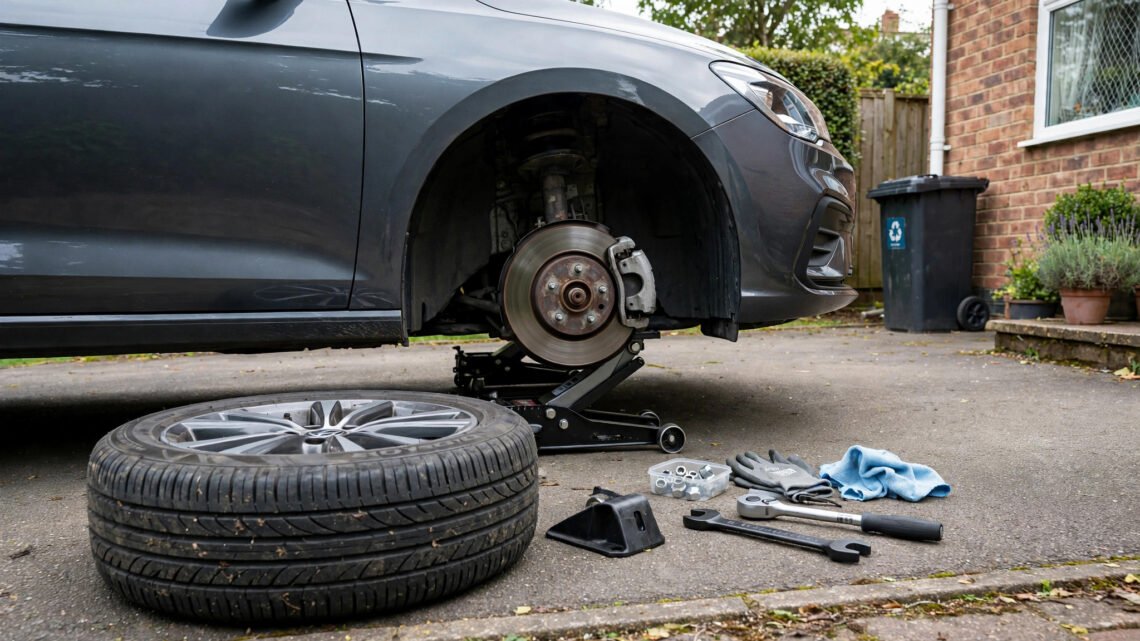
Rotation is a straightforward DIY job if you are comfortable with a jack and axle stands: loosen wheel nuts before jacking, work one corner at a time, torque nuts to the manufacturer’s spec (in your manual — over-tightening warps brake discs), and never work under a car supported only by a jack. Total cost: zero, plus your time. Most garages and tyre fitters will rotate tyres for £20–£40, often free if you are already in for a service or puncture repair — just ask. For those planning a long drive abroad, a pre-trip rotation plus pressure check is one of the highest-value preparations you can do: sustained motorway speeds punish unevenly worn tyres hardest. While the wheels are off, inspect brake pads and discs — it is free information.
The safety logic most drivers miss
Here is the counterintuitive bit experts stress: when you can only afford two new tyres, they go on the rear — even on a front-wheel-drive car. Worn rears cause oversteer (the back stepping out), which average drivers cannot correct; worn fronts cause understeer (ploughing straight on), which lifting off the throttle largely fixes. Rotation prevents you from ever facing this dilemma with a half-worn set. Also mind the age limit: tyres degrade with time regardless of tread — most manufacturers recommend replacement at six to ten years from the manufacturing date (stamped as a four-digit week/year code on the sidewall), even if they look fine. And keep pressures right: under-inflation by just 20% can cut tyre life by nearly a third and measurably worsens fuel economy — the boring monthly check that pays for itself.
Tyre safety and the MOT: what the tester checks
Rotation keeps wear even, but the MOT keeps you legal — and understanding what the tester examines turns the annual test from a lottery into a formality. The MOT checks: tread depth (minimum 1.6mm across the central three-quarters of the tyre, around its entire circumference), condition (no cuts, bulges, lumps or exposed cords — a bulge in the sidewall is an instant fail and a blowout risk), correct size and type for the vehicle, and that tyres on the same axle match. The advisories are the gold: “tyre worn close to legal limit” means budget for replacement within months; “slight damage to sidewall” means monitor closely. Check these yourself quarterly with a 20p coin (the rim hidden in the tread means legal depth) and a walk-around visual inspection — the two-minute habit that prevents MOT-day surprises. For those running vehicles for work, whether you buy or lease your van affects who pays for tyres — lease agreements often include maintenance, while owners budget per mile. Either way, the AA’s motoring guidance is clear: tyres are the most safety-critical consumable on the vehicle, and the cheapest part of the car to keep right. Check them more often than you check your phone’s battery, and they will never surprise you.
Frequently Asked Questions
Can I rotate tyres myself without special tools?
Yes — a jack, axle stands, wheel brace and torque wrench suffice. The non-negotiable safety rule: axle stands, never just the jack, and chock the wheels. If any of that sounds unfamiliar, pay the £30 and let a fitter do it.
Do I need to rebalance wheels after rotation?
Not routinely — rotation does not disturb balance. But if you feel vibration at speed after rotating, get the balance checked; the move can reveal an imbalance that was masked before.
Does rotation affect my TPMS sensors?
On most modern cars, the tyre pressure monitoring system relearns positions automatically after a short drive. Some older systems need a manual reset via the dashboard menu — check your manual.
What if my spare is a different size?
Space-saver spares are for emergencies only and never enter the rotation. Full-size matching spares can join a five-tyre rotation pattern — your manual will show it.
Thirty minutes, twice a year, zero pounds if you DIY: that is the entire cost of even tyre wear, consistent handling and a longer-lived set of rubber. Add it to the service schedule and forget about it — your tyres, your wallet and your braking distances will all be better for it. Pair the rotation with a quick brake check while the wheels are off, and the thirty minutes covers most of your chassis maintenance for the half-year.